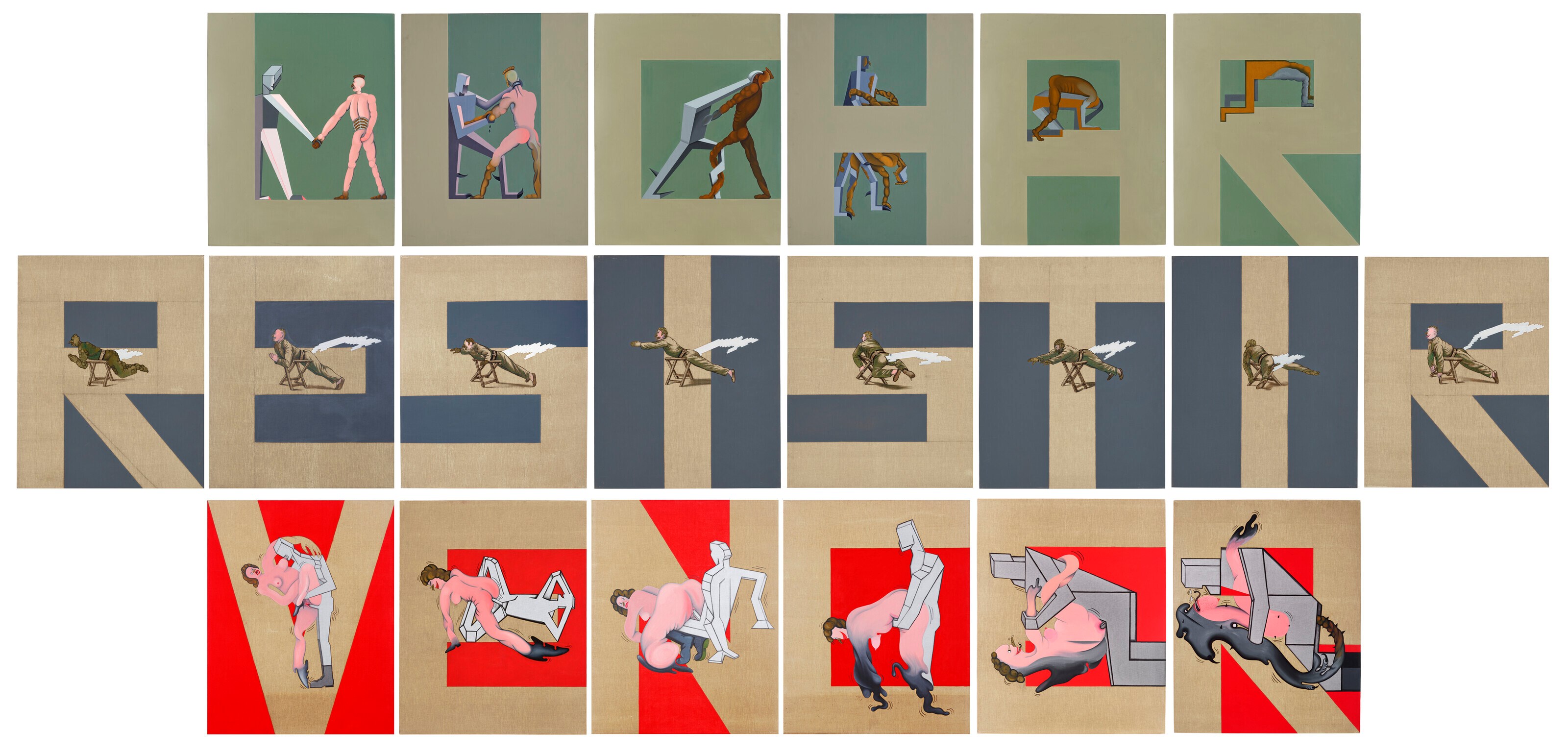
拍品 81OUTSIDE CUBA INSIDE: PROPERTY FROM THE FARBER COLLECTION OF CONTEMPORARY CUBAN ART
CARLOS CÁRDENAS (b. 1962)
Luchar, resistir, vencer
已结束2023年10月5日
成交价
USD 52,920
更多信息
专家说明
Among the protagonists of the critical, “demythifying” generation of Cuban artists that emerged in the 1990s, Cárdenas established a practice that continues to question the nature of systems and officialdom, reality and rationality. Currently based in New York, Cárdenas is represented in major collections, among them the Whitney Museum of American Art and the Museum of Art, Fort Lauderdale. Luchar, resistir, vencer recently featured in the major exhibition, Adiós Utopia: Dreams and Deceptions in Cuban Art since 1950, which opened at the Museum of Fine Arts, Houston in 2017 and traveled to the Walker Art Center.
“Cárdenas has worked more from the point of view of the grotesque, and from carnivalesque scatology, in deconstructing political slogans” critic Gerardo Mosquera once explained. “His figuration, possessing a keen graphic sense, is usually structured from a meaningful juxtaposition between soft and hard geometrical forms.” Among his most iconic works is the twenty-canvas polyptych, Luchar, resistir, vencer, which illustrates its fidelista dictum in hard-edged block letters arranged across three rows. The text is overlaid with “the image of a character who keeps painfully introducing into his anus a map of the island of Cuba made of geometrical shapes like construction blocks,” Mosquera observed. “As the process advances, the character is revealed to be made of excrement. The artist painted an entire series of works in which the figuration seemed to be made of shit” (“The Infinite Island: Introduction to New Cuban Art,” Contemporary Art from Cuba: Irony and Survival on the Utopian Island, exh. cat., Arizona State University Art Museum, Tempe, 1999, pp. 27-28).
Abby McEwen, Assistant Professor, University of Maryland, College Park