拍品 80OUTSIDE CUBA INSIDE: PROPERTY FROM THE FARBER COLLECTION OF CONTEMPORARY CUBAN ART
TONEL (ANTONIO ELIGIO FERNÁNDEZ) (b. 1958)
La silla
已结束2023年10月5日
成交价
USD 6,300
更多信息
专家说明
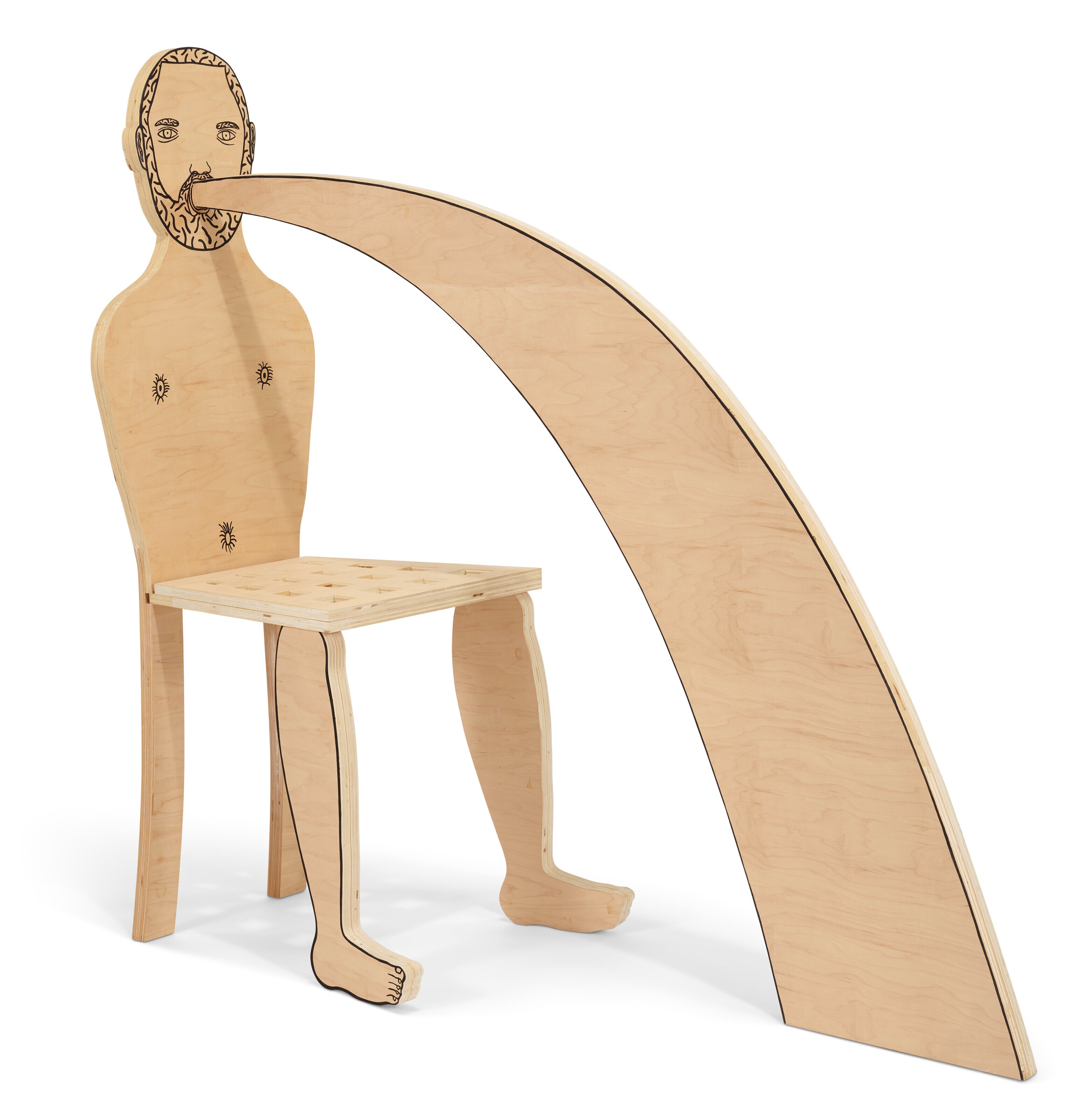
Tonel emerged in the early 1980s as part of Cuba’s vaunted Volumen I generation with a critical practice of caricature, advancing a long tradition of satirical illustration stretching from Conrado Massaguer and Jaime Valls to Chago and Rafael Fornés. Informed by Pop art and underground comix, his practice soon took a conceptual turn as he explored questions of ontology and language, sexuality and geography—often through the medium of self-portraiture, in the guise of the recognizable male character that recurs throughout his work. Frustrated and anxious by turn, this figure takes the unlikely form of a chair in the present sculpture, whose design acknowledges its linear conception (two related drawings) and its functional futility as a chair that thwarts its sitter.
“In one wooden sculpture in the form of an armchair self-portrait, Tonel appears as though both of his arms had been amputated,” writes curator Eugenio Valdés Figueroa, referring to La silla. “He is throwing up, spewing a well-delineated stream of (verbal? ideological?) vomit. The image functions on multiple levels: as a refusal of everything that the body—and the spirit—will not tolerate; as an impediment to others who would use the ‘chair,’ who would provide a ‘fifth leg.’ A play on words in an earlier work is already announced: ‘Vomit-is-culture’ [‘vomit sculpture’]: inexhaustible, gravid jetsam providing relief, temporarily restoring one’s emptiness” (“Solitude Laid Bare in the Garden of the Madhouse,” Tonel: Lessons of Solitude, exh. cat., Morris and Helen Belkin Art Gallery, Vancouver, 2000, p. 30).
Abby McEwen, Assistant Professor, University of Maryland, College Park