拍品 77OUTSIDE CUBA INSIDE: PROPERTY FROM THE FARBER COLLECTION OF CONTEMPORARY CUBAN ART
FLAVIO GARCIANDÍA (b. 1954)
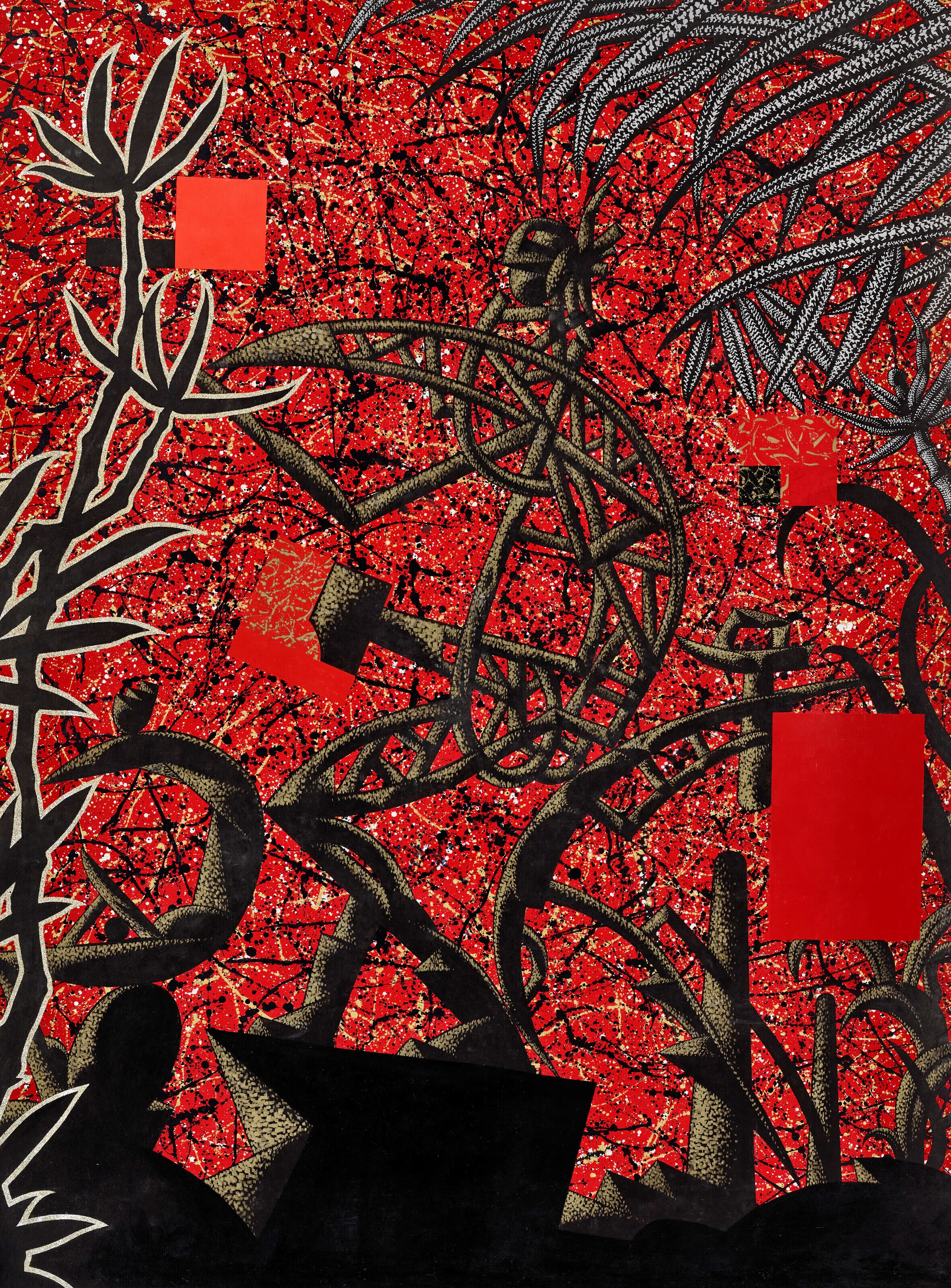
Segundo viaje de Marco Polo
已结束2023年10月5日
成交价
USD 37,800
更多信息
专家说明
Among Cuba’s most incisive and influential contemporary artists, Garciandía continues to evolve a practice that began with hyperrealism in the 1970s and has since embraced what he wryly describes as the “New Tropical Abstraction,” a punning mishmash of (post-)modernism, conceptualism, and kitsch. A member of Cuba’s groundbreaking Volumen I generation, he participated in the early editions of the Havana Biennial and was revered as a professor at Havana’s Instituto Superior de Arte, where he taught from 1981 to 1990. Garciandía received a Guggenheim Fellowship in 1992, and his works are included in major collections around the world including the Museo Nacional de Bellas Artes (Havana), the Museo de Arte Carrillo Gil (Mexico City), and the Blanton Museum of Art (Austin).
The present painting revisits Garciandía’s iconic installation The Marco Polo Syndrome, exhibited during the Second Havana Biennial (1986), in which the beloved comic-book character Elpidio Valdés—a mambí colonel who fought for Cuban independence from Spain—travels to China as a modern-day Marco Polo. “In later work” such as Segundo viaje de Marco Polo, notes Luis Camnitzer, “Garciandía synthesizes both kitsch stereotypes and political symbols. Hammers and sickles blend in with penises, flamingos, and palm trees, outlined with glitter on flat black or red backgrounds or on surfaces imitating the effects of batik” (New Art of Cuba, Austin, 2003, p. 22). Abstract Expressionism meets chinoiserie meets Suprematist square in Segundo viaje de Marco Polo, these disparate elements representing the ironic souvenirs of transcultural travel and the questions—about exoticism, appropriation, and (anti-)colonialism—raised therein.
Abby McEwen, Assistant Professor, University of Maryland, College Park