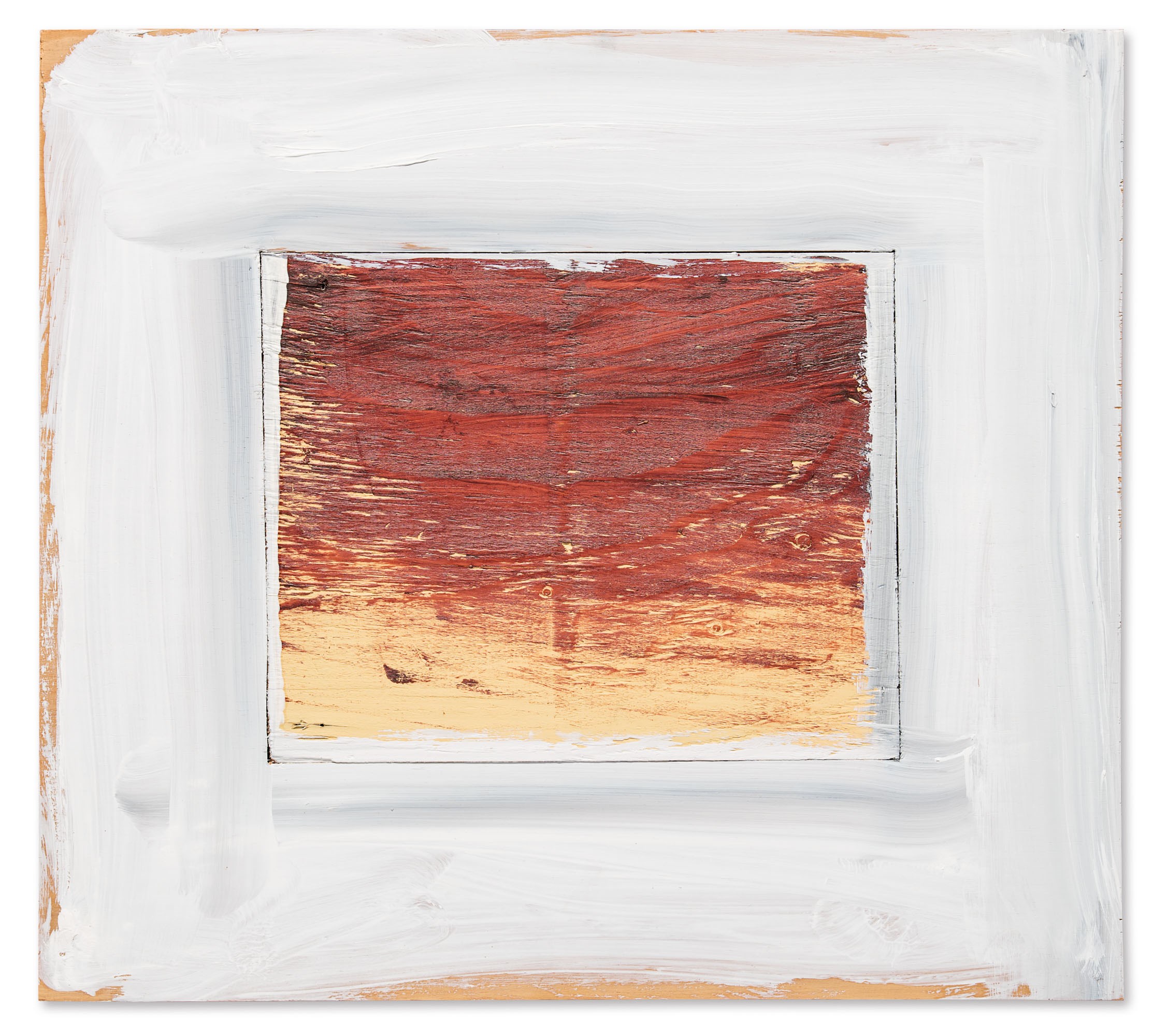
拍品 36
HOWARD HODGKIN (1932-2017)
Walking on Water
已结束2020年7月14日
估价
GBP 180,000–250,000
更多信息
专家说明
With its white-brushed frame surrounding a flickering heart of red, Howard Hodgkin’s Walking on Water (1999-2001) is a bright, jewel-like presence. Evocative of evening sunlight on sea or lake, the painting is at once richly atmospheric and elusively abstract. It is condensed as a haiku, its small scale resounding with lyrical force.
‘I am a representational painter, but not a painter of appearances’, Hodgkin once explained. ‘I paint representational pictures of emotional states’ (H. Hodgkin, quoted in E. Juncosa (ed.), Writers on Howard Hodgkin, London 2006, p. 104). The hues and shapes of his works meld sensory impressions with an interior world of memory and feeling. By enshrining them in painted frames, he sought to make them into autonomous, self-sufficient objects.
As Hodgkin entered old age, the thickly layered, heavily worked pigment common to his earlier paintings gave way to a newfound economy and clarity of technique. He conjured eloquent effects with the subtlest of touches, working freely on surfaces sometimes scarcely larger than a postcard. Adrian Searle singled out Walking on Water – aptly titled for its seemingly miraculous ease – as exemplary of this late flowering.
‘A couple of rough swipes of a denatured alizarin cross the painting’s central area, grazing the surface of the plywood support’, observed Searle. ‘The wood is a bit scratched, and the paint has picked up these imperfections, which look like nothing so much as hesitant reflections grazing ruffled water … Paradoxically, because these little works are apparently more modest and concise, and are more judicious in their effects, they carry more weight … They make you look at what is around them, and make you realise how much can be done with very little, and how a bit of dirt from the palette, a small gesture, a sense of the internal dialogue between one mark and the next, can actually say something, and be extremely physical and at the same time highly suggestive’ (A. Searle, ‘Rainbow Warrior’, The Guardian, 17 July 2001).
This painterly blend of plastic and ‘suggestive’ qualities is central to Hodgkin’s work. Its essential privacy is not at odds with its emotive power, nor its abstract beauty with its wistful echoes of the real world. ‘Obviously, my language of forms has far more than a physical purpose,’ the artist once said. ‘Alone in my studio, working on my pictures, more than anything, I long to share my feelings’ (H. Hodgkin, London, 13 March 1995, in J. Elderfield and H. Hodgkin, ‘An Exchange’, in Howard Hodgkin Paintings, London 1995, p. 80).