拍品 30
SIR EDUARDO PAOLOZZI (1924-2005)
Paris Bird
已结束2020年7月14日
成交价
GBP 37,500
更多信息
专家说明
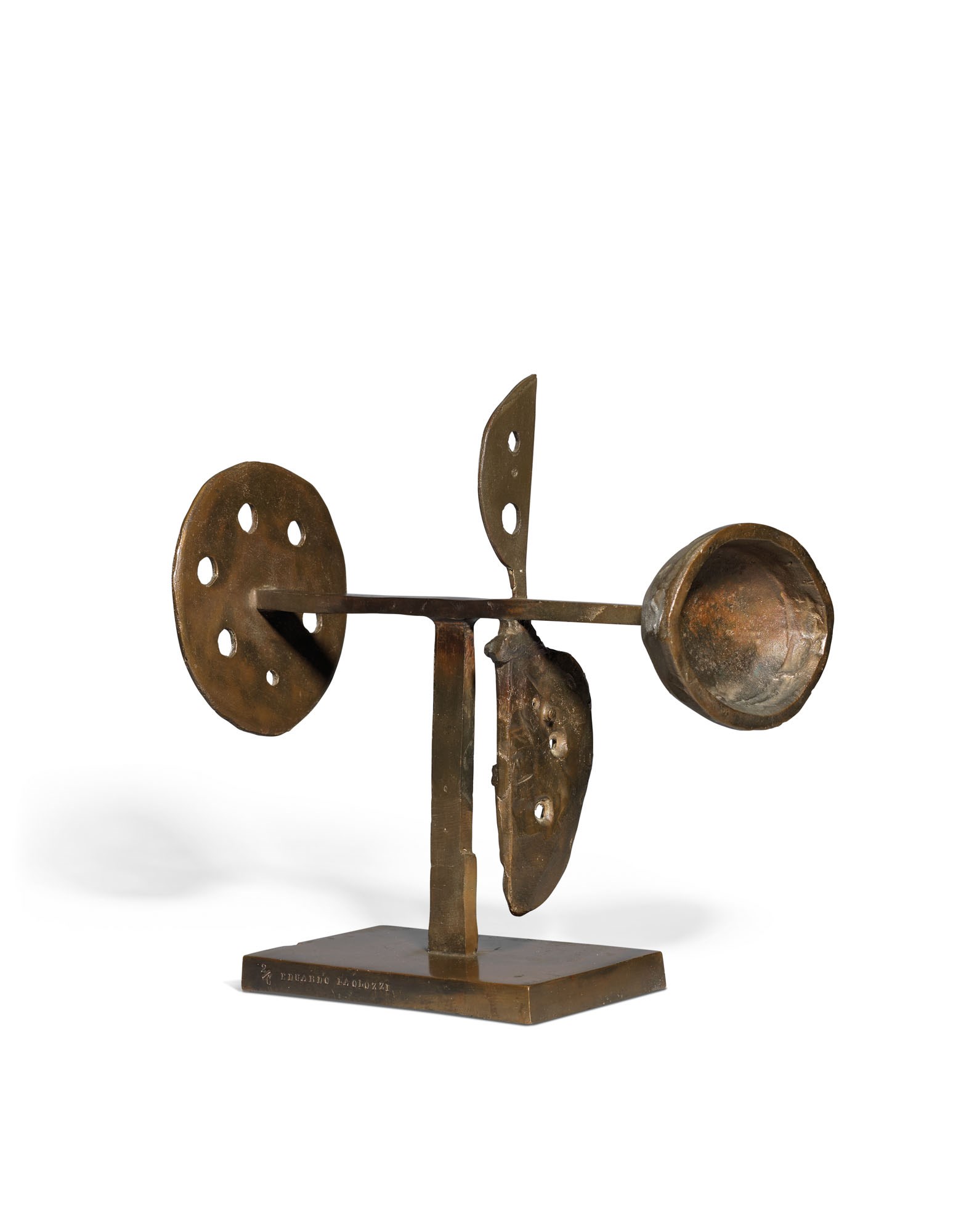
Paris Bird, 1947-48, is one of Paolozzi's most significant works from his time living in Paris. One of only three casts left in private hands, other casts from the same edition are held in the collection of the Tate Gallery, London; The Scottish National Gallery of Modern Art, Edinburgh; and The Art Gallery of New South Wales, Australia.
Born in Scotland to Italian parents, Paolozzi studied at Edinburgh College of Art and then at the Slade School of Art in London from 1944. His time here was short-lived, and Paolozzi abandoned his studies at the Slade to move to Paris in 1947, funded by the proceeds of his exhibition held at the Mayor Gallery that same year. Followed shortly by his friend William Turnbull, who joined him in 1948, both artists set out to escape the somewhat traditional and stifling art scene in London in favour of an artistically freer existence in the French capital. Richard Morphet explains, ‘One of the most noticeable differences from London was the degree to which, in Paris, being an artist was accepted as a natural, serious, full-time profession and job of work. Moreover the climate of thought at the time in Paris was specifically sympathetic to the creative individual’s search for self-expression free of implicit restrictions on the use of unconventional idiom or content’ (R. Morphet, exhibition catalogue, William Turnbull: Sculpture and Painting, London, Tate Gallery, 1973, p. 22).
While in his studio at 16 rue Visconti on the Île St Louis, Paris, Paolozzi began to experiment with constructing sculptural works from found or ‘junk’ objects and scraps of materials that were lying around his studio. Paris Bird, 1947-48 was conceived during this period, with areas of graining visible on some of the bronze elements suggestive of found wooden objects. Constructed of four arched forms on a T-shaped support that rests on a rectangular base, Paolozzi succeeds in creating an abstract work that stood in stark contrast to the Neo-Romantic style, which prevailed in Britain at the time. Originally made in clay and plaster for economic reasons, Paolozzi later cast the work in gunmetal and then bronze. One of the most prominent features of the present work are the striking pierced semi-circular forms, which resemble bird wings, propeller blades or some-kind of mechanical flying machine, emphasised by the title Paris Bird.
Paolozzi’s biomorphic sculptures, such as Paris Bird, are reminiscent of the Surrealist work of Alberto Giacometti from the 1920s, who he met while in Paris. During this time, Paolozzi also encountered Max Ernst and Dada artist Marcel Duchamp, who’s collages, ‘readymades’ and practices of adopting found objects into art, were of great interest to him.
Paris Bird, is not only a highly dynamic and visually arresting work but illustrates the pivotal time that Paolozzi spent in Paris, where he further pushed the boundaries of three-dimensional art, establishing him as one of the most inventive and experimental ambassadors of Modern British Art.