拍品 26PROPERTY FROM A PRIVATE COLLECTION, WASHINGTON D.C.
WILLIAM SCOTT (1913-1989)
Untitled
已结束2020年7月14日
成交价
GBP 275,000
更多信息
专家说明
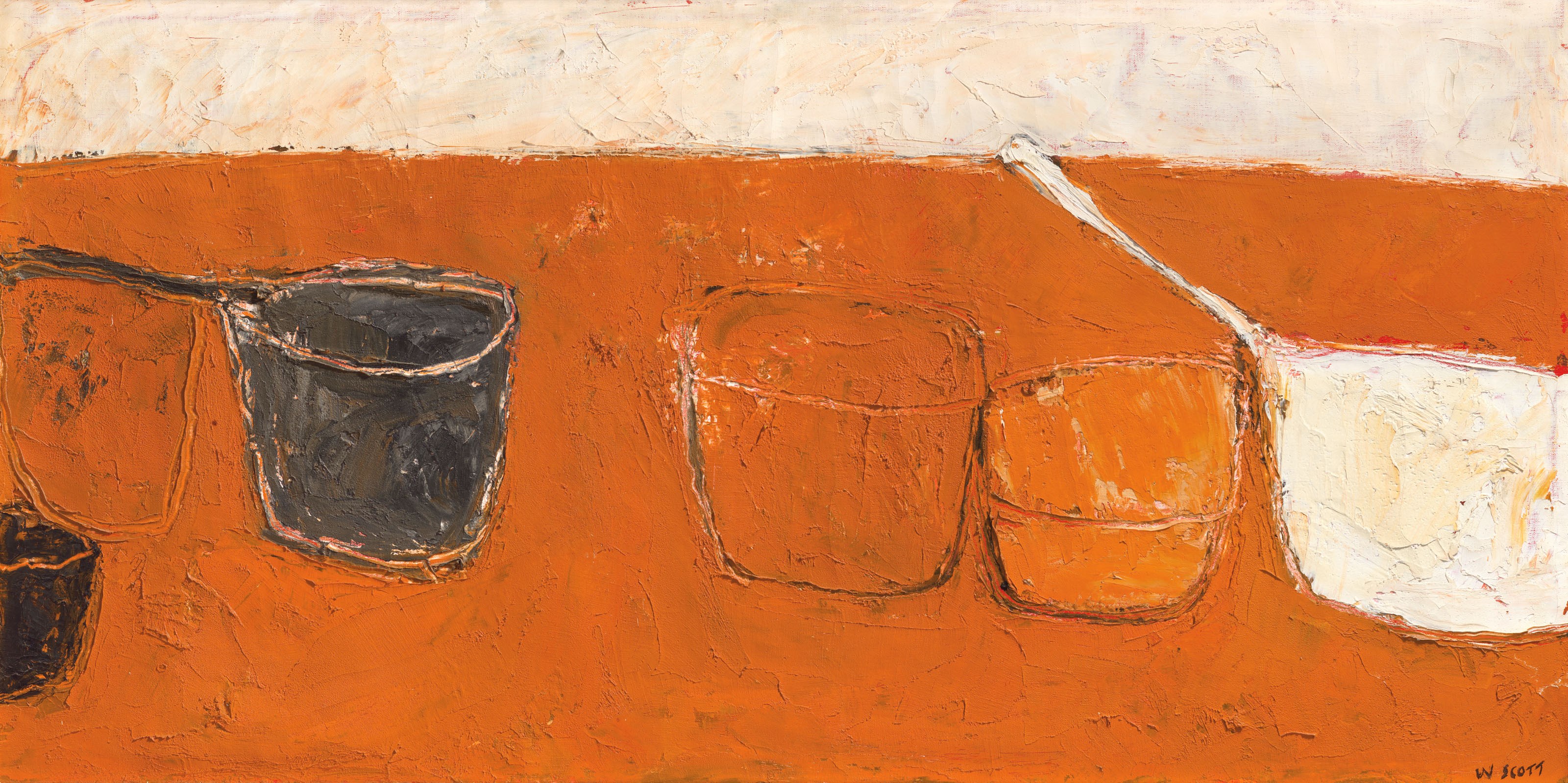
Created in 1956, Untitled is a key example of William Scott’s renewed focus on figuration and the still life during the 1950s, following several years working in a distinctly abstract vein. His decision to revisit the figurative in his art was, rather unexpectedly, driven by his encounters with the Abstract Expressionists in New York during the summer of 1953. Scott had travelled to the city following a brief teaching post at the Banff School of Fine Arts in Canada, and there came into contact with Jackson Pollock, Mark Rothko, Willem de Kooning, and Franz Kline. Admitting himself bewildered by the bold scale and audacity of their paintings, and yet equally seduced by the directness and immediacy of their technique, Scott began to pursue a new direction in his own art, using the traditional still life as a medium for experimentation.
Executed in bold, visceral brushstrokes, the richly worked surface of Untitled reveals Scott’s growing fascination with the very act of painting itself in response to these experiences, using layers upon layers of thick paint to create a highly sensual finish. As Scott explained: ‘The actual touch and the way I put paint on canvas matter very much. I am extremely interested in textural qualities – the thick paint, the thin paint, the scratched lines, that almost careful-careless way in which a picture’s painted…’ (W. Scott, quoted in D. Anfam, exhibition catalogue, William Scott, New York, McCaffrey Fine Art, 2010, p. 11). Here, the eclectic group of pots, pans and glassware that populates the table becomes a vehicle through which Scott can explore texture, mass and finish, their forms subsumed within the expressive force of his painting.
Purchased directly from the artist in the same year it was created, Untitled has remained in the same family collection for the last six decades.