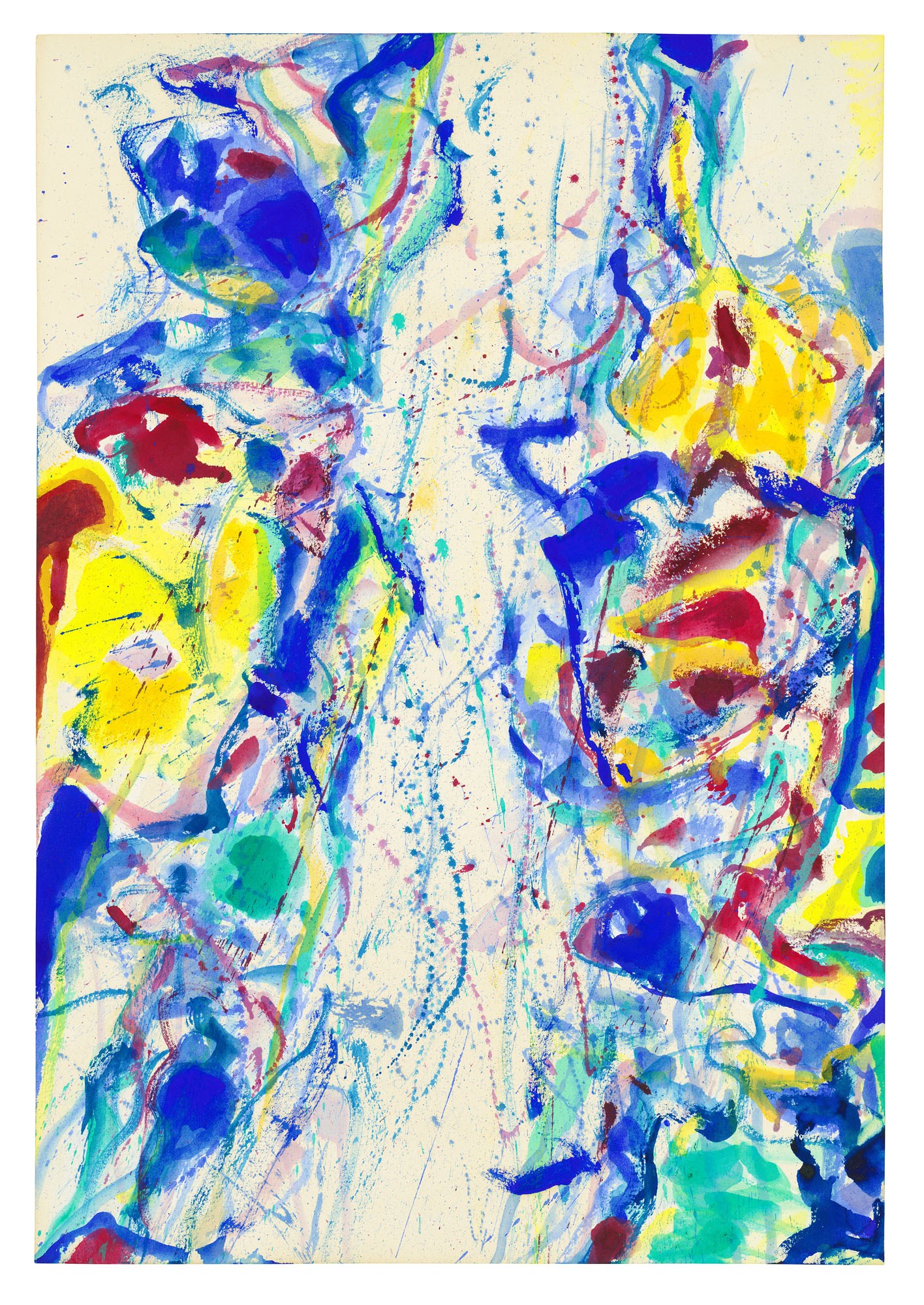
拍品 39
SAM FRANCIS (1923-1994)
Untitled
已结束2020年7月14日
成交价
GBP 150,000
更多信息
专家说明
Kaleidoscopic colours burst and bloom across Sam Francis’ Untitled (1957). Skeins of yellow, mauve and turquoise tangle with bold splashes of cobalt blue; dripped beads of watercolour careen up the bright white ground at its centre. Flowering with joyful energy, the work expresses Francis’ devotion to animated chromatic beauty.
Francis suspends Untitled’s arcing, gestural forms in a remarkable state of balance, all the more impressive for the work’s execution in watercolour. As critic Dore Ashton noted in 1959, ‘An aqueous medium is better suited to his lyricism … It is quite a task to suggest the element of chance, impromptu meetings and fallings away – as Francis does – and still remain master of your means’ (D. Ashton, ‘Art’, Arts and Architecture, vol. 761, no. 2, February 1959, p. 31).
At the heart of Francis’ output was an investigation into the interplay between light and colour, which he saw as liberating forces. ‘I like to fly, to soar, to float like a cloud,’ he said, ‘but I am tied down to place. No matter where I am ... it’s always the same. Painting is a way in and out’ (S. Francis, quoted in P. Selz, Sam Francis, New York, 1982, p. 14).
Born in California, Francis moved to Paris after completing his undergraduate studies in 1950. There he encountered paintings by Pierre Bonnard, Henri Matisse and Claude Monet, artists who strove to arrest the effects of light on canvas. In his mission to make colour emote and resonate, Matisse was a particularly enduring inspiration. By reconfiguring Abstract Expressionism’s transcendental vision of painting through the lens of Impressionist mechanics, Francis revealed a visual idiom uniquely his own and utterly invested in the potential of colour.
Untitled emits a forceful luminosity, dominated by the empyrean blues that would become Francis’ central focus in the 1960s. Lyrical and unbridled, the colour whirls upward, taking flight into existential freedom. As Francis reflected in an interview with his friend, the curator Peter Selz, ‘I work in a circular, gyro-like manner – spiral, move to levels. So, I keep coming back to something from before, but approached from a completely different point of view. A rearrangement of the psyche’ (S. Francis quoted in D. Burchett-Lere (ed.), Sam Francis: Catalogue Raisonné of Canvas and Panel Paintings, 1946-1994, Berkeley, 2011, p. 266).