Lot 6Spanish Colonial Art From the Family Collection of Ambassador Mello Franco
ANONYMOUS (BOLIVIA, 18TH CENTURY)
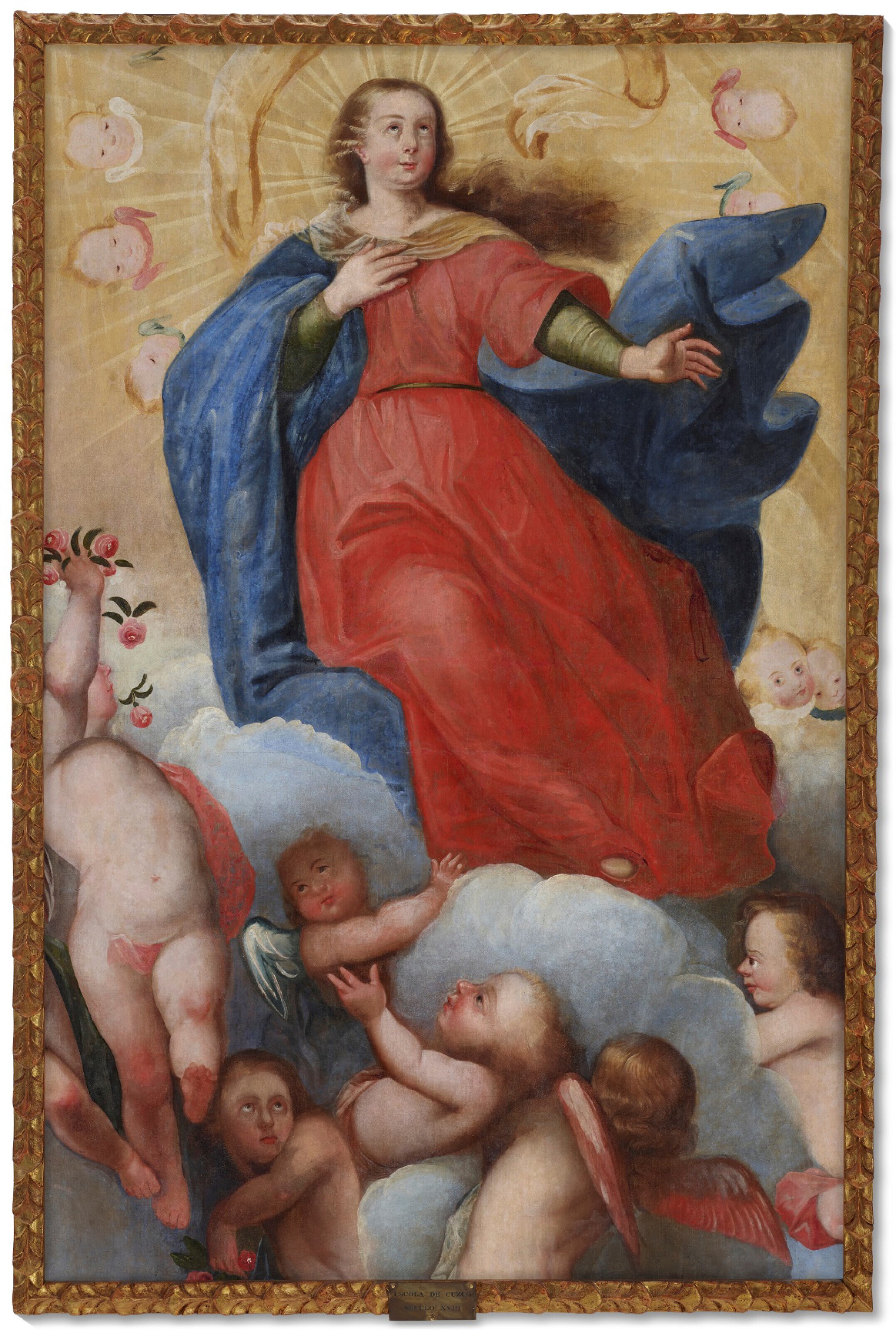
Assumption of the Virgin
Closed15 March 2024
Price Realised
USD 7,560
More Information
Specialist note
The feast of the Assumption of the Virgin Mary was celebrated as early as the sixth century when it was believed the event had taken place in the city of Ephesus, while other apocryphal stories claim that Mary’s life ended in Jerusalem. Thus, surrounded by the Apostles and in her own house, the Mother of God was assumed, body and soul, into heaven where she was crowned by God the Father, the Son and the Holy Spirit.
Although not declared an article of faith until 1950 with Pope Pius XII’s Munificentissimus Deus, the Virgin’s favored place alongside the Holy Trinity was greatly endorsed by the Catholic Church. Along with the assertion of the Virgin’s Immaculate Conception, the Franciscans in particular were avid promoters of the her superiority and infallibility. Instrumental in the evangelization of much of Spain’s holdings in the Americas during the colonial period, Catholic missionaries quickly recognized the persuasive power of the so-called “Cult of the Virgin,” and her natural associations to various indigenous deities throughout the region, such as Pachamama, or Mother Earth. Thus, the Assumption of the Virgin, along with other iterations of the Virgin’s majesty became a popular subject of religious art throughout the region.
While some examples depicting the Assumption of the Virgin included the departure from the earthly realm, her body shown rising from the tomb, surrounded by apostles and attendants, the present work instead focuses solely on her ascent into the heavens. Likely executed in the 18th century, this work adheres closely to the iconography promoted by European Baroque masters, namely Peter Paul Rubens, whose images would have circulated in the Americas through prints and engravings, like those done by Cornelis Galle I (1576-1650). Here, aided by a retinue of admiring putti, and having fulfilled her mission in life, the Virgin ascends, taking her rightful place in the heavenly realm. Much like Christ’s resurrection, the Virgin’s assumption into heaven, and the insistence of her otherworldliness helped to fortify the Christian message in the Americas: “When this mortal thing hath put on immortality, then shall come to pass the saying that is written: Death is swallowed up in victory."( I Cor 15:54.) Her splendid image and miraculous story no doubt would have inspired piety among the local population, promising redemption for those who are faithful to the Church.