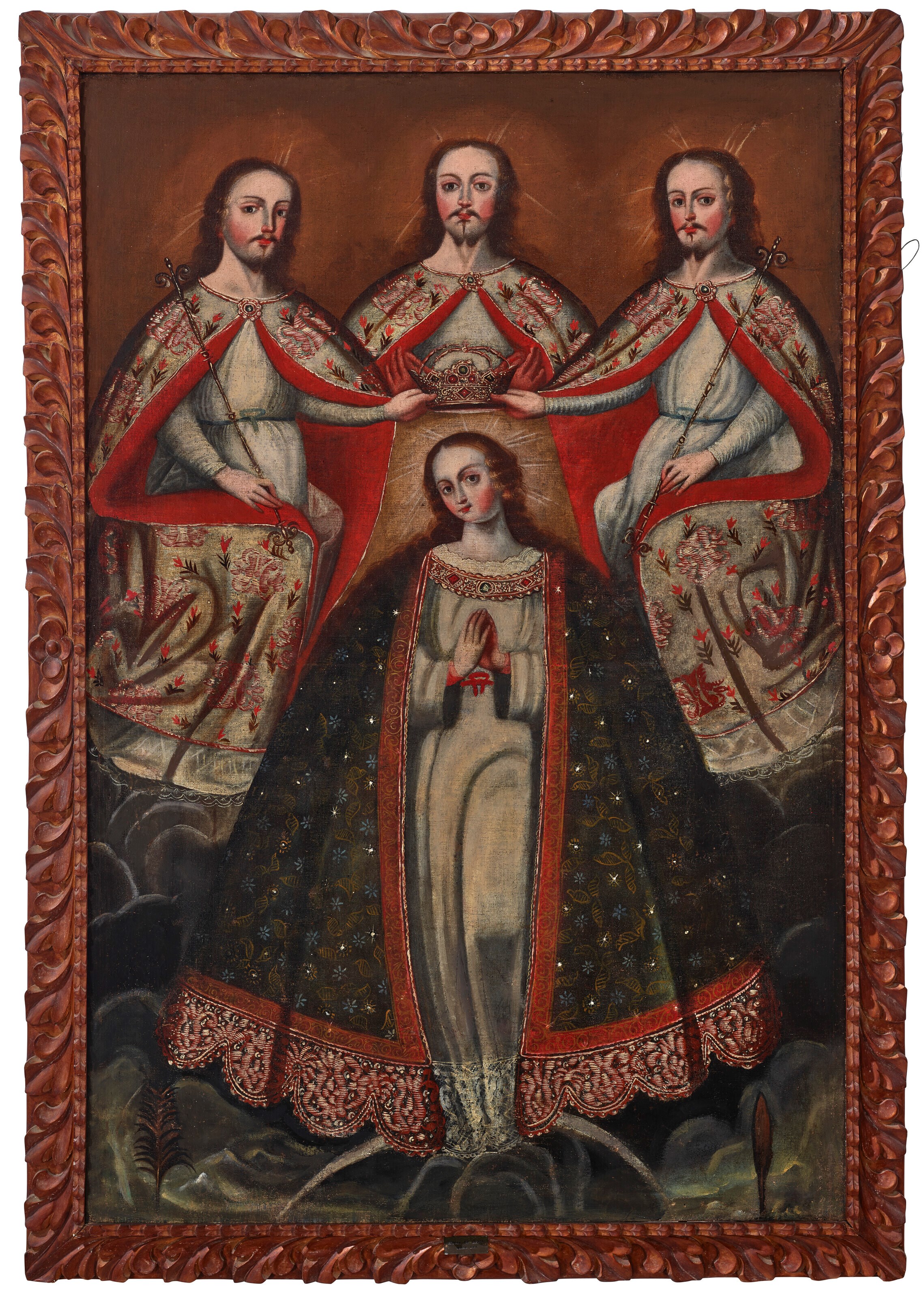
Lot 5Spanish Colonial Art From the Collection of Ambassador Mello Franco
ANONYMOUS (BOLIVIAN, 18TH CENTURY)
Coronation of the Virgin by the Holy Trinity
Closed15 March 2024
Price Realised
USD 10,080
More Information
Specialist note
The early medieval period saw a remarkable rise in the devotion to the Virgin Mary, coinciding with the edification of cathedrals throughout Europe. Images of the crowning of the Holy Virgin began to appear and the proliferation of the iconography of the Virgin through numerous depictions not only as Mother of God but also Mother of Mankind and Queen of Heaven was a celebrated theme by great masters throughout the ages, such as Gentile da Fabriano, Fra Angelico, Peter Paul Rubens, Diego Velázquez and Bernardo Bitti who lived and worked in Peru in the late sixteenth-century. Throughout Spain’s vast empire in the Americas, images of the crowning of the Virgin proved a potent symbol of the Church and its Counter-Reformation assault against heresy, and renderings of this theme were highly regarded by artists throughout the Viceroyalty of Peru in cities such as Cuzco, Lima, Quito, and Potosí.
While many European models of the Virgin’s crowing by the Holy Trinity often portrayed the Trinity more literally as Father (an older man), Son (a youthful man), and Holy Spirit (in the form of a dove), extant works by Andean painters of the time demonstrated a tendency to depict the Trinity in the form of three identical figures, as seen in the present work. A relatively novel convention that gained tremendous popularity in the new world, typical iconography featured the Virgin Mary, prominently in the center of the composition, in a white dress, and cloaked in a sumptuous dark blue mantel that often occupied nearly the entire width of the painting. Above her, the Holy Trinity is pictured, as three young men, identical in appearance, seated upon their heavenly thrones, as they place an elaborate crown fit for a queen, atop Mary’s head. In the present work, Mary looks upon the viewer, her head tilted slightly down in an act of humility, hands clasped in prayer, ready to receive the ultimate honor as Queen of Heaven. The Holy Trinity gazes out upon the viewer, as if confirming for us Mary’s majesty and her unparalleled status in Christian theology.
While many European models of the Virgin’s crowing by the Holy Trinity often portrayed the Trinity more literally as Father (an older man), Son (a youthful man), and Holy Spirit (in the form of a dove), extant works by Andean painters of the time demonstrated a tendency to depict the Trinity in the form of three identical figures, as seen in the present work. A relatively novel convention that gained tremendous popularity in the new world, typical iconography featured the Virgin Mary, prominently in the center of the composition, in a white dress, and cloaked in a sumptuous dark blue mantel that often occupied nearly the entire width of the painting. Above her, the Holy Trinity is pictured, as three young men, identical in appearance, seated upon their heavenly thrones, as they place an elaborate crown fit for a queen, atop Mary’s head. In the present work, Mary looks upon the viewer, her head tilted slightly down in an act of humility, hands clasped in prayer, ready to receive the ultimate honor as Queen of Heaven. The Holy Trinity gazes out upon the viewer, as if confirming for us Mary’s majesty and her unparalleled status in Christian theology.