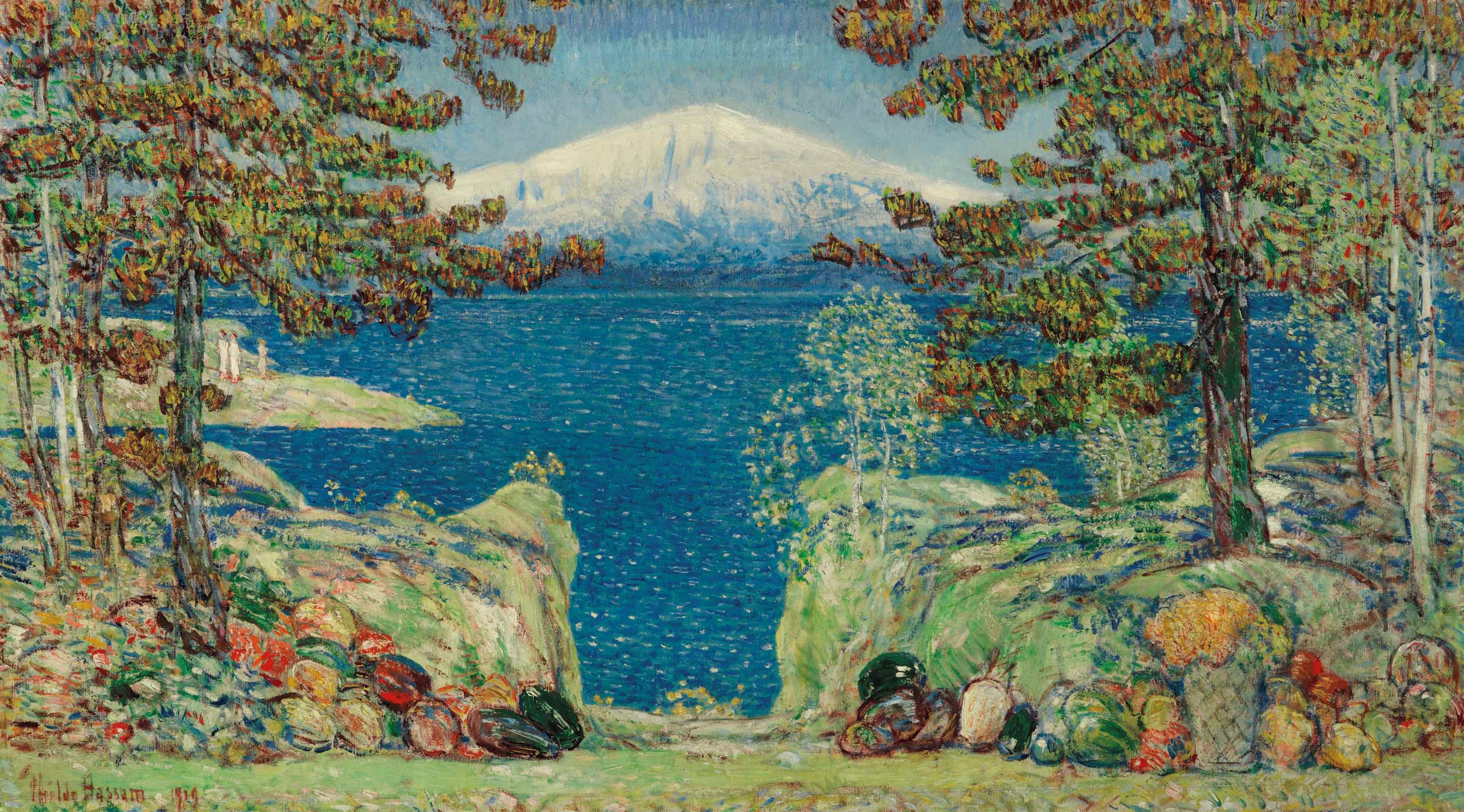
Lot 129
Childe Hassam (1859-1935)
California
Price Realised
USD 137,500
More Information
Specialist note
We would like to thank the Hassam catalogue raisonné committee for their assistance with cataloguing this work.
This painting will be included in Stuart P. Feld's and Kathleen M. Burnside's forthcoming catalogue raisonné of the artist's work.
Though primarily known for his East Coast scenes, Childe Hassam journeyed to the West Coast of the United States several times throughout the course of his career, and represented the diverse and rugged landscape of that region with deftness and care in works such as California. After traveling to Oregon, Idaho and Washington in the early years of the twentieth century, Hassam first visited California in 1914 in order to install his mural, Fruits and Flowers, at the Panama Pacific International Exposition in San Francisco, which took place the following year. Including the present work, only about a dozen works inspired by his travels there have been discovered.
Hassam’s experiences in California were dominated by interactions with Impressionist artists of the area, spending much of his time painting en plein air at sights like Point Lobos in Carmel-by-the-Sea. For example, Hassam accompanied California landscapist Francis J. McComas on a sketching trip to Carmel, which likely inspired Point Lobos, Carmel (1914, Los Angeles County Museum of Art, Los Angeles, California). "Carmel was a favorite painting locale for artists, but Hassam may have found it especially attractive because it reminded him of his beloved Appledore in New England. Northern California shares with Maine a rugged coastline, and Hassam seems to have approached both shores in similar terms. He focused on the weather-hewn boulders, constructing them with the same forceful, short, vertical and diagonal brushstrokes and rich, contrasting, dark and light hues that appear in his Maine paintings. Only the cypress...alludes to a western locale. When a group of Hassam’s California landscapes was exhibited in the winter of 1915-16, they were considered 'striking' and generally praised for their 'remarkable effects of filtered sunlight.'" (I.S. Fort, M. Quick, American Art: A Catalogue of the Los Angeles County Museum of Art Collection, Los Angeles, California, 1991, p. 210) In the present work, Hassam combines these panoramic landscape effects with the inclusion of a bounty of fruit, vegetables and flowers in the foreground, recalling the theme of his Exposition mural.
While California Impressionism was established in its own right by the time of his visit, Hassam’s large and looming figure in the greater context of American Impressionism certainly had its influence. As H. Barbara Weinberg states, “Hassam’s demonstration in his western scenes of the merits of Impressionism for depicting the region’s forms, light and atmosphere intersected with, and may even have stimulated, the development of California Impressionism.” (Childe Hassam: American Impressionist, New Haven, Connecticut, 2004, p. 197) Regardless, Hassam’s brief time in California was beneficial for all artists involved, and the use of bright colors and remarkable effects of sunlight seen in the present work were certainly inspired by Hassam’s interactions with his fellow painters, and of course, the inimitable California landscape.