拍品 116
HERRI MET DE BLES (BOUVINES C.1510-AFTER 1550 ANTWERP)
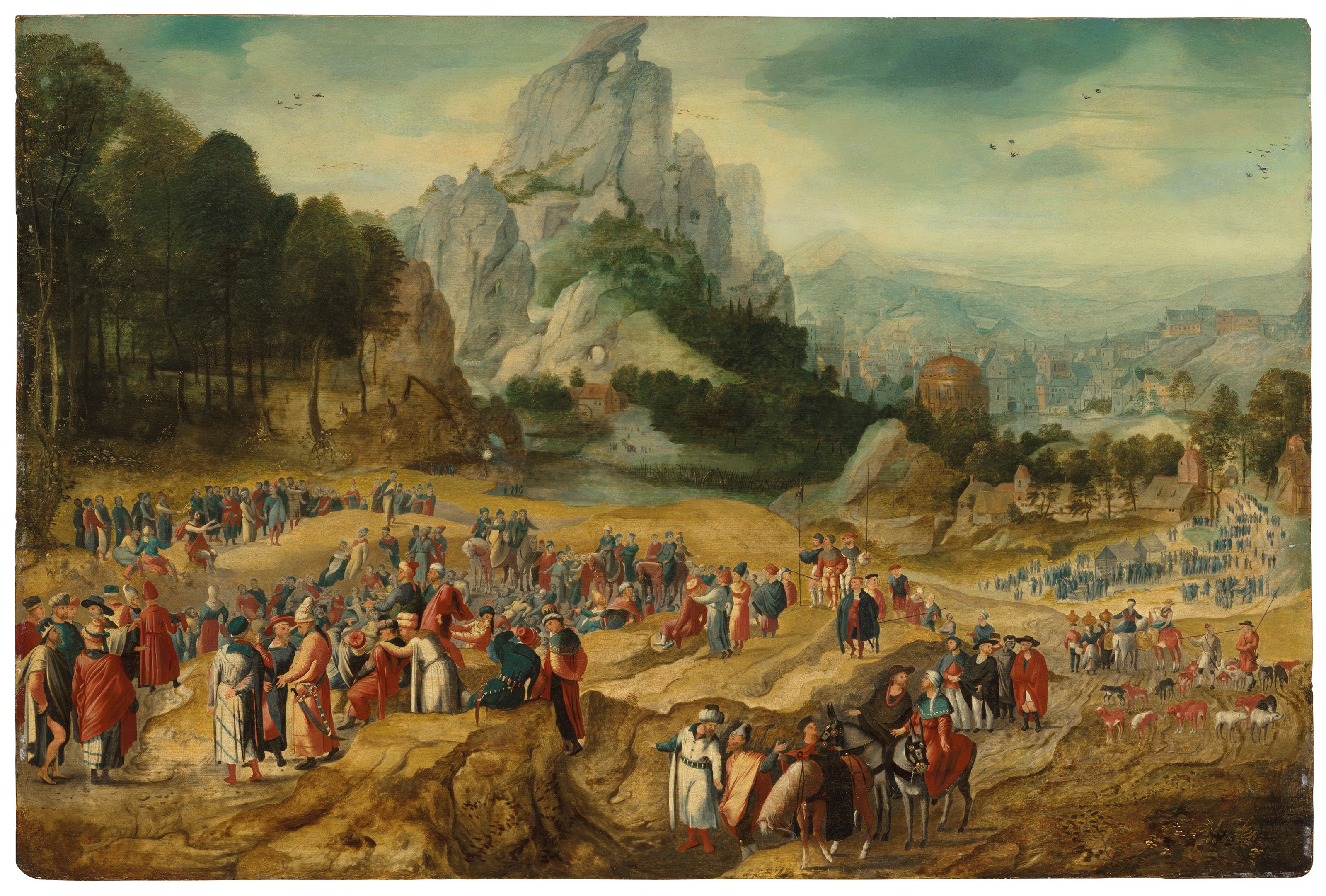
An extensive landscape with the Preaching of Saint John the Baptist and the Baptism of Christ
已結束2021年7月9日
成交價
GBP 75,000
更多資訊
專家說明
From the beginning of the sixteenth century, landscape painting as a genre had begun to be ‘zealously cultivated’ in the Netherlands and especially Antwerp, the region’s cultural and mercantile centre since the decline of Bruges during the late 1490s (M.J. Friedländer, Early Netherlandish Painting: Antonis Mor and his Contemporaries, XIII, Leiden, 1975, p. 23). The most important exponent of this new tradition was Joachim Patinir, whose inventive and meticulous landscapes of jagged rocks, sweeping valleys and wide vistas laid the foundations for the development of the Weltlandschaft (world landscape), that would continue to be developed by later artists like Albrecht Altdorfer, Hieronymous Bosch and Pieter Brueghel the Elder. One of Patinir’s most important followers was Herri met de Bles. Born circa 1510, Met de Bles may have been his nephew and is likely to have been the ‘Herry de Patenir’ who registered as a member of the Antwerp Guild of Saint Luke in 1535.
The subject of Saint John Preaching allowed Met de Bles to explore the Weltlandschaft genre to its fullest, incorporating the city of Jerusalem in the distance and wilderness of mountains and forests in the middleground. In addition to the main figural group, the artist has also included a miniscule Baptism of Christ, taking place in the lake at the foot of the mountain, where The Holy Spirit can just be seen shimmering above Christ's’ head. Subsequently to his 1989 publication, Dr. Gibson suggested that the multitude of exotic figures flocking to hear the Baptist preach may have been influenced in part by the work of Jan van Amstel, given the profusion of genre details, such as the peasant group to the right carrying jars on their heads and riding laden mules.
The present picture is the largest of several versions of the composition, which differ chiefly in the landscape. One is in the collection of the Dortmund Museum für Kunst; a lost version is recorded by Friedländer as having been in the Hoschek auction in Vienna; a further example was sold from the collection of Sir Francis Dashwood Bt. as by the Brunswick Monogrammist in 1972; there is a fragment in the York City Art Gallery that shows the group surrounding Saint John (seen here at lower left), and a simplified example of the main figure group is held in the Museu Nacional d'Art de Catalunya, Barcelona, where it is given to either Met de Bles or his workshop.