拍品 113
NETHERLANDISH SCHOOL, CIRCA 1520-40
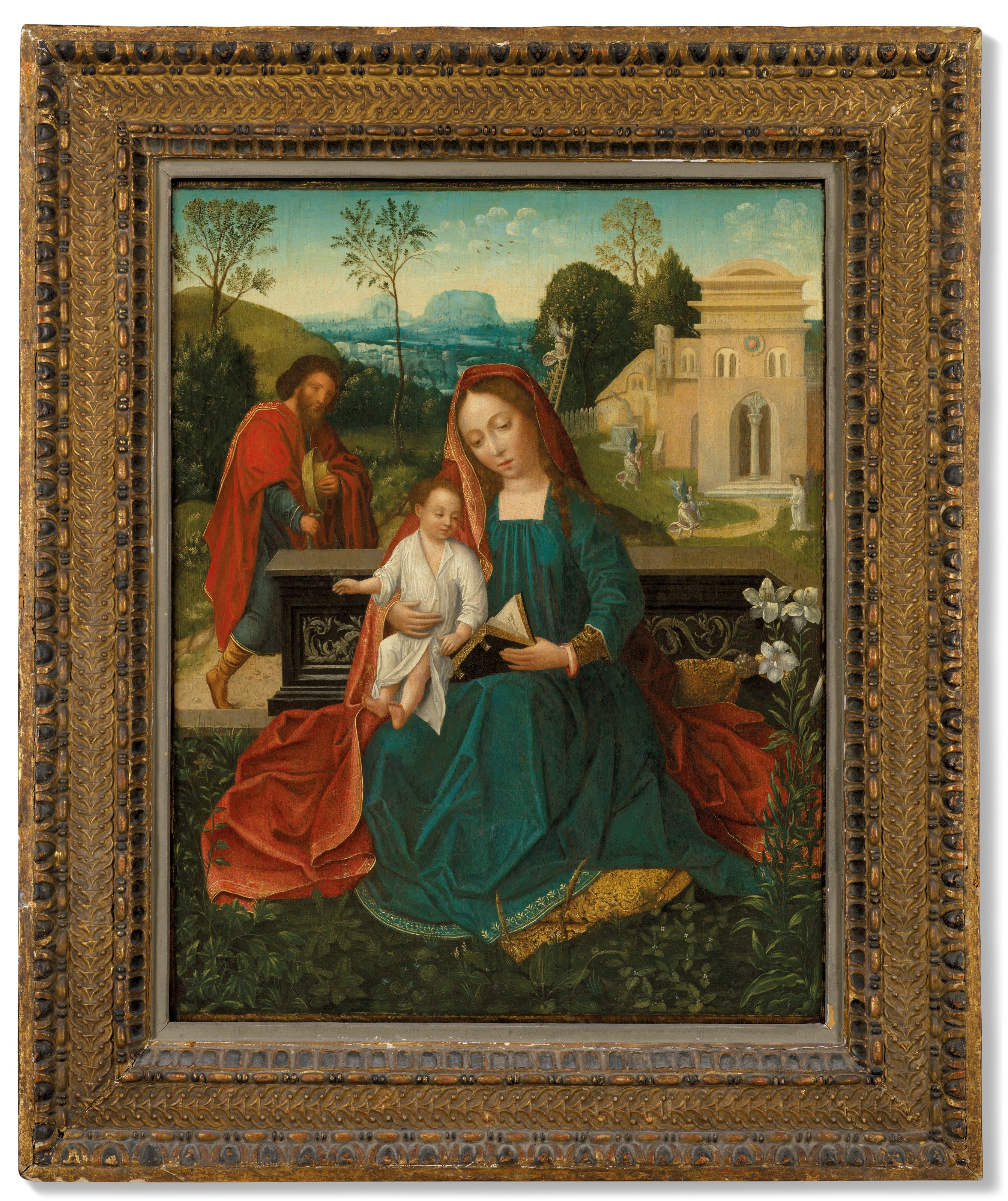
The Holy Family in a landscape
已結束2021年7月9日
成交價
GBP 62,500
更多資訊
專家說明
The figures of the Virgin and Child at the centre of the composition reoccur in a number of early sixteenth century panel paintings, suggesting that they derived from a popular model drawing circulating through Netherlandish workshops at that period. While the panel shows a number of stylistic affinities with Bruges painting of the early sixteenth century, most notably with works by Adriaen Isenbrant and Gerard David, elements of the composition also appear to suggest links with Brabantine artists like the Master of Embroidered Foliage and Goswijn van der Weyden. Comparable figures, for example, can be found in a Virgin and Child from the circle of the Master of the Embroidered Foliage (formerly in the Voss collection, Berlin); in the central panel of a small triptych by Goswijn van der Weyden (Burgos, Museo Diocescano-Catedralico); and in the Virgin and Child enthroned by the Master of the Legend of the Magdalene (Antwerp, Museum Mayer van den Bergh).
Depictions of the Virgin with an open book in her hand, holding the Christ Child on her knee, had become a popular trope in Netherlandish painting, perhaps ultimately taking inspiration from Rogier van der Weyden’s Durán Virgin (Madrid, Museo Nacional del Prado). The subject, derived from the apocryphal Gospel of Saint Matthew, shows the moment when the Virgin stopped with the Christ Child and Joseph to rest, fleeing into Egypt to avoid King Herod’s decree that all children under the age of two be killed. During their rest, Christ ordered a palm tree to bend so that Joseph could collect its fruit. Similarly, a stream sprung up to provide the Holy Family with water. The group of angels in the background of this scene, one shown on a ladder by a tree, another seeming to gesture to a fountain, may perhaps serve as a reference to these miracles. It is also possible that the picture was intended rather as a depiction of the Holy Family not connected with a specific narrative moment. Angelic attendants in such images proliferated in the Netherlands, such as The Holy Family by the Master of the Antwerp Epiphany (Delft, Stedelijk Museum Het Prinsenhof).
Sacha Zdanov, to whom we are grateful for his assistance in the preparation of this catalogue entry, notes the existence of at least two versions of the present composition (private communication, Februrary 2021). The first was published by G.J. Hoogewerff in 1929 (‘Zes onbekende oud-Nederlandsche schilderijen’, Onze Kunst, XLVI, 1929, pp. 68-66, fig. 3) and represents a single angel in the distant landscape rather than the four here depicted. The second, preserved in a photograph in the Friedländer archive (held at the RKD), appears almost identical to the present work, and was noted by Friedländer to have been in the collections of Antonio Ferrer and the Hamburg entrepreneur and collector, Siegfried Wedells. While slight discrepancies between this photograph and the present work make a definite identification between the two difficult, and may show two distinct, though close, versions, they may indeed be one and the same painting, with the differences reflecting changes in the condition of the panel.