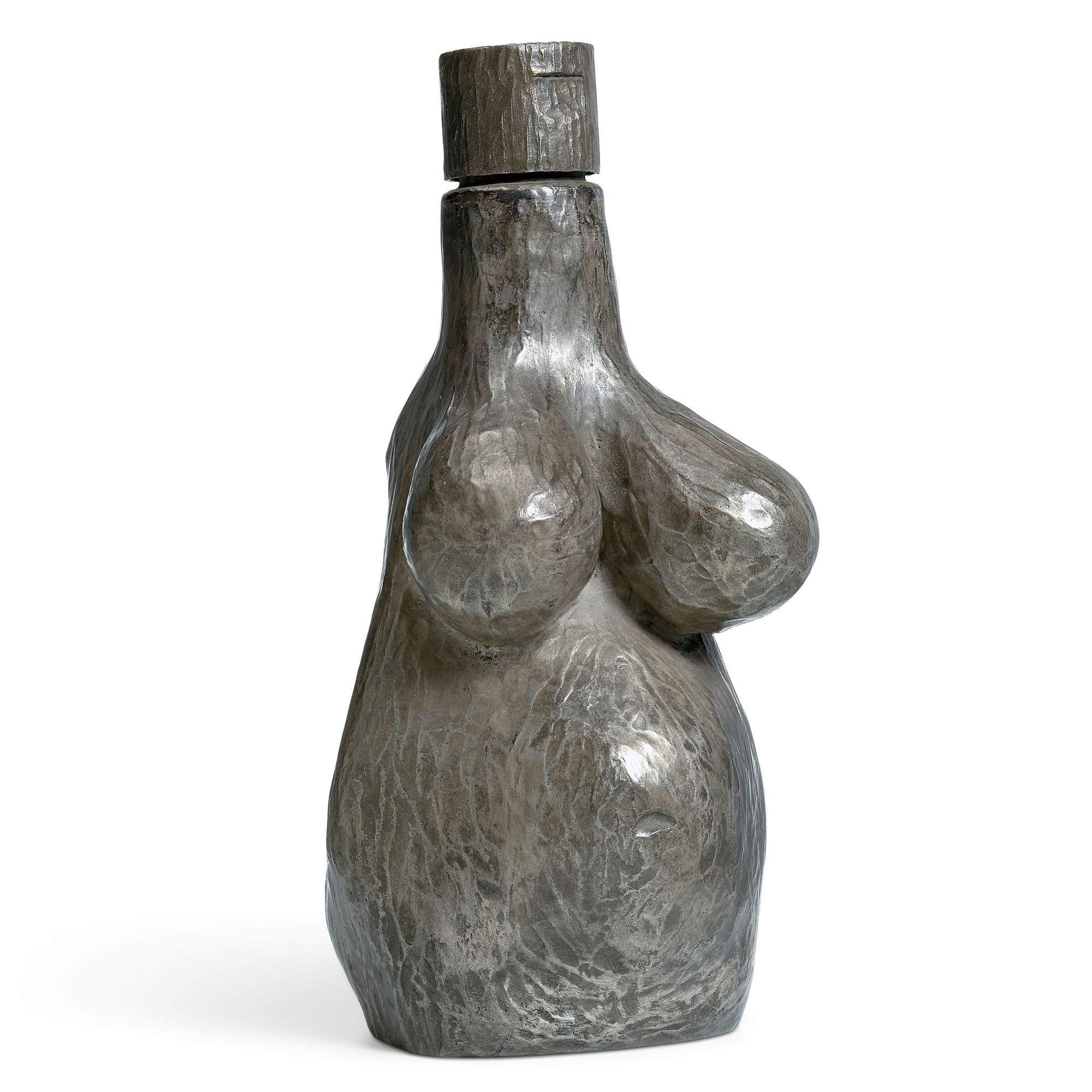
拍品 16
LOUISE BOURGEOIS (1911-2010)
Femme
已结束2020年7月14日
估价
GBP 100,000–150,000
更多信息
专家说明
A curvaceous, totemic form in textured bronze, Femme (2006) exemplifies Louise Bourgeois’ sensual command of sculpture. The figure is small enough to hold in the hand, inviting intimate engagement: its large breasts and swelling stomach create a voluptuous female body, evocative of ancient fertility idols such as the Venus of Willendorf. In place of her head is what appears to be a bottle-cap, transforming the woman into a stylised vessel. This brazen physical presence, Bourgeois implies, contains an interior: an apt image for an artist whose work centres around psychosexual explorations of the subconscious and inner life.
Bourgeois had employed versions of this motif as early as her Femme Maison paintings of the 1940s, which replaced the heads of nude women with houses – a vision of the split between body and mind, and of the loss of identity concomitant with becoming a ‘housewife.’ Throughout her decades-long practice Bourgeois used such symbolic images to express her most personal thoughts, desires, and feelings, voyaging her own psyche while also illuminating wider societal and cultural themes. In its playful bottle-like form, Femme pictures woman as both object of worship and as container, daring us to look inside.
Created when Bourgeois was ninety-four years old, Femme represents a succinct, potent distillation of her life and ideas: while richly autobiographical, the sculpture is a resoundingly universal presence. As Penelope Vinding writes, ‘Despite the personal starting-point, Bourgeois’ works are rooted within a shared human horizon of experience. We recognize the existential themes like life/death, man/woman, love/hate, loneliness/belonging etc.; themes that are part of every society, and which are associated with strong, often ambivalent emotions. Bourgeois’ personal drama is only the core around which they are played out’ (P. Vinding, ‘The Space and the Body’, in Louise Bourgeois: Life into Art, exh. cat. Louisiana Museum For Modern Art, Humlebaek 2003, p. 12).