拍品 12
GLENN LIGON (B. 1960)
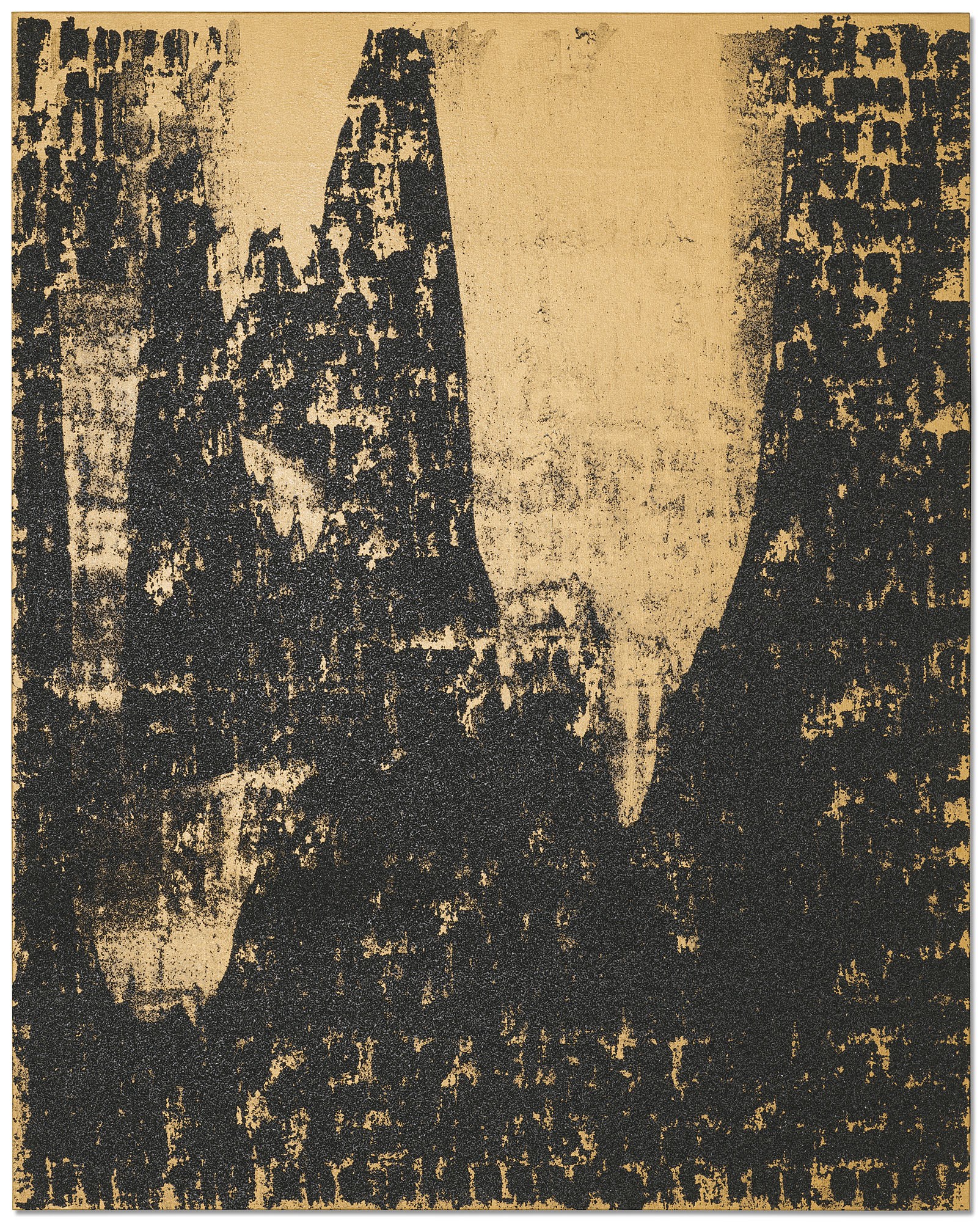
Figure #96
已结束2020年7月14日
估价
GBP 280,000–350,000
更多信息
专家说明
‘There is a custom in the village – I am told it is repeated in many villages – of buying African natives for the purpose of converting them to Christianity. There stands in the church all year round a small box with a slot for money, decorated with a black figurine, and into this box the villagers drop their francs. During the carnival which precedes Lent, two village children have their faces blackened – out of which bloodless darkness their blue eyes shine like ice – and fantastic horsehair wigs are placed on their blond heads; thus disguised, they solicit among the villagers for money for the missionaries in Africa’ - James Baldwin, ‘Stranger in the Village’, 1953
Figure #96 (2011) is a beautiful and haunting example of Glenn Ligon’s ‘Figure’ series: an iconic group of coal-dust silkscreens in which the artist takes his appropriated text paintings into the realm of total abstraction. Overlaid and abraded, Ligon’s carbonised writing cascades down the 1.5-metre canvas, coalescing into a black, sparkling mass. Words and letters melt into a chorus of illegible, flickering marks, their sense obscure and their status uncertain. In places the silkscreen’s golden background tears through the dark curtain of script, echoing the ripped posters of Paris’s mid-century affichistes as much as the craggy Abstract Expressionist paintings of Clyfford Still. Ligon composes and decomposes words into a dramatic, dazzling picture, creating an ambiguous, richly textured vision of meaning and its dissolution.
The ‘Figure’ of Ligon’s title might be seen to refer to a pictorial pattern, motif or diagram; it might equally designate a human form. Indeed, as is typical of Ligon’s work, the ‘Figure’ series is directly concerned with the presentation of the self through text and image. These works are part of his ongoing formal engagement with James Baldwin’s 1953 essay ‘Stranger in the Village’. Sharing his identity as a gay, black man, Baldwin is a key literary touchstone for Ligon. In the essay, Baldwin tells of his intense alienation as the only black person living in a remote Swiss community, finding parallels between his experience and the wider history of race relations in America. Describing the Swiss villagers raising funds to convert ‘African natives’ to Christianity, Baldwin mentions ‘a small box with a slot for money, decorated with a black figurine’: just one of many possible ‘Figures’ suggested in the shadows of Ligon’s work.
The ‘Figure’ series is derived from Ligon’s own earlier painting Masquerade (2002), itself a near-illegible picture of this passage from Baldwin’s text. As Sarah Lehrer-Graiwer observes, in the ‘Figure’ paintings Ligon therefore ‘quotes himself quoting Baldwin, and the double mediation that results degrades graphic form into entropie abstractions on the verge of decipherability … The masking effected by the coal dust also resonates with Baldwin’s here-unreadable account of the white villagers’ alarming employ of blackface in their obscene fundraising drives. The surfaces appear as fragile and fugitive, as ravaged and ruptured, as the explosive emotional and psychological content of the text’ (S. Lehrer-Graiwer, ‘Glenn Ligon: Regen Projects’, Artforum, March 2010, p. 255). In this abstracted ‘double mediation’ Ligon explores textual and visual expression as modes that can conceal as much as they reveal: Figure #96 embodies aspects of Baldwin’s essay even as it obscures his printed words. Language, image and identity are exposed as mercurial things, shifting or even falling apart according to their context and manner of presentation.
Figure #96’s striking materiality furthers the entanglement of medium and message. Ligon was partly inspired to use coal dust by Andy Warhol’s Diamond Dust silkscreens, which use diamond dust to convey glamour, luxury and even holiness, embellishing his pictures of high-heeled shoes or sanctifying his portraits of Joseph Beuys. Coal dust has different connotations: it originates as a dense industrial waste product, but is transformed in Ligon’s work into a splendid, scintillating surface that is laden with complex meaning. When responding to Baldwin, Ligon explains, the black dust’s physical weight had its own special importance. ‘I wanted the material that I was using for the paintings to have the same kind of gravitas as the text’ (G. Ligon, quoted in S. Andrews, ‘Glenn Ligon: in Conversation,’ in Glenn Ligon – Some Changes, exh. cat. Contemporary Art Gallery at Harbourfront Centre, Toronto, 2005, p. 173). Combining his sharp semiotic intelligence with a profound, painterly beauty, Figure #96 sees Ligon taking Baldwin’s text as a vehicle for the reading and rereading of his own selfhood. It exemplifies Ligon’s navigation of reading, looking and living as a black man in contemporary America, and finds glittering majesty in the dark and difficult.