专家说明
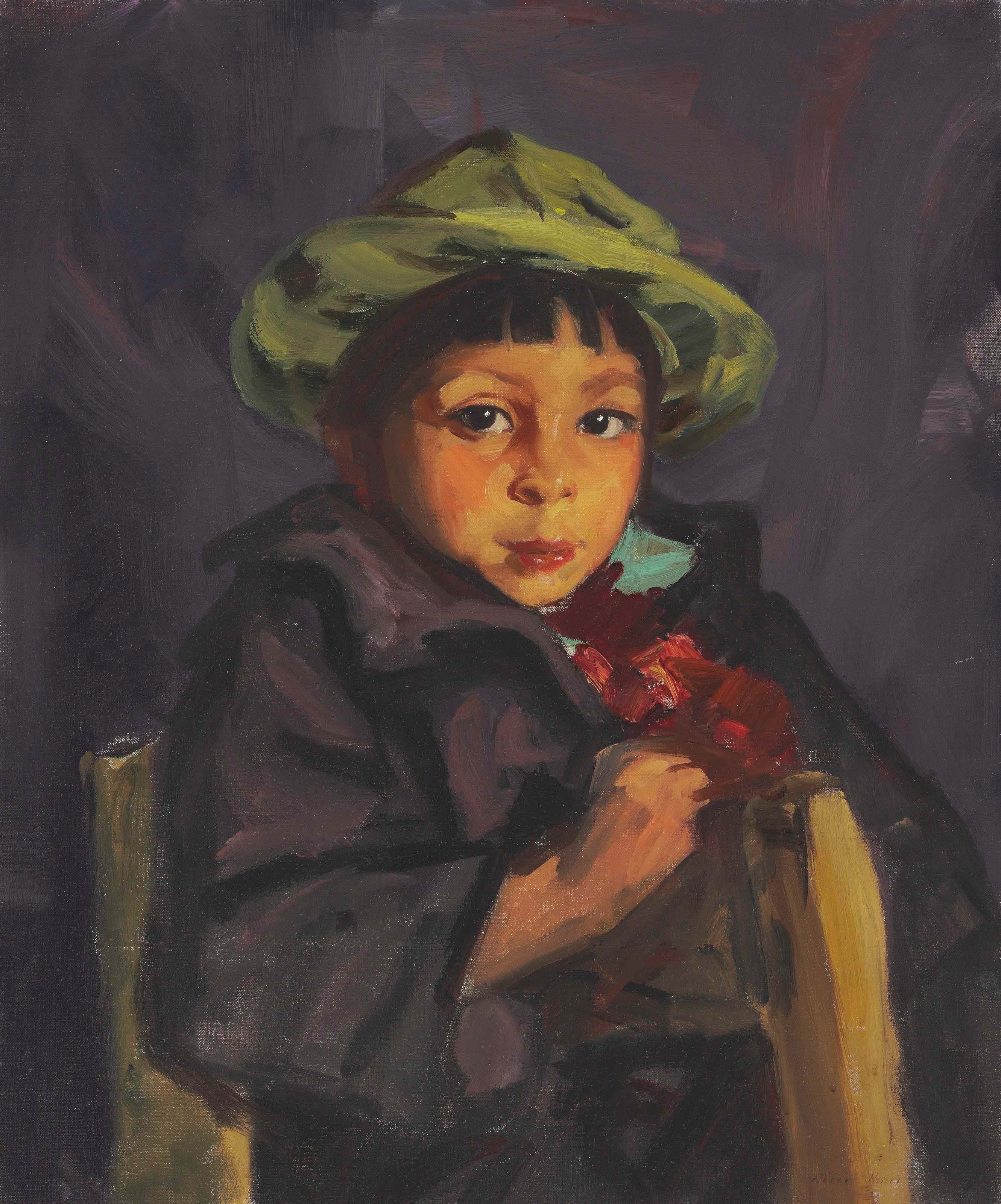
Francisco, painted by Robert Henri on his final trip to Santa Fe, is a marvelous example of the portraits executed during the artist’s three summers in New Mexico in 1916, 1917 and 1922. As with his time in Ireland, Spain and across America, Henri’s fascination with the local culture, and more importantly the people, is vividly evident in his artworks from these years. Indeed, Henri declared, "I am looking at each individual with the eager hope of finding something of the dignity of life, the humor, the humanity...I do not wish to explain these people...I only want to find whatever of the great spirit there is in the Southwest. If I can hold it on my canvas I am satisfied." (as quoted in V.A. Leeds, Robert Henri: The Painted Spirit, New York, 2005, p. 25)
Henri wrote of his favorite locations in 1920, "Santa Fe is my pick for several reasons...It is a wonderful climate, a wonderful place to be in just for the joy of being in it. It is always interesting. The sky and mountains are always changing. It's a charming old place, old Indian, old Mexican. There are fine and interesting people there the year round." (as quoted in, Robert Henri: The Painted Spirit, p. 26) Painted with thick painterly brushstrokes in rich hues of purple, green, orange and red, Francisco is a powerful image evocative of this multifaceted community. Here, the young sitter, who posed for at least four portraits by the artist, is depicted with a beautiful brown complexion, rosy cheeks and soulful eyes, wearing a colorful cap, scarf and coat. He sits against a purposefully vague, nondescript background, looking over the back of his chair to confront the viewer head-on. This elimination of setting detail places particular emphasis on the sitter, creating a focused portrait of the individual that seems to capture ‘the great spirit’ Henri was searching for in the Southwest.
Henri wrote of his favorite locations in 1920, "Santa Fe is my pick for several reasons...It is a wonderful climate, a wonderful place to be in just for the joy of being in it. It is always interesting. The sky and mountains are always changing. It's a charming old place, old Indian, old Mexican. There are fine and interesting people there the year round." (as quoted in, Robert Henri: The Painted Spirit, p. 26) Painted with thick painterly brushstrokes in rich hues of purple, green, orange and red, Francisco is a powerful image evocative of this multifaceted community. Here, the young sitter, who posed for at least four portraits by the artist, is depicted with a beautiful brown complexion, rosy cheeks and soulful eyes, wearing a colorful cap, scarf and coat. He sits against a purposefully vague, nondescript background, looking over the back of his chair to confront the viewer head-on. This elimination of setting detail places particular emphasis on the sitter, creating a focused portrait of the individual that seems to capture ‘the great spirit’ Henri was searching for in the Southwest.