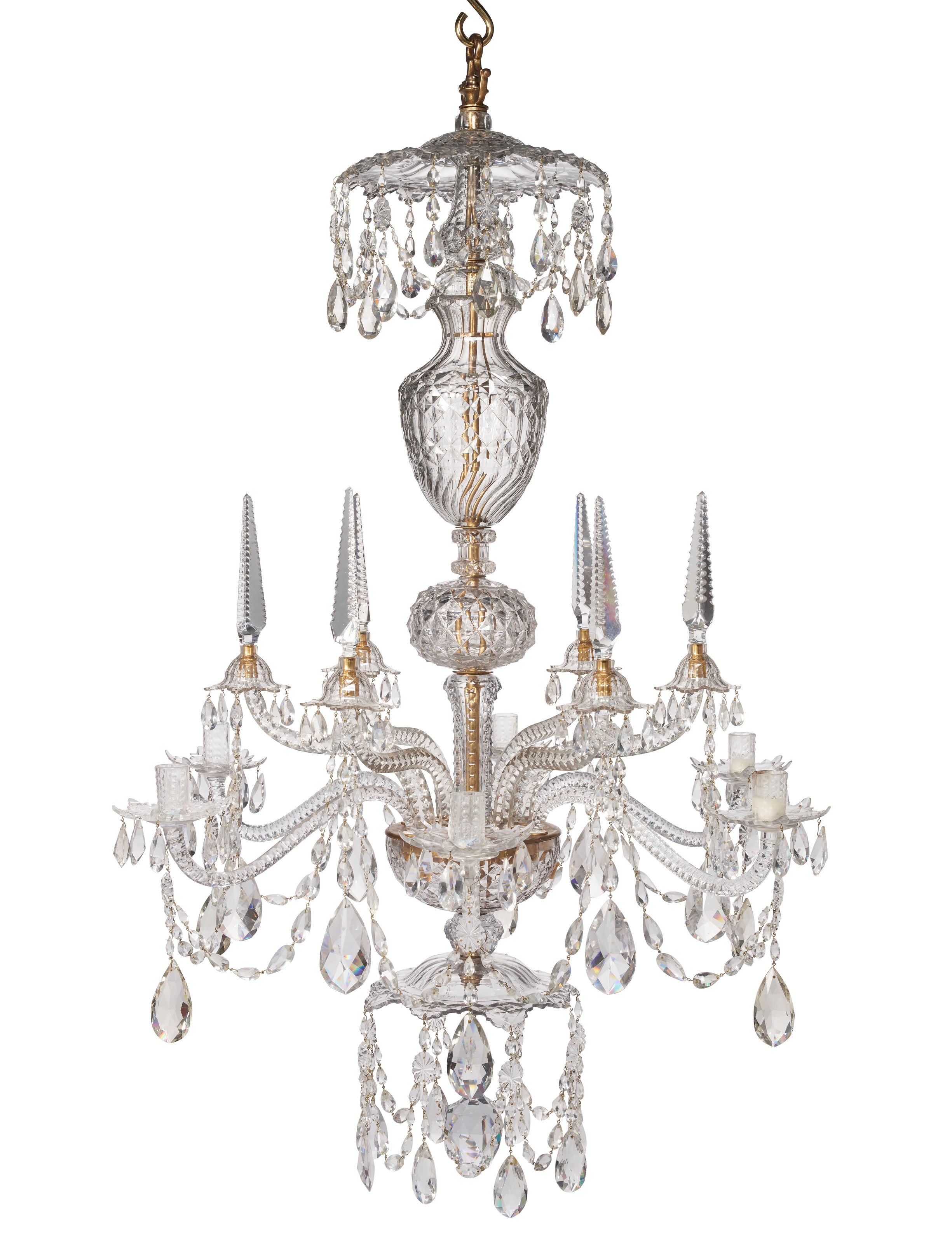
Lot 57PROPERTY FROM A PRIVATE COLLECTION, PALM BEACH, FLORIDA
A GEORGE III CUT-GLASS SIX-LIGHT CHANDELIER
ATTRIBUTED TO WILLIAM PARKER, LATE 18TH CENTURY
Fermé20 October 2021
Prix réalisé
USD 43,750
Plus d'informations
Note du spécialiste
William Parker (fl. 1768-1784) of Fleet Street London is perhaps the most influential chandelier maker of his age, credited with bringing the trend for the neoclassical to lighting and supplying his wares to some of the most notable spaces in England including Chatsworth for the Duke of Devonshire, Carlton House for the Prince of Wales, the White Drawing Room at Houghton Hall, and for the Assembly Rooms in Bath.
This chandelier was reputedly created for Frenchpark House in County Roscommon, Ireland. The earliest recorded member of the French family to reside at Frenchpark was Patrick French fitz Stephen of Galway (d. 1667). His son, Dominick French was granted over 5,000 acres of land in county Roscommon that same year, and his grandson, John French, received 2,000 more acres a decade later. The land rich family long resided at Frenchpark and had considerable wealth and influence. When this mirror was commissioned, the house was being redecorated in the Neoclassical Georgian style by Arthur French MP (1728–1799). His grandson, Arthur French (1786–1856) was created Baron de Freyne of Artagh in the English Peerage in 1839 and Baron de Freyne of Coolavin in the Irish Peerage in 1851. The Barony de Freyne continues to this day, though Frenchpark was sold by the 7th Baron de Freyne in 1952 to the Irish Land Commission, which thereafter demolished it in the 1970s.
This chandelier was reputedly created for Frenchpark House in County Roscommon, Ireland. The earliest recorded member of the French family to reside at Frenchpark was Patrick French fitz Stephen of Galway (d. 1667). His son, Dominick French was granted over 5,000 acres of land in county Roscommon that same year, and his grandson, John French, received 2,000 more acres a decade later. The land rich family long resided at Frenchpark and had considerable wealth and influence. When this mirror was commissioned, the house was being redecorated in the Neoclassical Georgian style by Arthur French MP (1728–1799). His grandson, Arthur French (1786–1856) was created Baron de Freyne of Artagh in the English Peerage in 1839 and Baron de Freyne of Coolavin in the Irish Peerage in 1851. The Barony de Freyne continues to this day, though Frenchpark was sold by the 7th Baron de Freyne in 1952 to the Irish Land Commission, which thereafter demolished it in the 1970s.