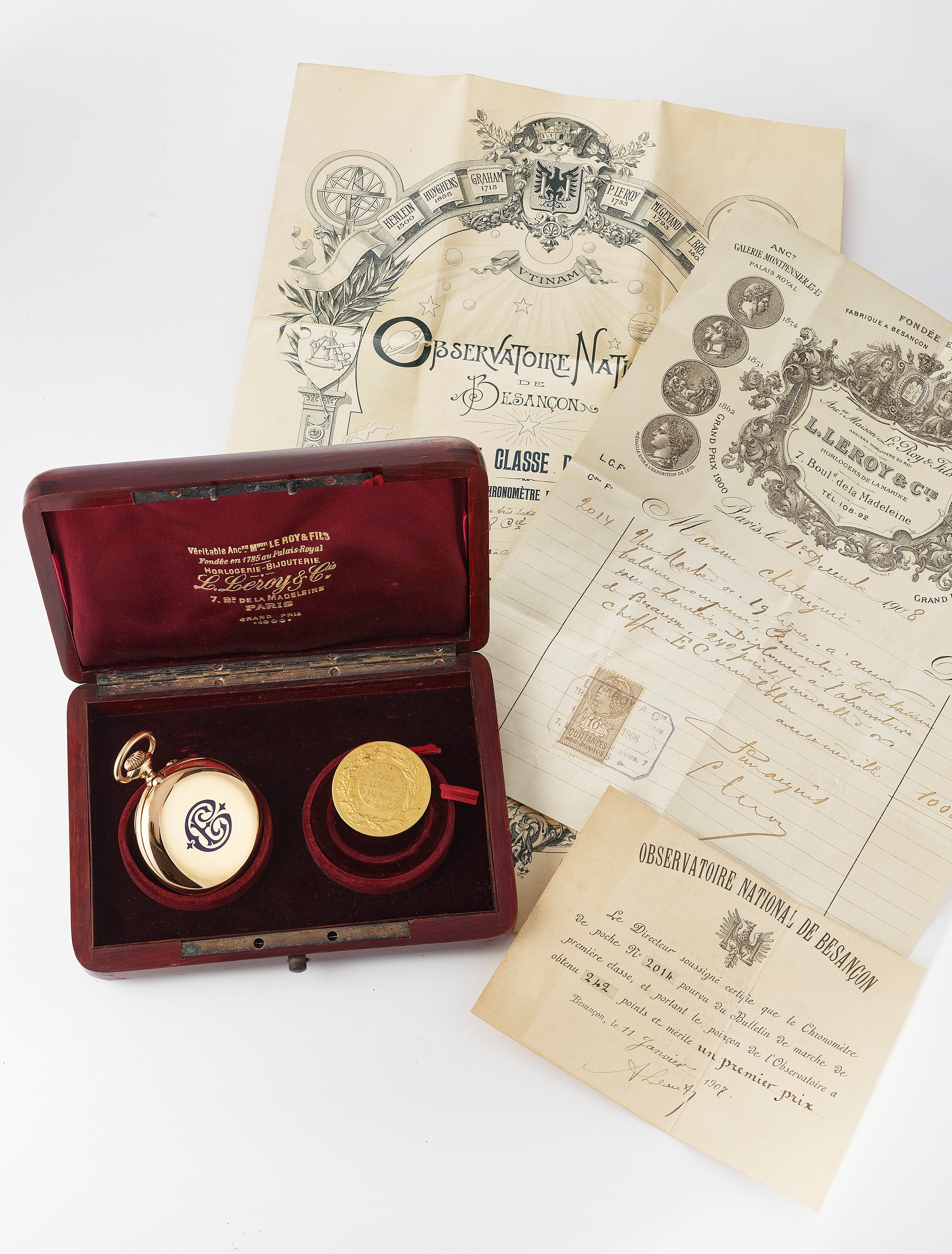
Lot 474
L. LEROY & CIE., 18K GOLD OPENFACE KEYLESS LEVER CHRONOMETER WATCH
NO. 64'414, CASE NO. 2'014
Fermé18 May 2021
Prix réalisé
CHF 9,375
Plus d'informations
Note du spécialiste
This very fine keyless lever chronometer is sold with the Bulletin de Marche from the Besançon Observatory and the original gold medal won at the occasion, confirming that it obtained the First Prize at the Category A timing contest held from 27 November 1906 – 10 January 1907, with 242 marks.
Its highest quality movement is stamped with the “Viper’s Head”, symbol used by the Besançon Observatory to mark movements which had successfully passed the chronometer tests. It is furthermore fitted with an anibal-brass Guillaume balance, invented by Dr. Charles Edouard Guillaume.
The overall appeal is further enhanced by the superior quality case with hidden hinges, a characteristics of the firms' highest quality production, the excellent overall condition of the timepiece and the presence of the original gold medal, Observatory Bulletin, invoice and presentation box, all rarities by themselves.
The Guillaume Balance
Anibal is an alloy invented by Dr. Charles Edouard Guillaume which exhibits unusual properties, both in terms of thermal expansion and in changes in elasticity. Around 1900, Guillaume attempted to eliminate the so-called Middle Temperature Error caused by the fact that the change of rate in a timekeeper with a steel-brass bimetallic balance is approximately a linear function of temperature, while the change of rate caused by change in elasticity of a balance spring is approximately a quadratic function. Thus, it equals zero at only two temperatures, causing secondary error. Countless attempts were made to eliminate Middle Temperature Error, usually by means of auxiliary compensation devices.
In 1899, Guillaume noticed that steel with an addition of 44.4% nickel had a negative square coefficient of thermal expansion. This alloy, combined with brass in bimetallic lamina, makes its expansion close to quadratic. Balances with bimetallic rims made of anibal and brass are usually called Guillaume balances, or, as their inventor called them, integral balances. When combined with special balance springs, they exhibit remarkable temperature stability, on occasion not exceeding 1/50 second per day.
L. Leroy & Cie.
The Leroy dynasty of famous watchmakers was founded in 1751 by Charles Leroy, watchmaker to the King and renowned chronometer maker. After his death in 1771, the firm based at Paris' prestigious Palais Royal continued commerce under different leadership.
Louis Leroy, Horloger de la Marine, started as a watchmaker for the company in 1879 and took over the business with Jules Desfontaines, changing the firm's name to L. Leroy et Cie. Louis' brother Léon Leroy, who had joined in 1895, became partner in 1914.
Leroy watches participated in various exhibitions and were awarded numerous prices, especially at chronometer contests.