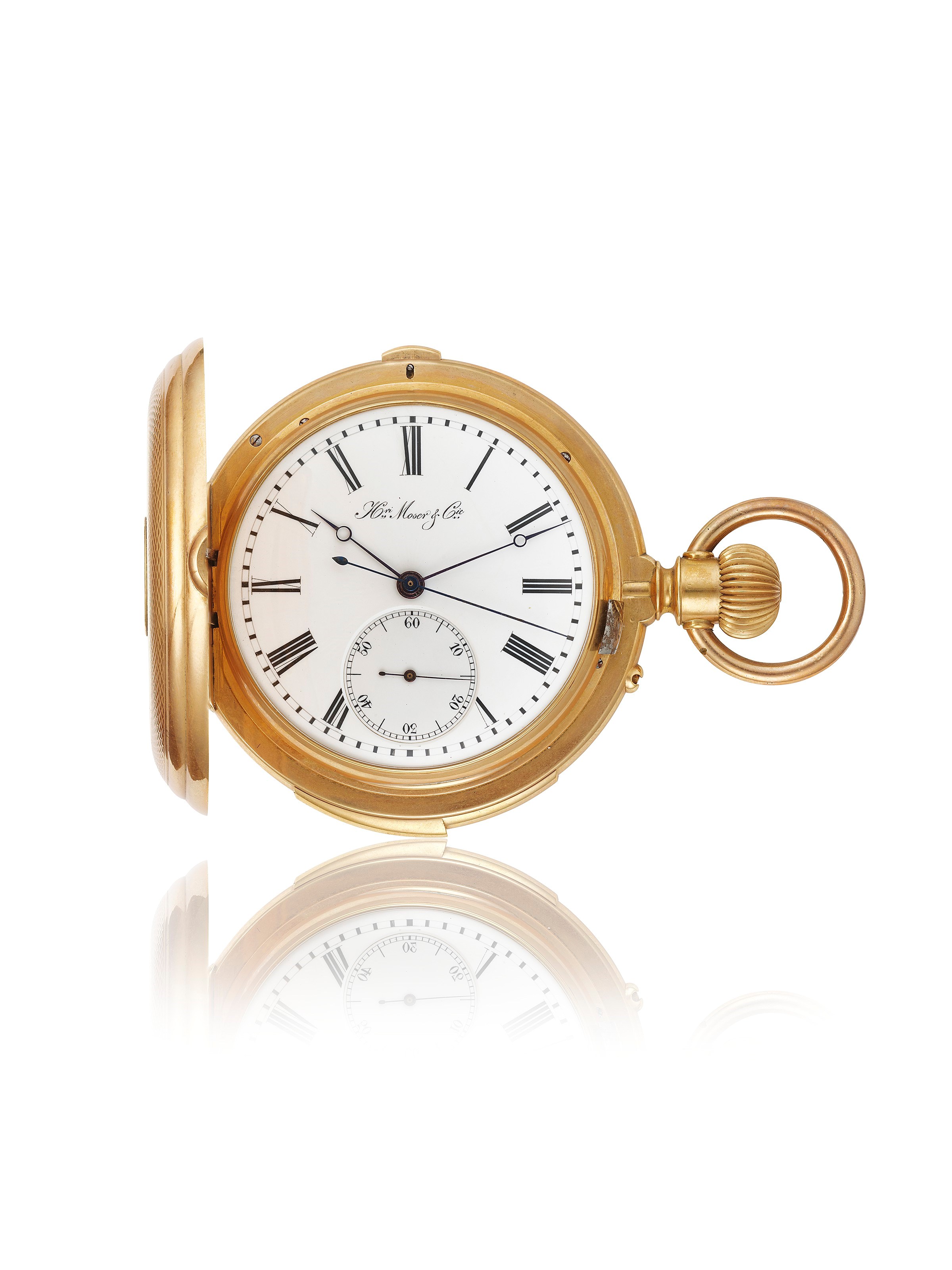
Lot 472
HENRY MOSER, 18K GOLD HUNTER CASE TWO TRAIN MINUTE REPEATING INDEPENDENT DEAD BEAT SECONDS KEYLESS LEVER WATCH, MADE FOR THE RUSSIAN MARKET
NO. 34’438
Fermé18 May 2021
Prix réalisé
CHF 16,250
Plus d'informations
Note du spécialiste
This fine and rare example of a complicated timepiece made by Henry Moser for the Russian market combines a minute repeating mechanism with stoppable independent dead beat seconds, activated/stopped by a push button in the band. Housed in a substantial and heavy gold case, the watch is furthermore preserved in very good overall condition.
The independent dead seconds mechanism requires two going trains, one for the movement and one for the sweep centre seconds hand, allowing it to be stopped without stopping the main train in order not to interfere with the accuracy of timekeeping. The invention of this mechanism is attributed to Moise Pouzait, Geneva 1776.
Johann Heinrich Moser, better known as Henry Moser, born in 1805 in Schaffhausen, was a descendant of a watchmaker dynasty and a celebrated watchmaker. At the age of 22 he immigrated to Russia and opened the trading company H. Moser & Cie.
In 1829, Moser established a watch factory in Le Locle and rapidly became a veritable timekeeping empire. At its height, the manufacture had 64 different calibres, including 24 complications, and was among the main suppliers to the Russian market, notably to the Imperial Court and Carl Fabergé.
Henry Moser returned to Schaffhausen in 1848 and contributed greatly to the industrial boom of the city, most notably with the construction of a hydroelectric dam on the Rhine. He also supported Florentine Ariosto Jones in the foundation of the International Watch Company (IWC).
Moser died in 1874, and in 1877, his heiress sold the entire Russian trading operation as well as the factory in Le Locle. Under the names "H. Moser & Cie." or "Heinrich Moser & Co.", the factory continued to produce mechanical movements until 1979.
In 2002, the brand "H. Moser & Cie." was once again registered internationally, the first collection was presented at Basel Fair 2006.