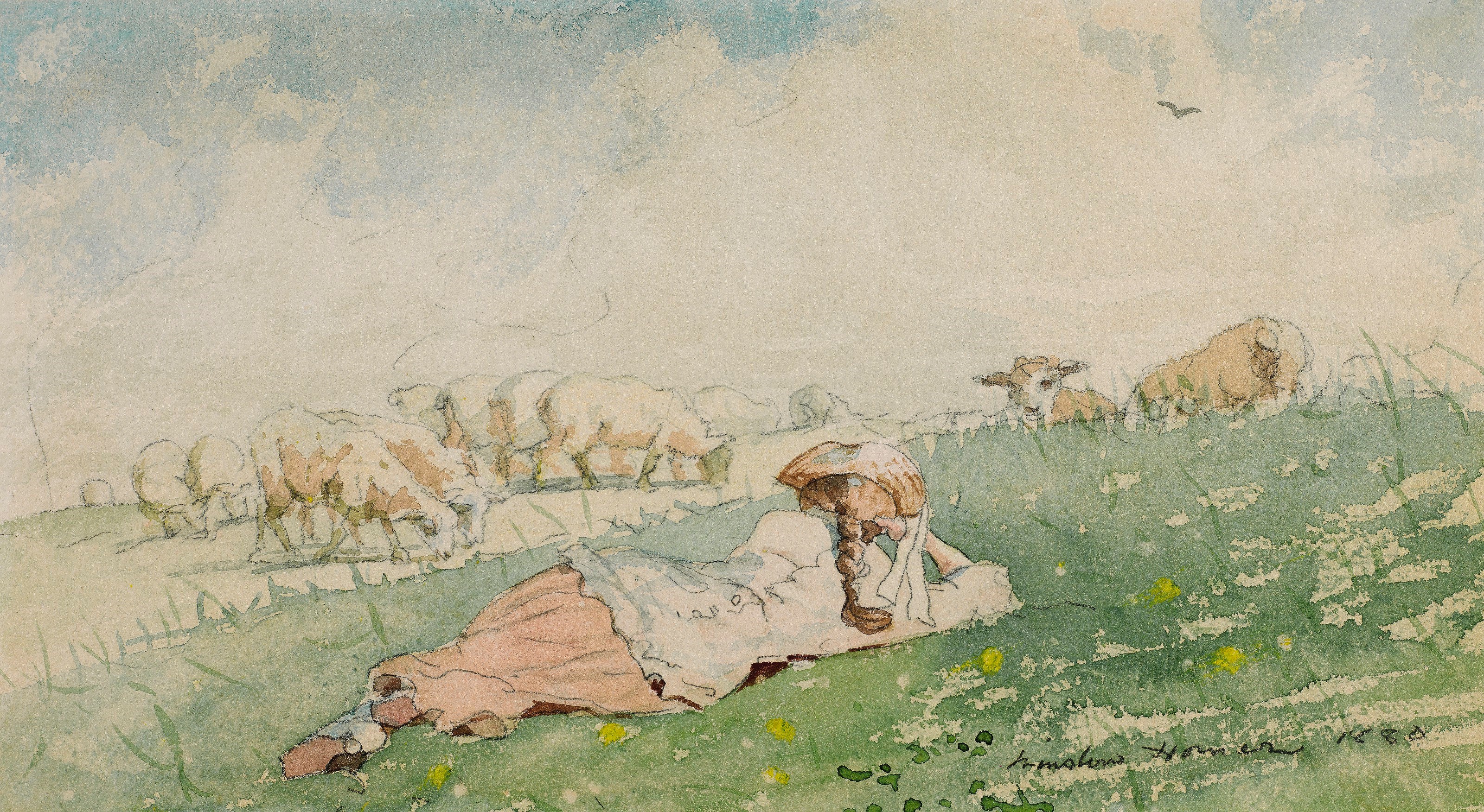
Lot 19Property from a Distinguished Private Collection, Washington, D.C.
Winslow Homer (1836-1910)
The Shepherdess
Fermé7 August 2020
Prix réalisé
USD 106,250
Plus d'informations
Note du spécialiste
Following his career-establishing depictions of Civil War soldiers in the 1860s, Winslow Homer solidified his place as a great American artist with his paintings of nostalgic rural life over the following decades. During a time of Restoration for the country, Homer's concentration on the simple ways of the past, exemplified by his shepherdesses, reflected the need for hope and peace in the nation. At the same time, his tendency toward a contemplative mood in his works acknowledged the feelings of the public in a time of national uncertainty. Encompassing several of the most important themes from this era of Homer's career, as well as exhibiting his unmatched skill with the medium of watercolor, The Shepherdess is a beautiful example from one of Homer's most acclaimed series.
The Shepherdess was inspired by Homer’s time at Houghton Farm, a working homestead in Mountainville, New York, owned by the artist’s first and most important patron, Lawson Valentine. A varnish manufacturer who eventually owned approximately forty works by the artist, Valentine purchased Houghton Farm in 1876. Homer visited the property shortly thereafter, and he returned for several extended visits over the following years. Sheep husbandry was an essential part of the working farm, and the shepherdess is inarguably among the most celebrated subjects from this period of Homer’s career. As Frederic Ilchman writes, “Homer's Houghton Farm images of shepherdesses illustrate, more strongly than any other subject matter he chose to represent, the nostalgia then present in his work.” (Winslow Homer in the 1870s: Selections from the Valentine-Pulsifer Collection, Hanover, New Hampshire, 1990, p. 70)
In the present example, Homer presents a single shepherdess relaxing in a field as she watches over her grazing flock. Dressed in a traditional costume complete with beribboned hat, and casually resting with head in hand, the young woman embodies an idealized vision of pastoral tranquility and personal reflection. Homer delineates the figure and sheep with expressive pencil lines and watercolor shadows, and then conveys the atmosphere of the day through artfully applied washes of color, punctuated with sharper blades of grass and pops of yellow flowers. The single bird visible in the distant sky completes the transportive scene.
As George W. Sheldon proclaimed in 1882, "Winslow Homer, indeed, never fully found himself until he found the American shepherdess." (Hours with Art and Artists, New York, 1882, p. 140) The present work exemplifies the hopeful nostalgia and peaceful escapism of this seminal series of Homer’s career.