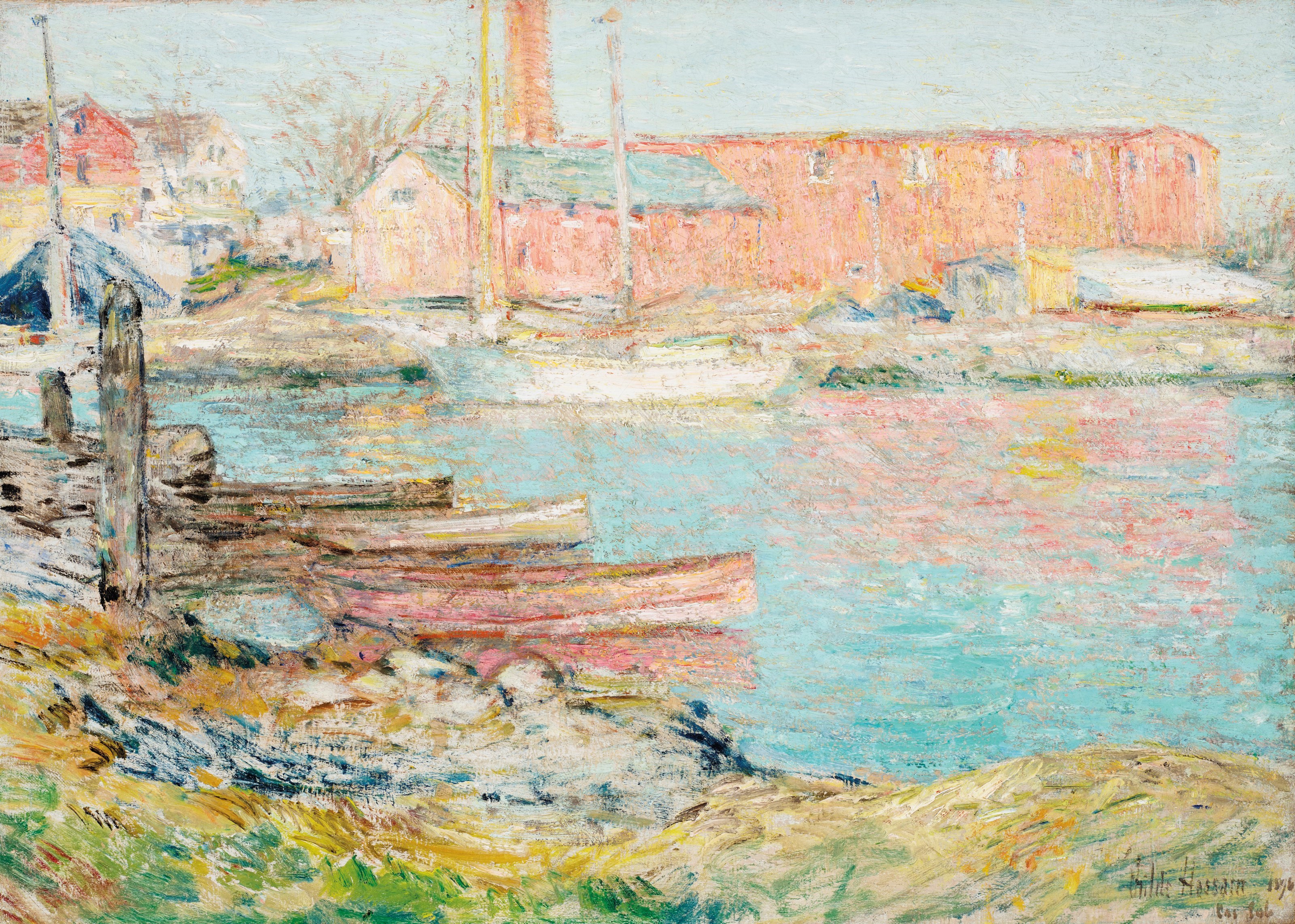
Lot 14Property from the Estate of Heidi Bingham Stott
Childe Hassam (1859-1935)
The Red Mill, Cos Cob
Fermé7 August 2020
Prix réalisé
USD 212,500
Plus d'informations
Note du spécialiste
We would like to thank the Hassam catalogue raisonné committee for their assistance with cataloguing this work.
This painting will be included in Stuart P. Feld's and Kathleen M. Burnside's forthcoming catalogue raisonné of the artist's work.
One of the earliest paintings from the artist's time in Cos Cob, Connecticut, The Red Mill depicts the Palmer and Duff shipyard with the town's mill at left. Hassam began making summer trips to Cos Cob in 1894 and continued to do so until 1918, staying at the Holley Boarding House, which acted as the intellectual center for the local art community. Other frequent artist visitors included John Henry Twachtman, J. Alden Weir and Theodore Robinson.
Susan G. Larkin writes, "The subject matter Hassam favored in Cos Cob differed dramatically from the sea and rocks he painted at Appledore. And although the Holleys and MacRaes grew their own fruits and vegetables, cultivated extensive flower borders, and filled the house with bouquets, Hassam ignored garden images there. He focused now on architectural and figural subjects...The old houses, barns, mill, and shipyard inspired so many pictures that Hassam nicknamed the art colony 'the Cos Cob Clapboard School.' But he, more frequently than anyone else, depicted the rustic vernacular architecture." ("Hassam in New England," Childe Hassam: American Impressionist, exhibition catalogue, New York, 2004, p. 147)