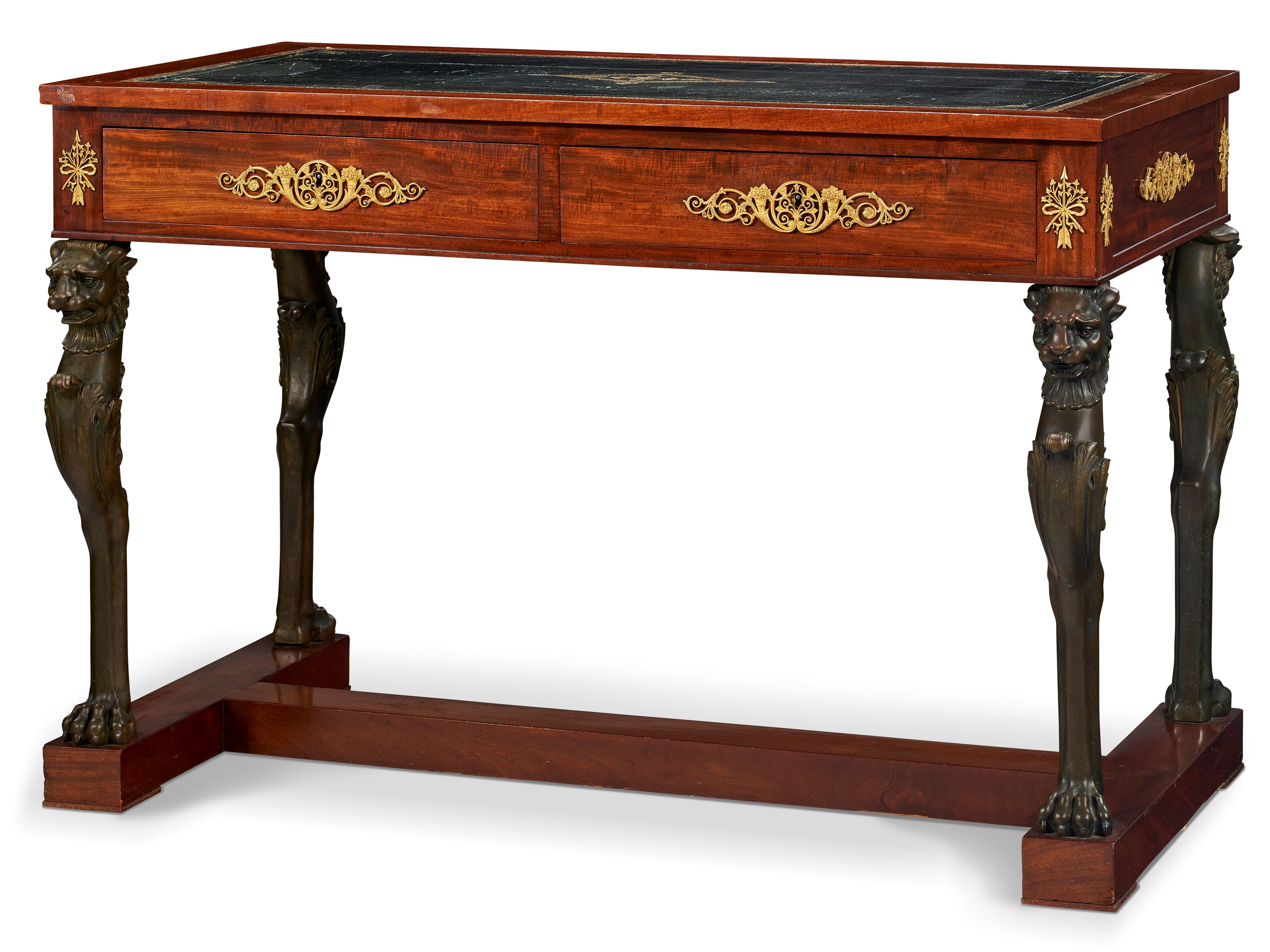
Lot 85THE COLLECTION OF ADOLPHUS ANDREWS, JR. AND EMILY TAYLOR ANDREWS
AN EMPIRE ORMOLU AND PATINATED BRONZE-MOUNTED MAHOGANY LIBRARY TABLE
CIRCA 1810
Closed18 June 2024
Estimate
USD 8,000–12,000
More Information
Specialist note
This mahogany library table was created in the first decades of the nineteenth century in the sober antique manner popularized by the French architects Charles Percier (1764-1838) and Pierre-François Fontaine (1762-1853) through their enormously influential volume, Recueil de Décorations Intérieures, first printed in Paris in 1801. Unquestionably, the design element on this table most clearly inspired by Percier and Fontaine is the muscular, leaf-adorned lion-monopodia feet, which appear several times in the Recueil de Décorations Intérieures including on a grand secrétaire à cylindre executed by Mr. H. (pl. 32); a second time with the addition of small flowers beneath the lion's ears on a table à thé executed by Mr. G. (pl. 42); and a third time, with more elaborate foliate carving to the upper legs, on a bureau executed by Mr. V. (pl. 38, no. 1). The lion monopodium of classical Rome was one of the most alluring ornamental forms from antiquity for designers throughout Europe at the end of the 18th century and early in the 19th century. They derived from classical artifacts such as a marble table with similar monopodia in Herculaneum (see G. Richter, The Furniture of the Greeks, Etruscans and Romans, London, 1966, fig. 572). For an example of the kind of Roman monopodium that inspired the Empire-period examples, see the alabaster specimen, circa 1st century B.C. - 4th century A.D., sold by Christie's, London, 11 May 2000, lot 57.