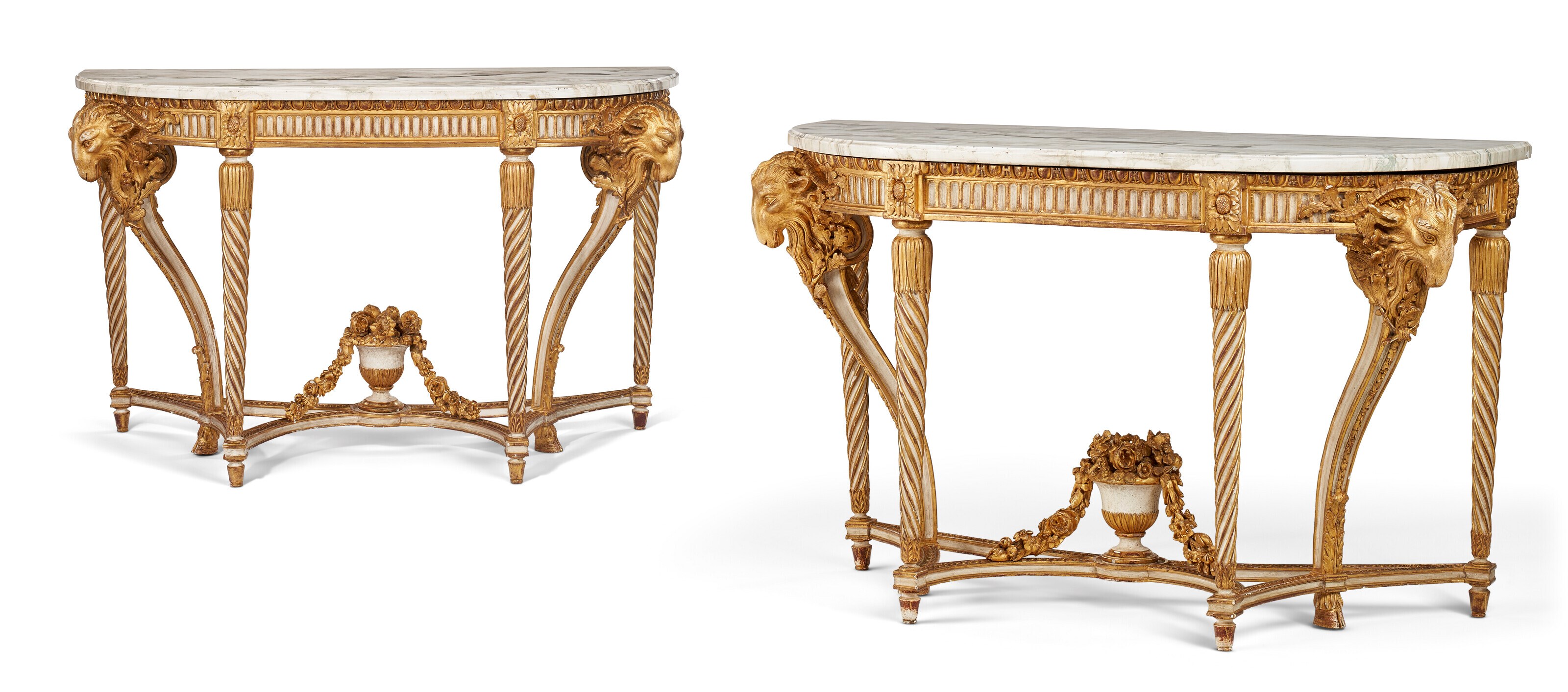
Lot 11THE COLLECTION OF ADOLPHUS ANDREWS, JR. AND EMILY TAYLOR ANDREWS
A PAIR OF LATE LOUIS XV WHITE PAINTED AND PARCEL-GILT CONSOLE TABLES
CIRCA 1765-70
Closed18 June 2024
Estimate
USD 80,000–120,000
More Information
Specialist note
As the taste for Rococo exuberance in France faded in the 1760s, the more austere, architectural style of the first wave of Neoclassicism known as the goût grec was embraced by the tastemakers of the time . The new forms and styles of the goût grec were largely disseminated by influential designers and ornemanistes such as Jean-Charles Delafosse and Jean-Louis Prieur, alongside architects such as Jean-François de Neufforge and Victor Louis.The first experimental items of furniture in the goût grec were conceived and produced as early as around 1754-1756 with the celebrated bureau plat executed for the amateur connoisseur Ange-Laurent Lalive de Jully, probably by Joseph Baumhauer and Philippe Caffiéri to the designs of Louis-Joseph Le Lorrain, now in the Musée Condé at Chantilly. The brother of Madame de Pompadour, the Marquis de Marigny was probably the most high-ranking and fervent proponent of the new style, who being head of the Royal Garde-Meuble, was extremely influential in making the goût grec the most fashionable trend of the time.
The visual vocabulary of the goût grec was heavily influenced by ancient Greek and Roman art, with bucrania and animal masks and heads being among some of its most popular decorative devices. These powerful design elements were used in the most varied ways and in every media; they can be found cast in ormolu, molded in porcelain, as well as carved from wood. Console tables where ram’s heads are used similarly to this lot include Ennemond Alexandre Petitot’s tables for the ducal court in Parma, now preserved at the Palazzo ducale di Colorno, and Prieur’s designs for the Royal Palace in Warsaw (illustrated here). Both Prieur and Petitot incorporated the ram’s heads as one of the principal motifs that gave unique character to their furniture. Another common design feature between these consoles and the above ones by Petitot and Prieur is the contrasting straight and curved lines of the legs, that render these tables particularly architectural. It is possible that this combination of intricate legs and pronounced ram’s heads in the same table was influenced by the works of André-Charles Boulle, whose oeuvre was rediscovered in France at the time the goût grec became en vogue. In fact, a console with elaborate legs and ram’s heads is illustrated in his Nouveaux Deisseins de Meubles et Ouvrages de Bronze et de Marqueterie Inventés et gravés par André Charles Boulle. A pair of ormolu-mounted ebony corner consoles made in the goût grec style (illustrated here), originally in the collection of the Comte d’Orsay, sold Christie’s, New York, 21 May 1996, lot 333 and subsequently from the collection of Lily and Edmond J. Safra, Sotheby’s, New York, 3 November 2005, lot 168, were executed similarly to Boulle’s designs from about 60 years earlier and thus it is possible that besides ancient Greek and Roman art, the master of French Baroque furniture-making was also an influence on the maker of these console tables.
This lot was once part of the legendary collection assembled by Mrs. Anna Thomson Dodge (1871-1970) for Rose Terrace, her Grosse Pointe residence modelled on the Petit Trianon at Versailles. A leading philanthropic benefactor and patron of the arts in Detroit with a passionate interest in French eighteenth-century art, Mrs. Dodge enlisted the celebrated art dealer Joseph Duveen to help form the collection. His unrivaled access to the finest examples available on the market led to the acquisition of a series of masterpieces, many with royal provenance, including the celebrated porcelain-mounted bureau by Carlin, originally supplied to Empress Maria Feodorovna, which was for long the most expensive piece of French furniture sold at auction.