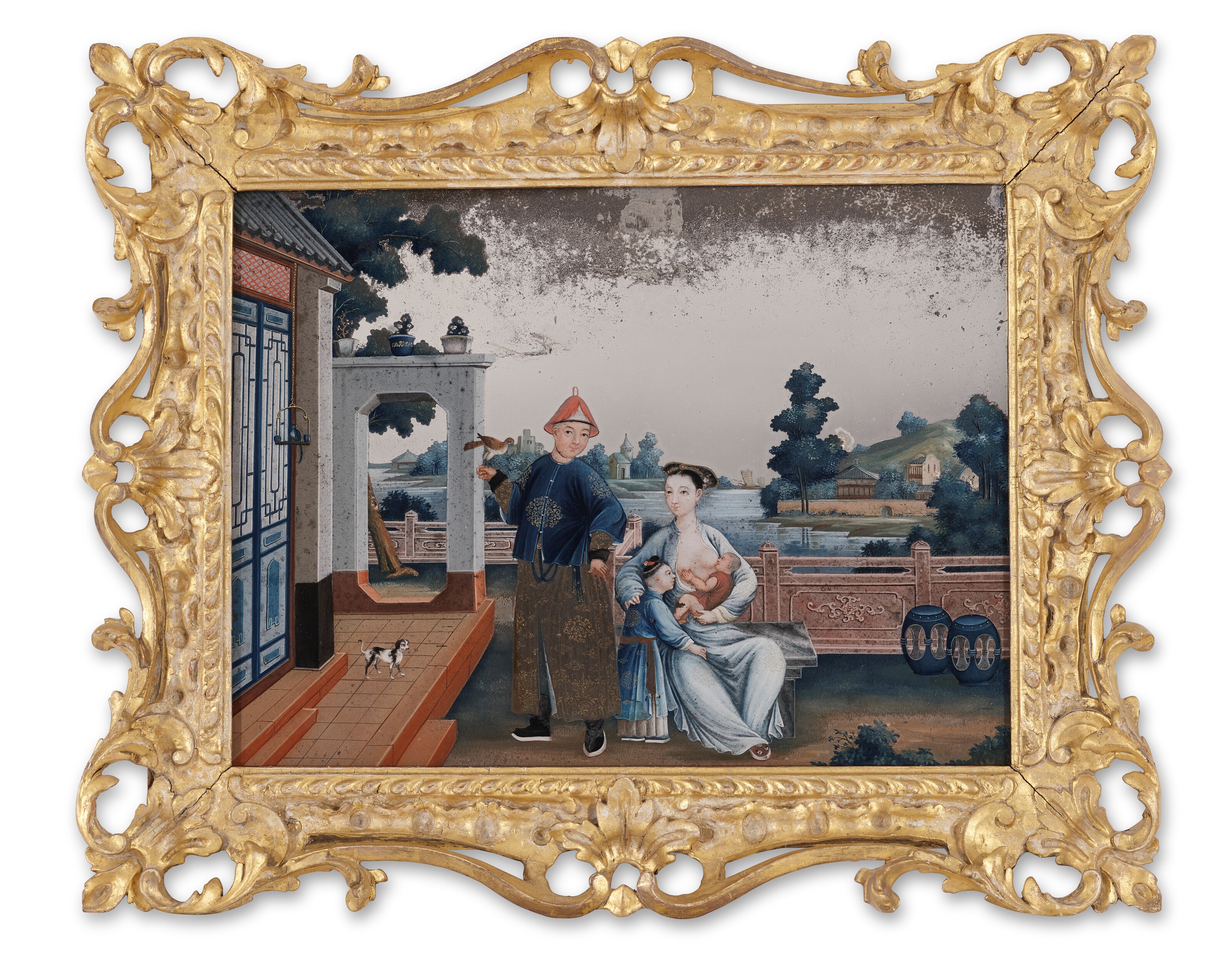
Lot 4THE COLLECTION OF ADOLPHUS ANDREWS, JR. AND EMILY TAYLOR ANDREWS
A CHINESE REVERSE-PAINTED MIRROR IN AN EARLY GEORGE III GILTWOOD FRAME
THE MIRROR QING DYNASTY, QIANLONG PERIOD, THE FRAME CIRCA 1760
Closed18 June 2024
Estimate
USD 8,000–12,000
More Information
Specialist note
THE ART OF REVERSE-PAINTING
The practice of painting on mirrors developed in China after 1715 when the Jesuit missionary Father Castiglione arrived in Beijing. He found favor with the Emperors Yongzheng and Qianlong and was entrusted with the decoration of the Imperial Garden in Beijing. He learned to paint in oil on glass, a technique that was already practiced in Europe but which was unknown in China in 1715. Chinese artists, already expert in painting and calligraphy, took up the practice, tracing the outlines of their designs on the back of the plate and, using a special steel implement, scraping away the mirror backing to reveal glass that could then be painted. Glass paintings were made almost entirely for export, fueled by the mania in Europe for all things Chinese. Although glass vessels had long been made in China, the production of flat glass was not accomplished until the 19th century. Even in the Imperial glass workshops, set up in Beijing in 1696 under the supervision of the Bavarian Jesuit Kilian Stumpf, window glass or mirrored glass was not successfully produced. As a result, from the middle of the 18th century onwards, when reverse glass painting was already popular in Europe, sheets of both clear and mirrored glass were sent to Canton from Europe. They most often depicted bucolic landscapes, frequently with sumptuously dressed Chinese figures at leisurely pursuits. Once in Europe the best were often placed in elaborate giltwood Chippendale or Chinoiserie frames.
THE PAINTING
This reverse-painted mirror depicts a beautiful scene of a Manchu family in their gardens along the Pearl River. The father is a wealthy Qing Dynasty official, evidenced by his traditional Manchu clothing. He is wearing a Liangmao (涼帽), or 'cool hat', which was made of woven rattan-like material and worn by Qing officials during the summer seasons, in contrast to the Nuanmao (暖帽), or 'warm hat' which was made with black velvet and worn in the winter seasons.
THE PROVENANCE
This reverse-painted mirror was in the collection at Wateringbury Place, which was the remarkable creation of David Style. John Harris described the collection in the introduction to the Christie's 1978 sale catalogue: 'The compositional result is so idiosyncratic as to defy description. My memory is a kaleidoscopic effect of colour and objects, warm and rich, quirky, full of amusement and flashes of inspirational juxtapositions'. Not all items were selected on purely decorative merit, many pieces were of extraordinary quality: the Italian ormolu and pietra dura cabinet from Hamilton Palace, pieces from Ashburnham Place and Leeds Castle, a suite of Regency furniture by Morel & Hughes from Northumberland House.