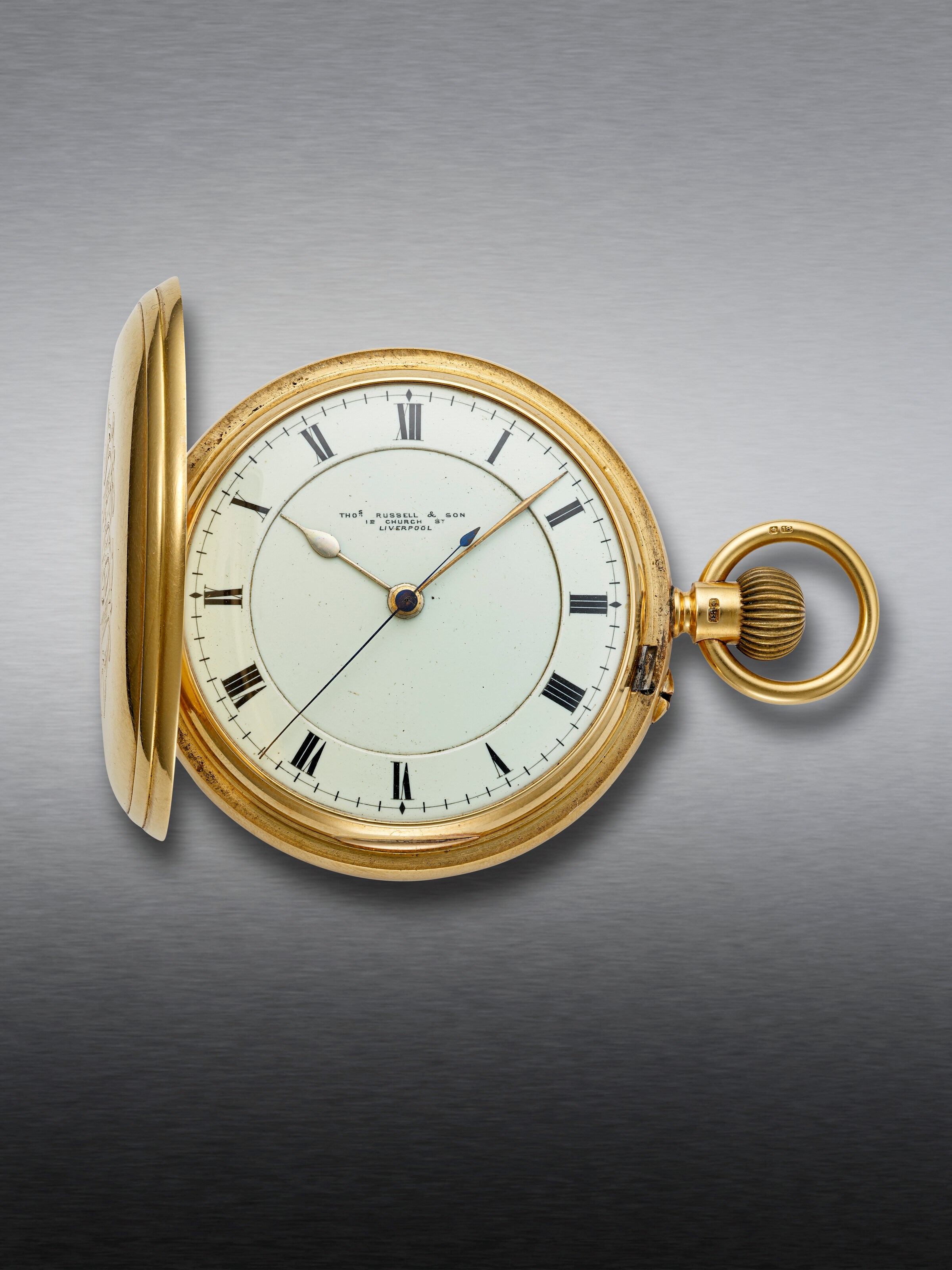
Lot 411
THOMAS RUSSELL & SONS, LIVERPOOL, A VERY FINE AND RARE YELLOW GOLD CENTRE SECONDS HUNTING CASED FREE-SPRUNG KEYLESS LEVER KARROUSEL POCKET WATCH
Closed30 May 2024
Price Realised
CHF 3,780
More Information
Specialist note
The back cover is engraved with the following dedication “Presented to Captain M.D. Hughes of the S.S. ‘Volga’ by her owners and underwriters as a recognition of his services on September 9th 1912”.
The Karrusel mechanism was invented around 1890 and patented in 1893 by Bahne Bonniksen (1859-1935), a Danish watchmaker working in England. Recognizably similar to the tourbillon, the karrusel was designed to ensure that a watch kept time regardless of how it was positioned. Although the rotating escapement of the karrusel has the same equalizing effect on positional errors as the tourbillon it is constructed in an entirely different way. The genius of Bonniksen’s invention was that, unlike the tourbillon, it could be made in quantity and serviced by any competent watchmaker. Furthermore, the karrusel watch was an exceptionally good timekeeper due largely to the relatively slow rotation of 52 ½ minutes. In fact, the timekeeping performance of the karrusel is usually equal, in many cases better and certainly more consistent than the tourbillion. Exceptional results were seen at the Kew Observatory trials with most watches obtaining between 79 and 89 marks out of 100. By 1904, thirty-eight of the best fifty watches tested at Kew were karrusels and in 1905 even a standard (without Kew certificate) karrusel was advertised as being “guaranteed to be well within the limits of the Kew Observatory class “A” requirements”.
Thomas Russell is considered one of the best watchmakers in Liverpool in the mid-19th century. He set up shop on Slater Street in Liverpool. Since the city functioned as a seafaring port, much of Russell's business came from the manufacture of ships clocks and chronometers. He is noted for creating the Russell Hunter pocket watch. When Thomas and his son were granted a Royal Warrant by Queen Victoria, they began stamping their watches "by Appointment to Her Majesty the Queen and HRM the Duke of Edinburgh and the Admiralty".