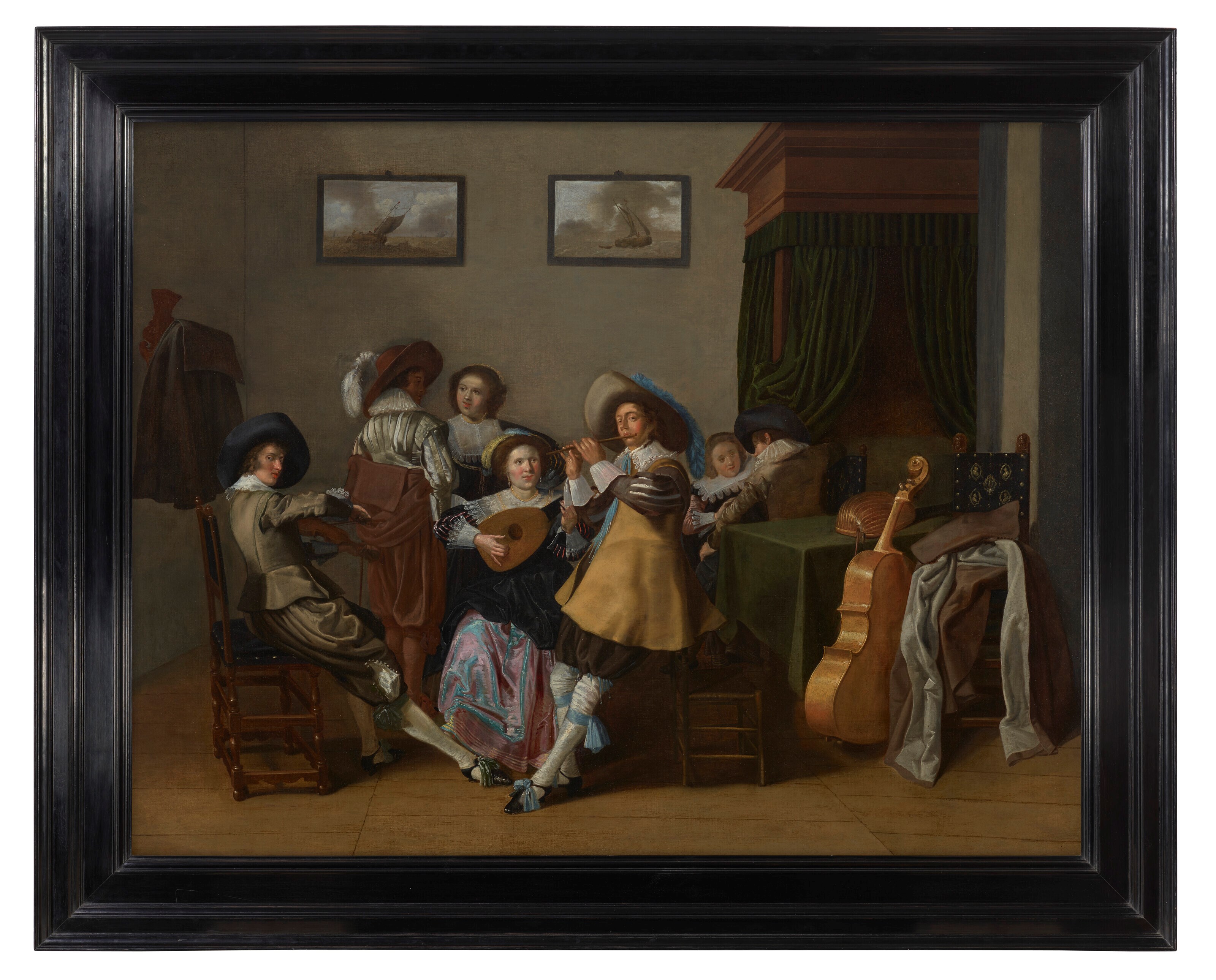
Lot 328
DIRCK HALS (HAARLEM 1591-1656)
A musical company in an interior
Closed31 January 2023
Estimate
USD 60,000–80,000
More Information
Specialist note
Little is known of Dirck Hals’ early education, but Arnold Houbraken relays that he studied with his elder brother, Frans. He may also have worked under the Rotterdam-born artist Willem Buytewech, who was active in Haarlem between 1612 and 1617 and was an early pioneer of the ‘merry company’, the subject matter for which Dirck is most known today. While Buytewech’s merry companies retained vestiges of the moralizing character of their sixteenth-century antecedents, particularly images depicting the Parable of the Prodigal Son, Hals translated the theme into a secular idiom that largely celebrates the joie de vivre of a carefree youth. To be sure, the fleeting strains of music emanating from the trio in front may have served as a reminder to some viewers of temporary nature of love, youth and beauty, but these issues are subordinated to a youthful exuberance captured by the artist’s virtuoso technical abilities.
The scale of this painting is unusual in Hals’ oeuvre, though by no means unprecedented. Further examples of similar scale are today in the Rijksmuseum, Amsterdam (inv. no. SK-A-1796) and Gemäldegalerie der Akademie der bildenden Künste, Vienna (inv. no. 684). A third, which was on long-term loan to the Frans Hals Museum, Haarlem, recently sold Christie’s, London, 8 July 2021, lot 22. Perhaps on account of its uncharacteristic scale, the painting long bore an attribution to Hals’ younger Haarlem colleague, Jan Miense Molenaer. However, Molenaer’s paintings of the 1630s are more rigidly composed than Hals’ and his figures lack their lightness of touch. In 2003, Britta Nehlsen-Marten, who only knew the painting from an old photograph, included it in her catalogue raisonné on Dirck Hals as an unsigned work by an artist in his circle. A recent cleaning revealed it to be an autograph work from the 1630s. Pieter Biesboer has suggested the painting belongs to a brief period in which Hals' coloring approaches that of Hendrick Pot, who had returned to Haarlem in 1633 following a short period in England (private communication, 23 November 2022).
We are grateful to Dr. Fred G. Meijer for endorsing the attribution following firsthand inspection of the painting and to Dr. Pieter Biesboer for independently endorsing it on the basis of photographs.