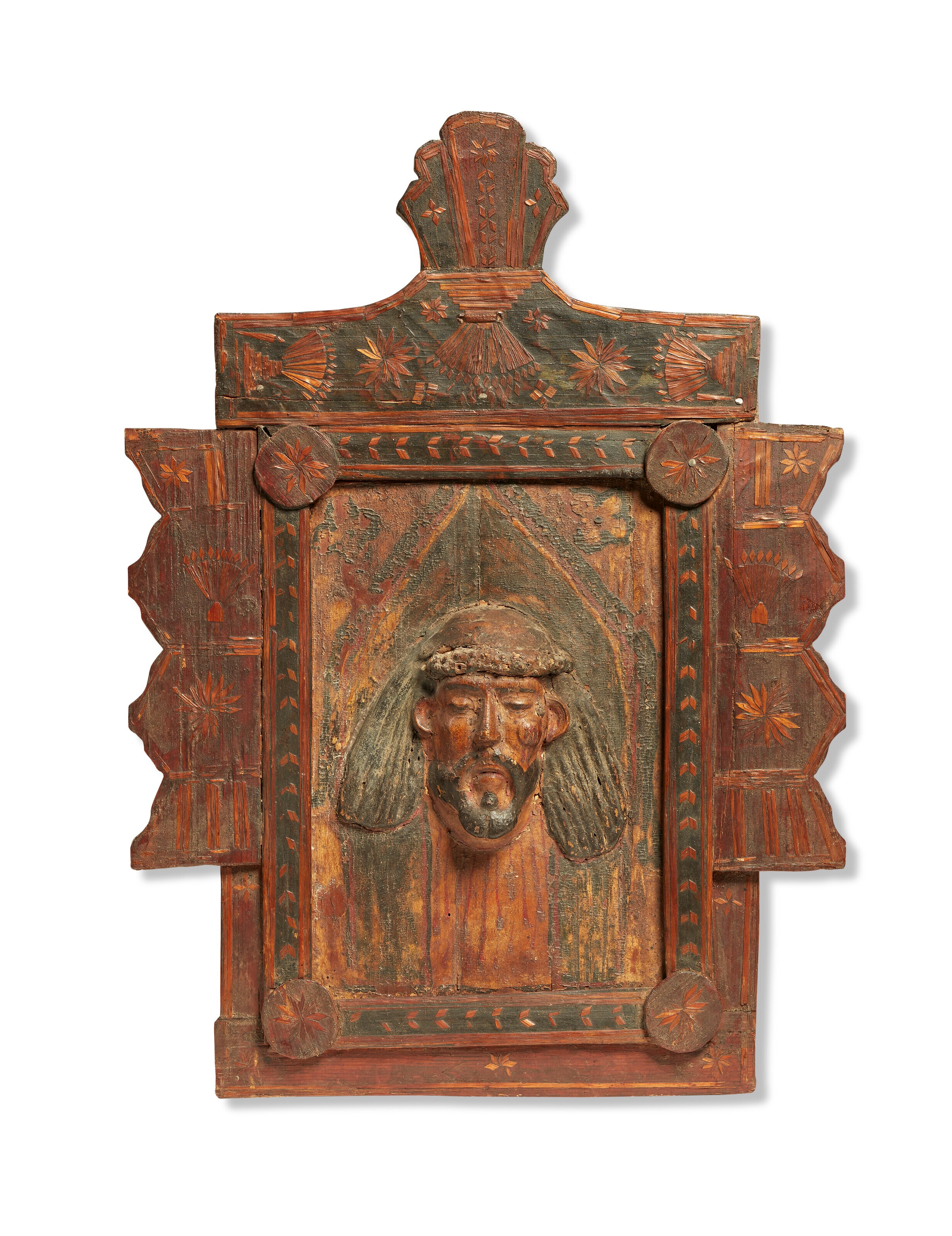
Lot 475
BAS-RELIEF REPRÉSENTANT LE VISAGE DU CHRIST
TRÈS PROBABLEMENT MEXIQUE, XIXe SIÈCLE
Closed28 November 2022
Price Realised
EUR 1,638
More Information
Specialist note
Cette intéressante tête du Christ est à rapprocher de celle ayant fait partie des collections de l'écrivain André Breton (1896-1966).
En voyage au Mexique en 1938 en compagnie de Diego Rivera et Frida Kahló, il fut touché par l'art populaire au point d'organiser à son retour à Paris une exposition mêlant des œuvres d'artistes contemporains dont certaines de son amie Frida Kahló, des photographies de Manuel Alvarez Bravo, des objets d'art précolombiens et des tableaux mexicains des XVIIIe et XIXe siècles (Galerie Renou et Colle, Paris, Mexique, 10-25 mars 1939). On comprend aisément l'attrait que l'écrivain put avoir pour ce pays, "lieu surréaliste" (voir M. Polizzotti, André Breton, Paris, 1999, p. 517), et cette civilisation où la religion et la mort ont une place particulière. Une tête de Christ proche de la notre mais sans son cadre, probablement le numéro 21 du catalogue de l'exposition de 1939, fit partie de sa collection dans son appartement du 42 rue Fontaine dans le IXe arrondissement de Paris. Elle fut vendue en 2003, suite au décès de son épouse (vente Mes Calmels et Cohen, Drouot, 7-17 avril 2003, lot 3292).
This interesting head of Christ is to be compared with the one that was part of the collections of the writer André Breton (1896-1966). On a trip to Mexico in 1938 with Diego Rivera and Frida Kahló, he was so touched by popular art that on his return to Paris he organised an exhibition combining works by contemporary artists, including some by his friend Frida Kahló, photographs by Manuel Alvarez Bravo, pre-Columbian art objects and Mexican paintings from the 18th and 19th centuries (Galerie Renou et Colle, Paris, Mexique, 10-25 March 1939). It is easy to understand the attraction that the writer had for this country, a "surrealist place" (see M. Polizzotti, André Breton, Paris, 1999, p. 517), and this civilisation where religion and death have a special place. A head of Christ similar to ours but without its frame, probably number 21 in the 1939 exhibition catalogue, was part of his collection in his flat at 42 rue Fontaine in the 9th arrondissement of Paris. It was sold in 2003, following the death of his wife (sale Mes Calmels and Cohen, Drouot, 7-17 April 2003, lot 3292).