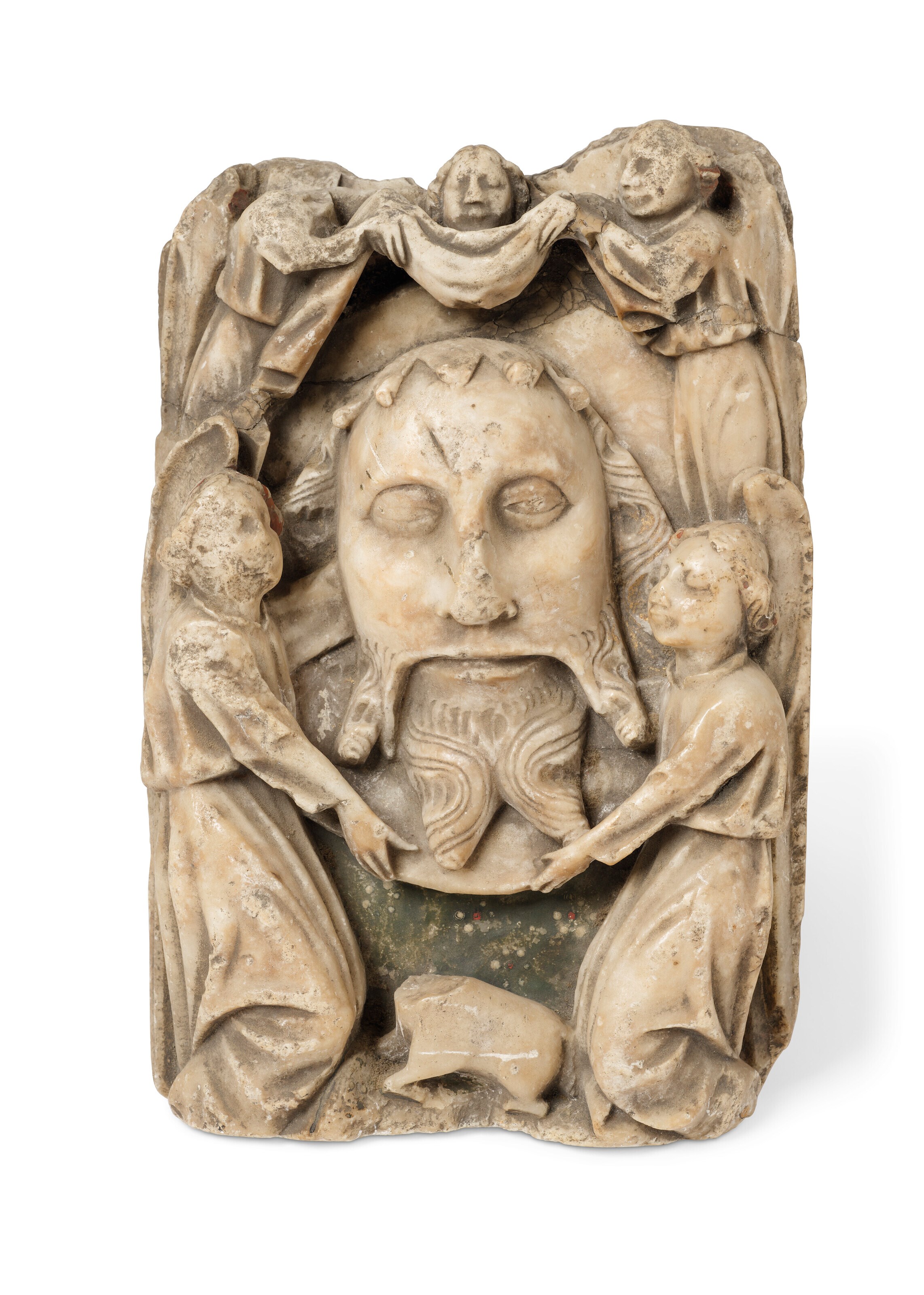
Lot 345
BAS-RELIEF REPRÉSENTANT LA TÊTE DE SAINT JEAN-BAPTISTE PORTÉE PAR DES ANGES
ANGLETERRE, NOTTINGHAM, XVe SIÈCLE
Closed28 November 2022
Estimate
EUR 8,000–12,000
More Information
Specialist note
Des exemples de Tête de saint Jean-Baptiste accostée d'anges et accompagnée de l'Agnus Dei sont décrits dans l'ouvrage de Francis W. Cheetham (op. cit. p. 318) comme du 'Type C' avec un comparable conservé au Victoria and Albert Museum de Londres (inv. A204-1946). Un relief donné par Henry P. McIlhenny au Philadephia Museum of Art reprend également une composition similaire (inv. 1962-67-8).
La production de reliefs en albâtre à Nottingham et dans le comté du Staffordshire a débuté au XIIe siècle. Dans un premier temps, la production était destinée à des figures funéraires, pour rapidement, vers 1340, s’étendre à des sculptures en ronde-bosse et des reliefs et panneaux de retables. La réputation des albâtres de Nottingham s’est répandue dans toute l’Europe et des documents d’archives attestent qu’ils étaient largement exportés. Comme F. Cheetham l’a démontré (loc. cit.) les albâtres anglais constituent une part importante de ce qui subsiste de l’héritage de l’art médiéval anglais.
Examples of the Head of St. John the Baptist flanked by angels with the Agnus Dei included are described by Cheetham (op. cit. p. 318) as ‘Type C’ with a comparable example held in the Victoria and Albert Museum, London (accession no. A204-1946). A relief, gift of Henry P. McIlhenny to the Philadelphia Museum of Art, has also a similar composition (accession no. 1962-67-8).
The production of alabaster reliefs in Nottingham and Staffordshire began in the 12th century. Initially, production was for funerary figures but, around 1340, it expanded to include low and high-reliefs and panels for altarpieces. The reputation of Nottingham alabaster spread throughout Europe and archival records show that it was widely exported. As Cheetham has mentioned (loc. cit.) English alabasters form an important part of the surviving legacy of English medieval art.