Lot 253PROPERTY OF A PRIVATE CANADIAN COLLECTOR
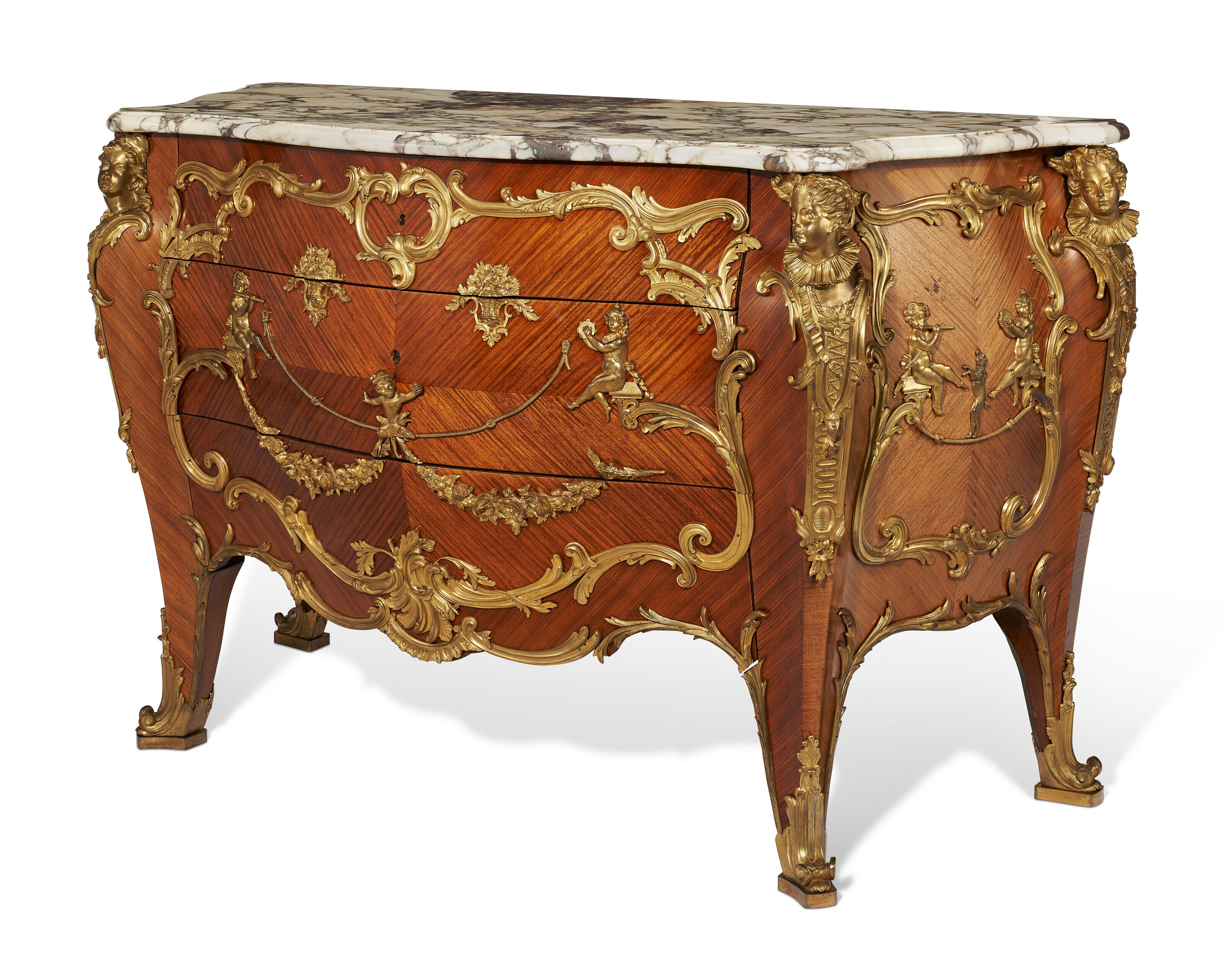
A LARGE FRENCH ORMOLU-MOUNTED KINGWOOD COMMODE
IN THE MANNER OF CHARLES CRESSENT, PARIS, LATE 19TH/EARLY 20TH CENTURY
Closed5 April 2022
Estimate
USD 20,000–30,000
More Information
Specialist note
This imposing commode is a fin de siècle interpretation of the playful sculptural style of the mid-18th century Régence which was manifested in Charles Cressent’s ‘commode aux enfants balançant un singe’, circa 1749-1755 now in the Louvre (OA 6868). The overall design, rooted in the 18th century fascination with ‘singerie’, inspired the pre-eminent cabinetmakers of the Second Empire and beyond, though the exact dating of the first copy in the 19th century remains somewhat shrouded in mystery. Christopher Payne refers to an unsigned copy bearing the lock-maker 'Souchet', whose workshop opened in 1835 and is closely associated with cabinetmakers of the Second Empire, specifically Charles-Guillaume Winckelsen (op. cit. p. 143). However, early 20th century scholarship suggests the earliest known examples could be potentially be linked to the 4th Marquess of Hertford, who appears to have either acquired or commissioned a pair of commodes, possibly from his preferred bronzier Charles Croaztier and foreman Carl Dreschler. By the late 19th century, the model had been produced by François Linke for his fellow ébéniste Antoine Krieger, an example of which is illustrated in P. Kjellberg Le meuble français et europeén du moyen âge à nos jours, Paris, 1991, p. 490.