Lot 183PROPERTY FROM A NEW YORK COLLECTION
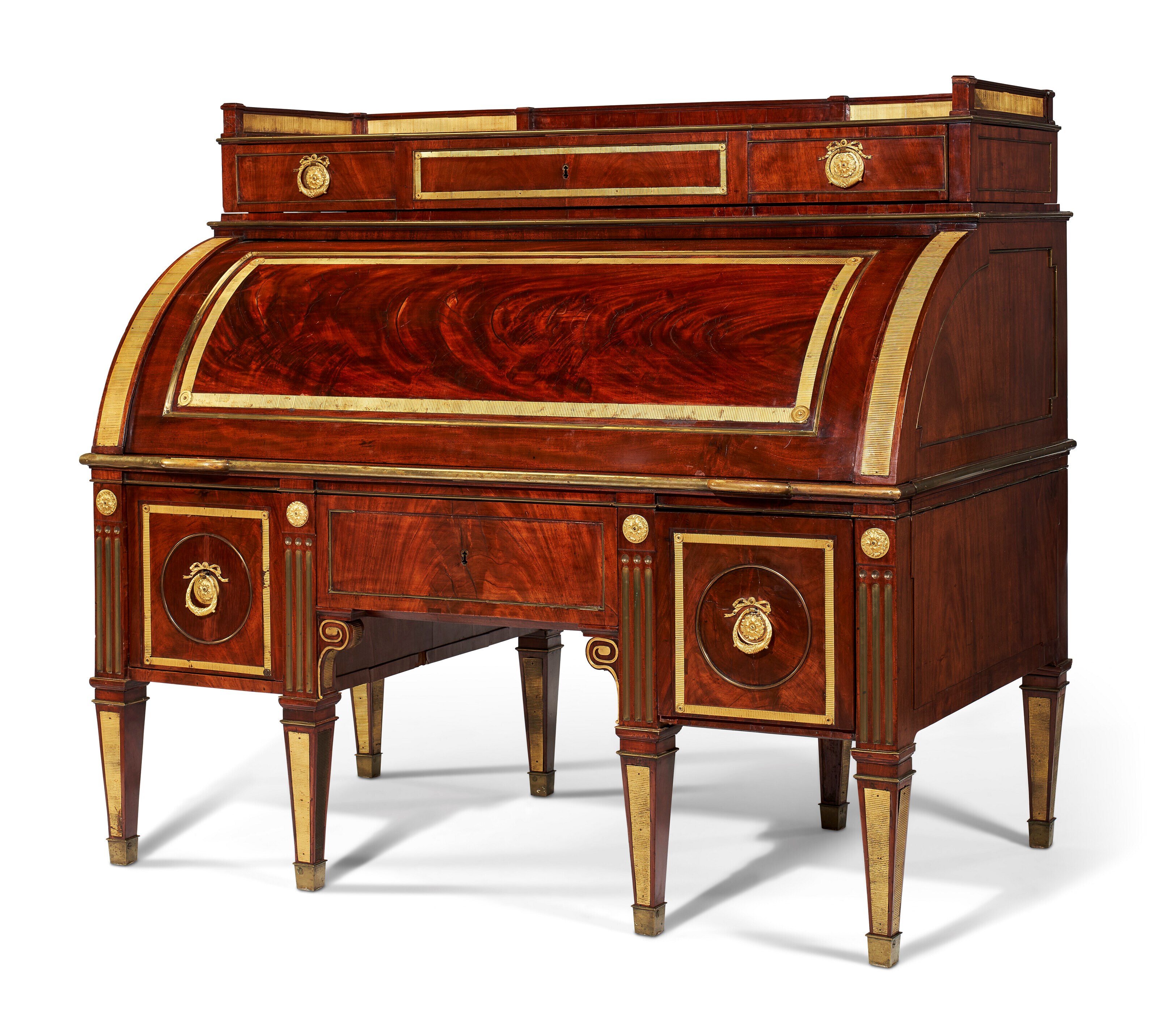
A GERMAN ORMOLU-MOUNTED MAHOGANY CYLINDER BUREAU
BY DAVID ROENTGEN, NEUWIED, CIRCA 1785
Closed5 April 2022
Price Realised
USD 151,200
More Information
Specialist note
Rollschreibtische, or bureaux à cylindre (roll top desks), were the most prestigious pieces of furniture made by David Roentgen in the 1780's. Evolved from the sinuous Klappschreibtisch with a shaped hinged flap, the earliest cylinder desk incorporates a roll top within a traditional rococo framework. Interestingly, some of these early examples appear as Tisch or Bureau à la Caunitz in Roentgen's invoices, named after the artistic Graf von Kaunitz, Austrian ambassador to Paris between 1750 and 1753, who has often been credited with inventing this mechanism. However, desks with a solid roll top only became more widely fashionable in Germany after circa 1770 and David Roentgen supplied his first example around 1772 to the Margrave of Baden for Schloss Mannheim, see R. Strattmann-Döhler, Mechanische Wunder Edles Holz, Roentgen-Möbel des 18. Jahrhunderts in Baden und Wüttemberg, Karlsruhe, 1998, pp. 98-101. Several closely related examples followed in the late Louis XV, Transitional and Louis XVI styles, which are either decorated with chinoiserie or floral marquetry, and after circa 1780, with figured mahogany with finely-chased ormolu mounts, such as the present lot. Roentgen accomplished his sensational conquest of the court of Empress Catherine the Great of Russia that reverberated all through Europe, by travelling to Saint Petersburg in 1783-1784 and offering the Empress a magnificent example, for which she paid him the princely sum of 25,000 roubles, 5,000 more than he had requested, see H. Huth, Roentgen Furniture, Abraham and David Roentgen, European Cabinet-makers, London and New York, 1974, pp. 20-21, fig. 63. He also supplied examples to Friedrich Wilhelm II of Prussia, to Louis XVI of France, and to his brother, the Comte de Provence, later Louis XVIII, whose wife also owned works by Roentgen, see note for lot 113 in this sale. The bureau sold to Louis XVI is probably the one now in the Royal Collection at Buckingham Palace (RCIN 293).
The present desk is a supreme example of Roentgen's confident, restrained manner that was so much appreciated by the most demanding patrons all over Europe. As on the lot 114 in this sale, the splendid mahogany veneers on this bureau are enhanced by finely chased ormolu mounts that were most likely supplied by the Paris in maître-doreur François Rémond. This desk also shares a number of similarities with the aforementioned royal bureaux. These include the small voluted arch in the kneehole that Roentgen used on the desk delivered for Friedrich Wilhelm II, see A. Stiegel, Präzision und Hingabe: Möbelkunst von Abraham und David Roentgen, Berlin, 2007, p. 99. In terms of overall composition, with its two large square drawers flanking a long narrow drawer, this bureau is arranged identically as the one delivered for the Garde Meuble in 1784 and now at Versailles, see Greber, op. cit., fig. 660. The Versailles bureau, along with the example in the Royal Collection, are both decorated with the same ormolu roundels above each leg that can be found on the present desk.
The present desk is a supreme example of Roentgen's confident, restrained manner that was so much appreciated by the most demanding patrons all over Europe. As on the lot 114 in this sale, the splendid mahogany veneers on this bureau are enhanced by finely chased ormolu mounts that were most likely supplied by the Paris in maître-doreur François Rémond. This desk also shares a number of similarities with the aforementioned royal bureaux. These include the small voluted arch in the kneehole that Roentgen used on the desk delivered for Friedrich Wilhelm II, see A. Stiegel, Präzision und Hingabe: Möbelkunst von Abraham und David Roentgen, Berlin, 2007, p. 99. In terms of overall composition, with its two large square drawers flanking a long narrow drawer, this bureau is arranged identically as the one delivered for the Garde Meuble in 1784 and now at Versailles, see Greber, op. cit., fig. 660. The Versailles bureau, along with the example in the Royal Collection, are both decorated with the same ormolu roundels above each leg that can be found on the present desk.