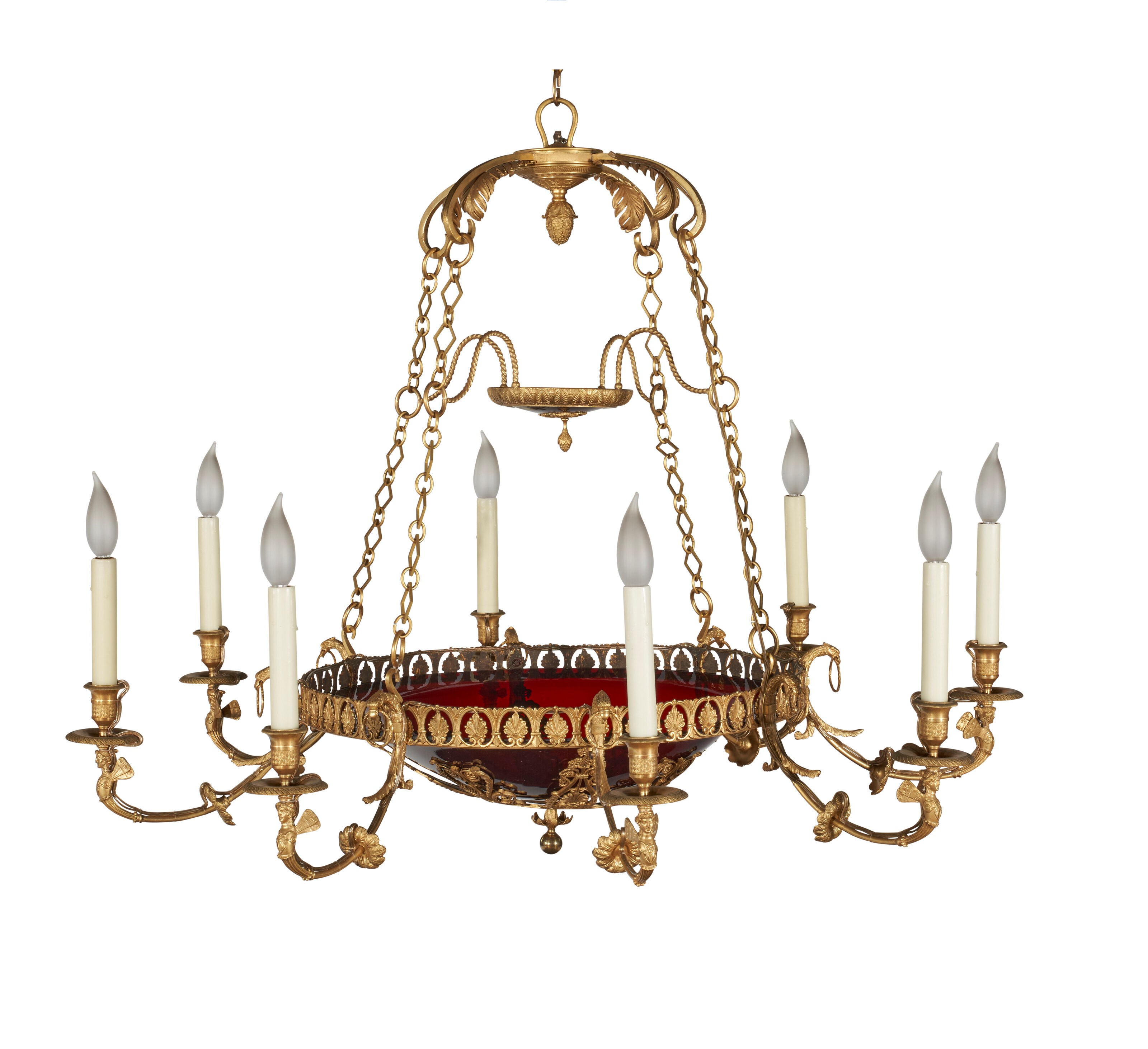
Lot 103CHICAGO CLASSICAL: A PRIVATE COLLECTION
A RUSSIAN ORMOLU AND RUBY GLASS EIGHT-LIGHT CHANDELIER
PROBABLY ST. PETERSBURG, CIRCA 1800
Closed5 April 2022
Estimate
USD 10,000–15,000
More Information
Specialist note
While influenced by neoclassical English chandeliers, the distinguishing feature of chandeliers produced in Russia in the late eighteenth century were the exquisite colored glass elements which they incorporated. These were typically one of three colors: cobalt blue, ruby red or emerald green. These colored glass sections were mostly produced in the Imperial Glassworks of St. Petersburg, which in 1792 employed more than 200 workers. Ruby glass was probably first developed in Russia by the eminent scientist Mikhail Lomonosov (1711-1765), who provided recipes for colored glass to the Imperial Glass Factory in 1752. Pyotr Druzhinin, Sidor Yurasov and Ivan Khyrov are also known to have mastered techniques for colored glass around 1770 (N. Asharina et. al., Russian Glass, Moscow, 1990, p. 22). Colored glass remained among the most prized products of the Imperial Glass Factory throughout the late 18th and 19th Centuries.