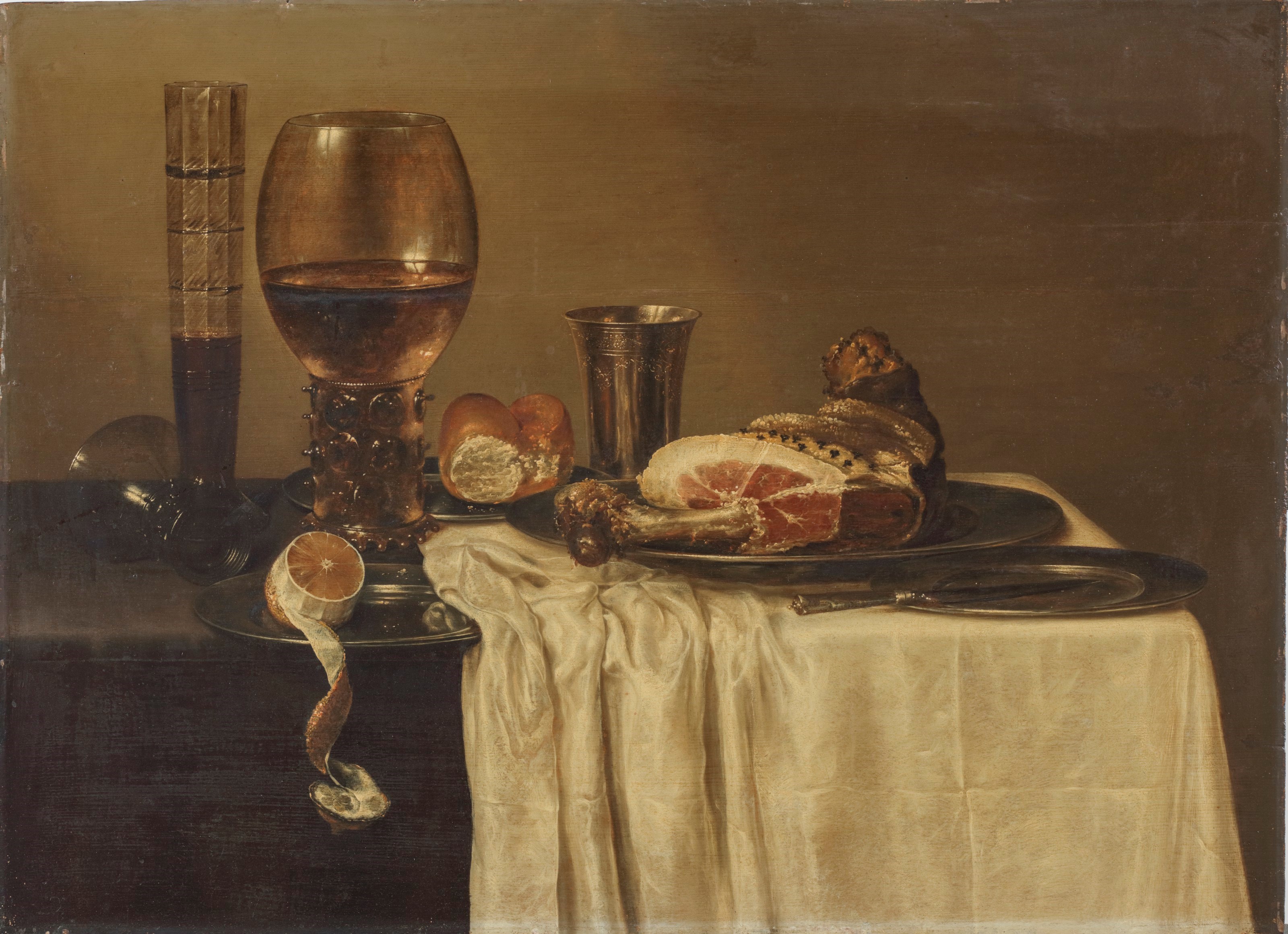
Lot 32PROPERTY FROM A DISTINGUISHED PRIVATE COLLECTION
Maerten Boelema de Stomme (Leeuwarden 1642-in or after 1644)
A ham on a pewter plate, a partly-peeled lemon, a roemer, a beer flute, a wine glass, a bread roll, a silver engraved cup and a knife on a pewter plate on a partly-draped table
Closed6 October 2021
Price Realised
EUR 43,750
More Information
Specialist note
Maarten Boelema was a native from Friesland and known as ‘de Stomme’ (the mute). In 1642, he was recorded in Haarlem as a pupil of Willem Claesz. Heda and enlisted in the Haarlem Guild.
His dated works span a mere two years, 1642-44, during which time he painted still lifes that were markedly influenced by Heda and Haarlem artists like Pieter Claesz. and Gerret Willemsz. Heda, with whom Boelema shared a particular interest in the depiction of hams, tazzas and roemers. The motif of a ham was indeed so popular in still lifes, that seventeenth-century inventories frequently listed works such as the present lot as ‘hammetjes’.
Bearing the inscription ‘HEDA’ on the knife blade, this nicely preserved composition has been regarded as by Willem Claesz. Heda in the past. However, Dr. Fred Meijer, to whom we are grateful, has attributed the picture to Boelema de Stomme and proposes on the basis of images a date of circa 1643.