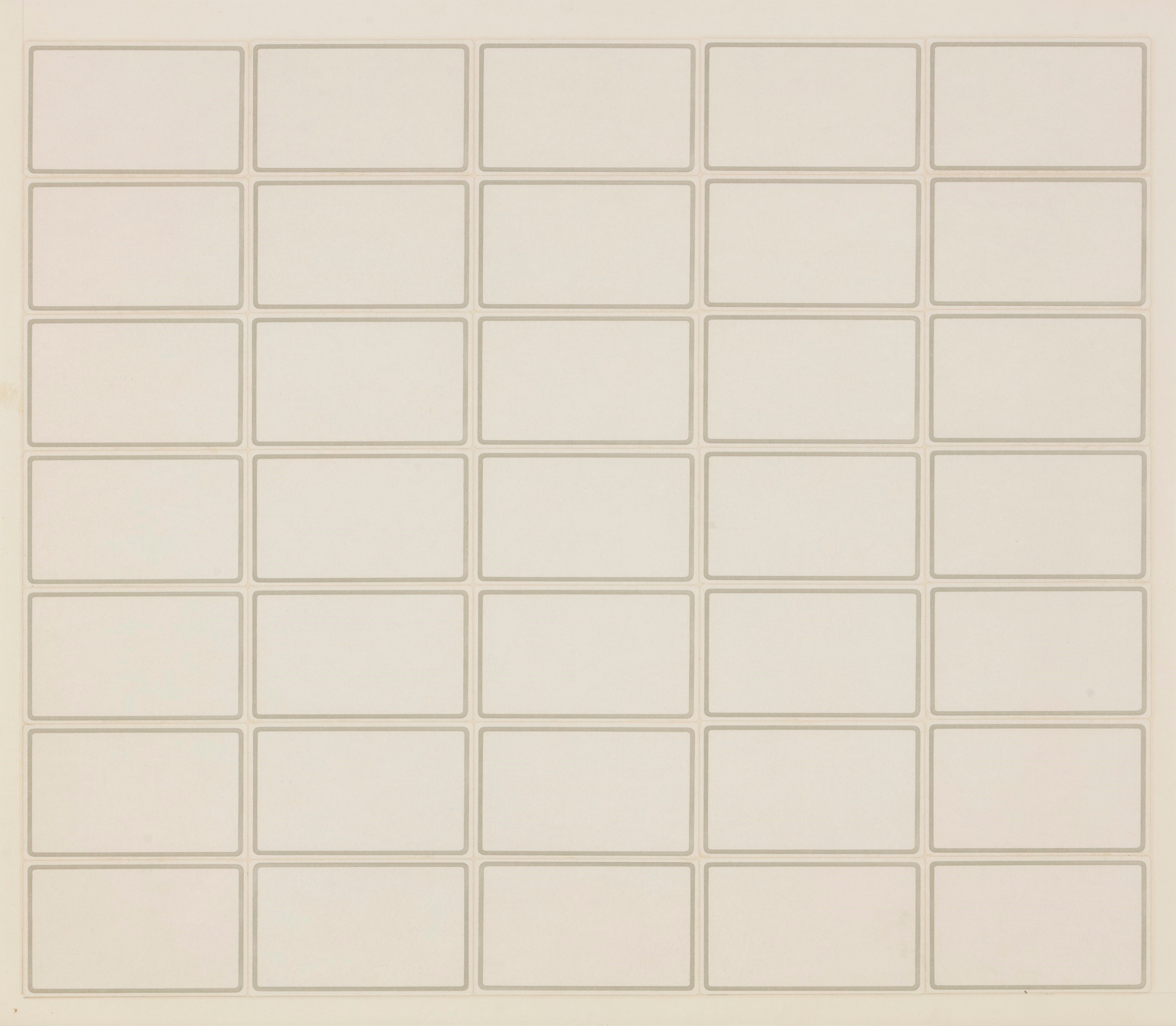
Lot 24
Peter Roehr (1944-1968)
Untitled (OB-107)
Closed25 May 2021
Price Realised
EUR 30,000
More Information
Specialist note
Created in 1967 – the year before Peter Roehr’s untimely death at the age of 23 – Untitled (OB-107) exemplifies the artist’s conceptual, serial language. The work consists of 35 adhesive labels affixed in neat rows to a piece of card, forming a pure monochrome grid. Throughout his prolific yet tragically brief career, Roehr explored the aesthetics of order and repetition, inspired by fields ranging from thermodynamics to Zen Buddhism. Using primarily industrial, manmade materials, he sought to highlight the levelling of energy that occurs when equal units are assembled together in so-called ‘montages’ – be it photographs, objects, film fragments, letters or sounds. ‘I believe that everything conceals within itself comprehensible qualities which we nevertheless seldom perceive’, he explained. ‘When we perceive a thing several times in a row … we notice these characteristics’ (P. Roehr, notes from 1965). Other examples from this particular series are held in the Städel Museum, Frankfurt am Main and the Staatliche Kunsthalle Karlsruhe.
Born in Lauenburg in 1944, Roehr studied at the Werkkunstschule in Wiesbaden. He was close to Frankfurt-based artists Thomas Bayrle and Charlotte Posenenske, and in 1964 struck up a friendship with Paul Maenz, who would go on to become one of the most influential German gallerists of the period. Together – in the year of the present work – Roehr and Maenz curated the pioneering group show Serielle Formationen (Serial Formations) at Frankfurt’s Goethe University. The exhibition showcased the work of artists such as Carl Andre, Dan Flavin, Donald Judd and Agnes Martin, many of whom had never been exhibited in Germany before. Roehr’s work certainly takes its place within the context of these figures: today he is widely considered a key progenitor of Minimal and Conceptual art.
Born in Lauenburg in 1944, Roehr studied at the Werkkunstschule in Wiesbaden. He was close to Frankfurt-based artists Thomas Bayrle and Charlotte Posenenske, and in 1964 struck up a friendship with Paul Maenz, who would go on to become one of the most influential German gallerists of the period. Together – in the year of the present work – Roehr and Maenz curated the pioneering group show Serielle Formationen (Serial Formations) at Frankfurt’s Goethe University. The exhibition showcased the work of artists such as Carl Andre, Dan Flavin, Donald Judd and Agnes Martin, many of whom had never been exhibited in Germany before. Roehr’s work certainly takes its place within the context of these figures: today he is widely considered a key progenitor of Minimal and Conceptual art.