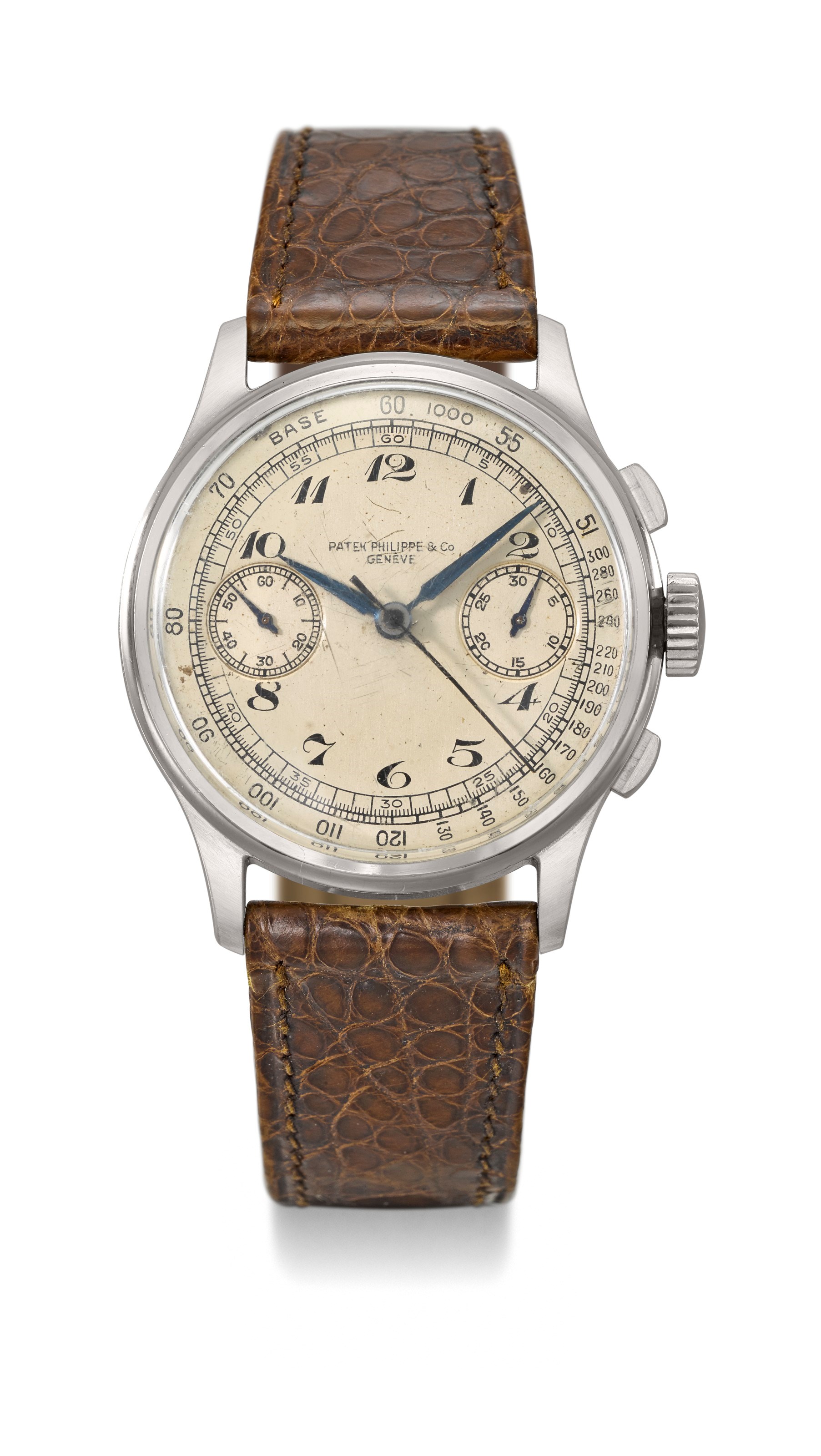
Lot 381The Property of a Private European Collector
PATEK PHILIPPE, STEEL CHRONOGRAPH WRISTWATCH WITH BREGUET NUMERALS, REF. 130
MOVEMENT NO. 860'494, CASE NO. 653'977
Closed18 May 2021
Price Realised
CHF 52,500
More Information
Specialist note
Privately consigned, this recently discovered reference 130 is a highly attractive timepiece, combining a stainless steel case and a hard enamelled Breguet numerals dial, a classic Patek Philippe chronograph for the collector.
Patek Philippe vintage wristwatches cased in stainless steel are unquestionably what almost every watch aficionado would like to own. Made in far fewer numbers than their precious metal equivalents, vintage steel chronographs in particular are practically always the rarest examples among their references and the reference 130 is certainly no exception. Of the almost 1500 pieces made of the model, only 270 were cased in steel and only just over 100 are known to exist today. The discovery of a previously unrecorded example such as the present watch is a very rare event indeed.
Research into the present ref. 130 shows that within about 15 years of its sale in 1938, it underwent some interesting changes. Fundamentally, the watch is as confirmed by the Extract from the Archives, fitted with a steel case and silvered dial with tachymeter scale, both of which it has today.
However, the Extract also states that “the original case was replaced with the above one during a servicing in our workshops”. Although the date of this replacement is not mentioned, further research indeed confirms that the case is made by master case maker André Wenger and delivered to Patek Philippe in 1949.
Close inspection of the very attractive Breguet numeral dial suggests that it also dates from the late 1940s due to the signature style and the fact that it has the dial maker Stern Frères punched numbers on the back, starting ‘93’ for Patek Philippe, a system only introduced around 1943-44.
It is evident that this charming chronograph is an ‘honest’ survivor of over 80 years of use, its replacements seemingly done for purely practical reasons along the way. Clearly bought by its original owner as a working instrument, it is certainly a possibility that it suffered major damage during the War years and was subsequently returned to Patek Philippe in the late 1940s to be fully recommissioned.
We are indebted to Eric Tortella for his assistance with the research of this rare timepiece..
Reference 130
Reference 130, one of Patek Philippe's landmark models, was launched in 1934 and remained in production until the 1960s. Distinguished by its timeless "Calatrava" design, the model was available in different precious metals as well as in stainless steel.
It is interesting to note that the lugs of the stainless steel version are different from the yellow, pink or white gold ones. Their slightly thicker but shorter design gives the watch a rather tonneau-shaped design and a more sportive, robust and masculine look.
Examples of steel ref. 130 with sector dials are illustrated in: ‘Patek Philippe Steel Watches’ by John Goldberger, pp. 212-223.