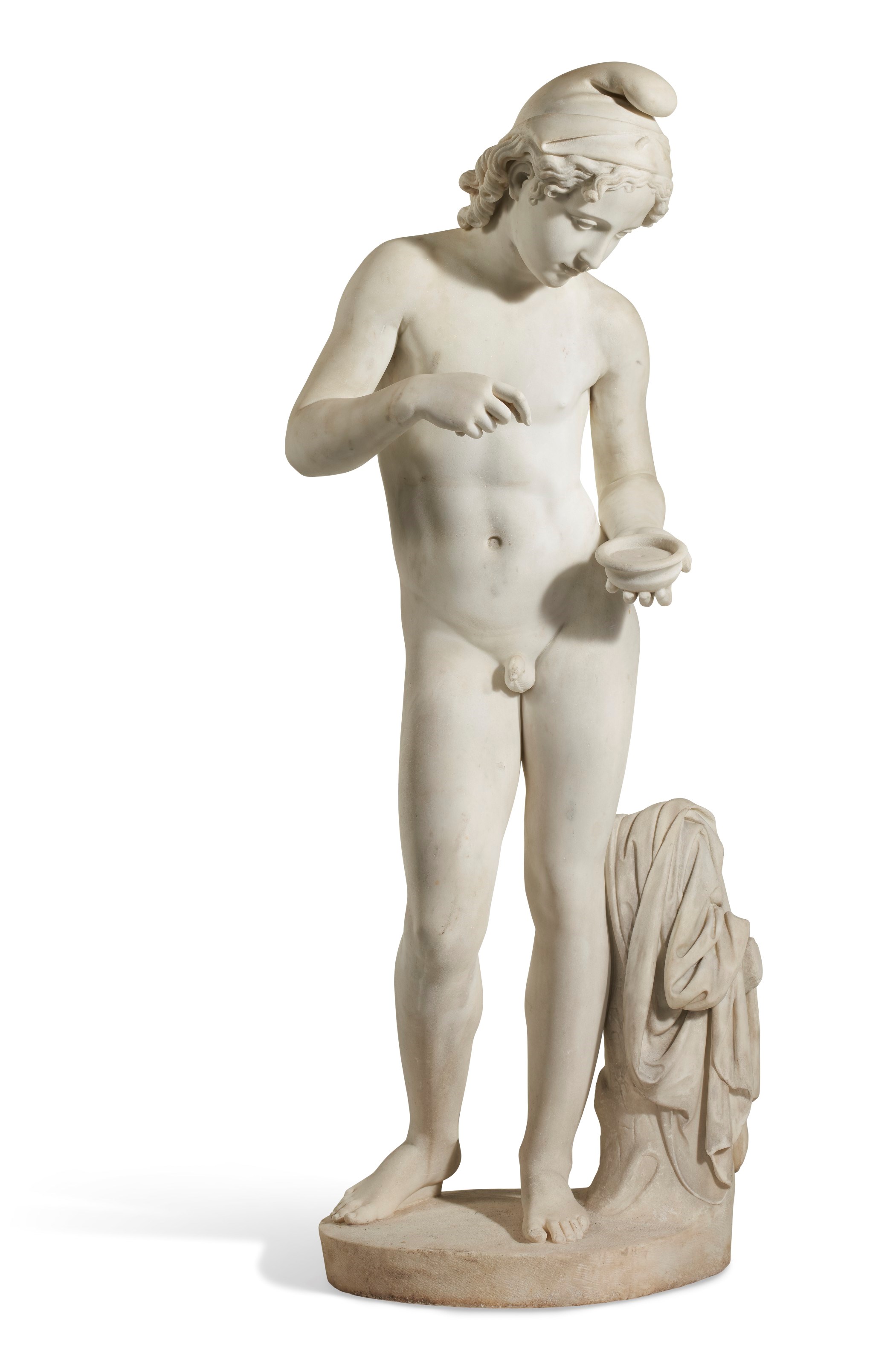
Lot 63
A WHITE MARBLE FIGURE OF A YOUTH, POSSIBLY PARIS OR GANYMEDE
ATTRIBUTED TO RUDOLF SCHADOW (1786-1822), 1810
Closed23 April 2021
Price Realised
USD 375,000
More Information
Specialist note
COMPARATIVE LITERATURE
G. Eckardt, Ridolfo Schadow: Ein Bildhauer in Rom zwischen Klassizismus und Romantik, Köln, 2000, pp. 76-78
Schadow was one of the most talented and original 19th century sculptors, and whose work was both contemporary with and closely related to, the most famous sculptors of the late 18th and early 19th century, Antonio Canova and Bertel Thorvaldsen. The present marble is a brilliantly-carved and conceived example of Northern neoclassicism, cool and emotionally restrained and, at the same time, an incredibly intimate and sensitive portrait of a young boy.
The son of a famous sculptor and the brother of a famous painter, Schadow was raised in an intensely artistic and sophisticated milieu. His father, Johann Gottfried Schadow (1764-1850), after studying in Italy, was named Court Sculptor to the Prussian court at Berlin in 1788 and Secretary of the Prussian Academy of Art. For the next sixty years he produced hundreds of royal, ecclesiastical and public sculptural commissions, including the iconic Quadriga atop Berlin's Brandenburg Gate. Ridolfo Schadow’s sculpture, like his father’s, was formed by Italy and the staggering treasures of Greek and Roman Sculpture on view – as well as the lively Grand Tourist trade which brought Europe’s most important living sculptors to the Eternal City.
The present model appears to be unpublished, but it relates closely to Schadow’s figure of Paris documented to 1811, just one year later than the present marble. Paris was a popular model with bronze versions still being cast into the mid-1820s and they remain in the collections of Graf von Schönborn-Wiesentheid, Schloss Weissenstein and the Prussian royal family at Schloss Charlottenhof, Potsdam.