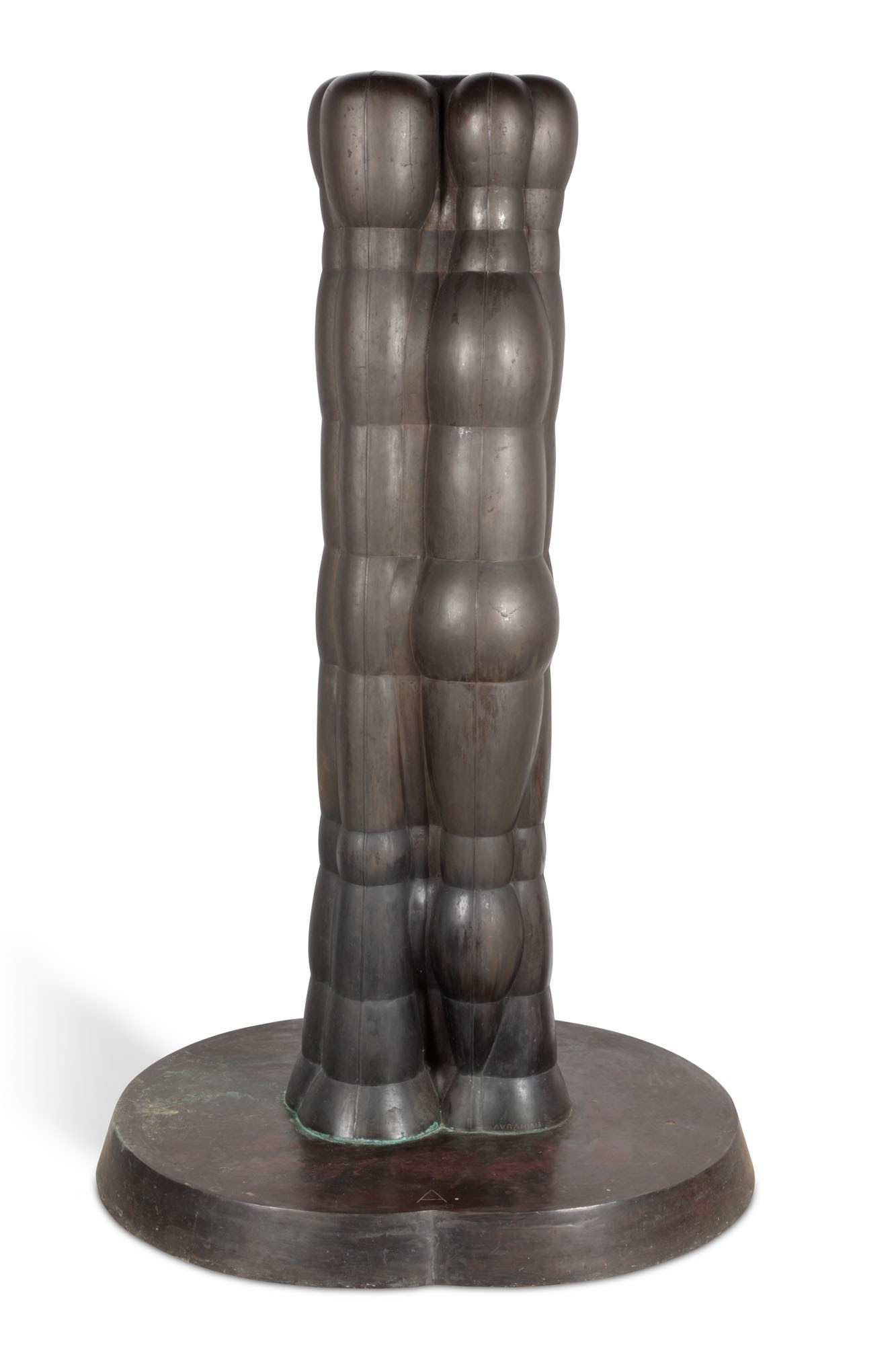
Lot 50
Joannis Avramidis (1922-2016)
Zweifigurengruppe B
Closed26 November 2020
Price Realised
EUR 112,500
More Information
Specialist note
Created in 1963 – the year after he represented Austria at the 31st Venice Biennale, and shortly before his first participation in documenta, Kassel – Zweifigurengruppe B is an imposing example of Joannis Avramidis’ distinctive sculptural practice. Cast in dark patinated bronze, a columnar figure stands over 1.5 metres in height, formed of swelling, softly cylindrical shapes that echo the curves of the human body. They blur organically together and fan outward, as if condensing plural bodies into one abstract totem. It is a stylised, de-individualised apparition, reflective less of a silhouette than of the body’s internal space. Avramidis’ work was defined by a quest for this essential figure. Born in the Soviet Union to Pontic Greek parents, he drew freely on his Hellenic heritage, referring to both Classical antiquity and the early Renaissance in his search for absolute form. These were eras when the divine proportion of the human body was held to be the measure of all things: Avramidis sought to express the same sense of the figure as a distillate of universal power, his works echoing archaic sculpture as much as the abstract formal purity of Modernists like Constantin Brâncuși.
As is typical of Avramidis’ style, Zweifigurengruppe B’s bodily elements are connoted solely by horizontal segmentation, creating a refined, pillar-like figure as reminiscent of architecture, stalagmite or tree-trunk as of human limbs and muscles. Staged as a conglomerate of stacked, modular volumes, this body seems perhaps capable of stretching to infinity, and might ultimately be seen to envision the spirit beyond the flesh as an avatar of ageless permanence. While harking back to antiquity, Zweifigurengruppe B is a resolutely contemporary presence. At once minimal and expansive, austere and sensuous, it epitomises the work of Austria’s foremost twentieth-century sculptor.
As is typical of Avramidis’ style, Zweifigurengruppe B’s bodily elements are connoted solely by horizontal segmentation, creating a refined, pillar-like figure as reminiscent of architecture, stalagmite or tree-trunk as of human limbs and muscles. Staged as a conglomerate of stacked, modular volumes, this body seems perhaps capable of stretching to infinity, and might ultimately be seen to envision the spirit beyond the flesh as an avatar of ageless permanence. While harking back to antiquity, Zweifigurengruppe B is a resolutely contemporary presence. At once minimal and expansive, austere and sensuous, it epitomises the work of Austria’s foremost twentieth-century sculptor.