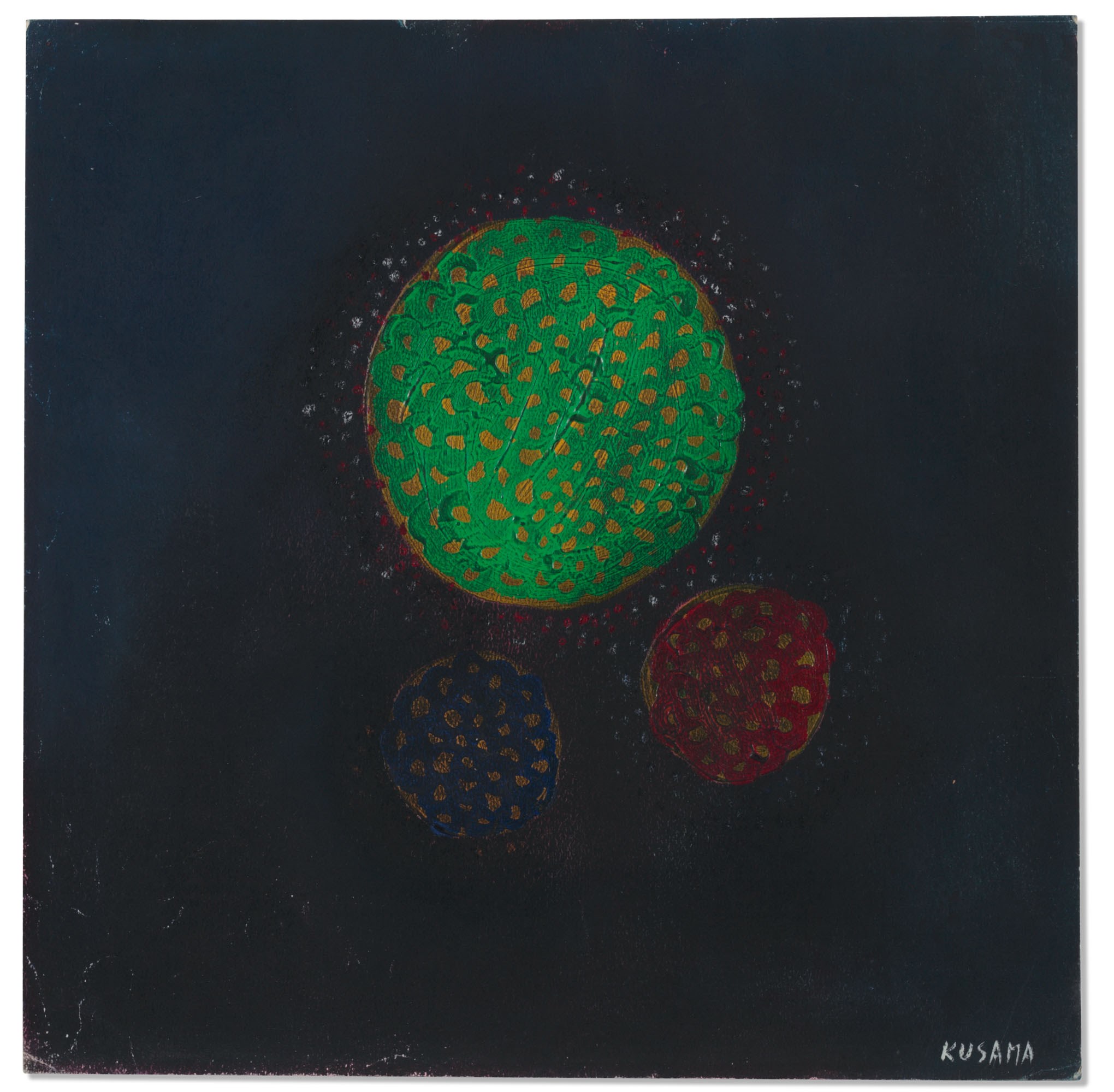
Lot 23PROPERTY FROM THE COLLECTION OF THE LATE BETTY VAN GEEST-VAN GARREL
Yayoi Kusama (b.1929)
Stars
Closed26 November 2020
Price Realised
EUR 187,500
More Information
Specialist note
Held for over half a century in the collection of celebrated Dutch journalist and writer Betty van Garrel, Shoe (1965) (lot 29) and Stars (1953) (lot 26) stem from the revolutionary early years of Yayoi Kusama’s practice. Acquired by van Garrel from Gallery OREZ in The Hague in 1965, they capture the major painterly and sculptural themes that would form the matrix of the artist’s output over the following decades.
Created in New York, where Kusama had moved in 1957, Shoe (lot 29) belongs to the early series of phallic sculptures that dominated her practice during the 1960s. Three biomorphic forms, made from stuffed and sewn fabric, protrude from the interior of a gold-painted stiletto. Kusama began this cycle of sculptures with the 1962 work Accumulation No. 1 (Museum of Modern Art, New York) – a chair covered in white fabric appendages – and would go on to apply these forms to a number of other objects including ladders, sofas and bottles. Kusama’s deliberately carnal imagery served as a way of exploring and overcoming her own sexual neuroses and phobias, instilled during a repressed and traumatic childhood. Inviting comparison with the bodily fabric sculptures of Louise Bourgeois, these overt creations set her apart from the male-dominated circles of 1960s New York, positioning her at the forefront of feminist practice. At the same time, their use of everyday objects tapped into the legacy of Dada: a heritage that found expression elsewhere in the contemporary currents of Pop Art, or even in the bristling nail sculptures of Günther Uecker.
The obsessive proliferation of singular motifs in this manner would become a defining feature of Kusama’s practice, finding important expression in her seminal installation Narcissus Garden at the Venice Biennale the following year. The mode of creation also underpinned her ground-breaking Infinity Net paintings, characterised by their seemingly endless webs of tiny repeated dots. Executed in 1953, while the artist was still living in Japan, Stars (lot 26) represents a vivid precursor to this series of works. Kusama’s use of the polka dot motif – now synonymous with her oeuvre – was based on hallucinations she suffered as a child, in which coloured dots covered her body and surroundings. In her paintings, it became a means of looking beyond her personal psychological struggles, obliterating her physical and mental being into the infinite expanse of time and space. ‘Our earth is only one polka dot among a million stars in the cosmos’, she explained. ‘Polka dots are a way to infinity’ (Y. Kusama, Manhattan Suicide Addict, Tokyo 1978).