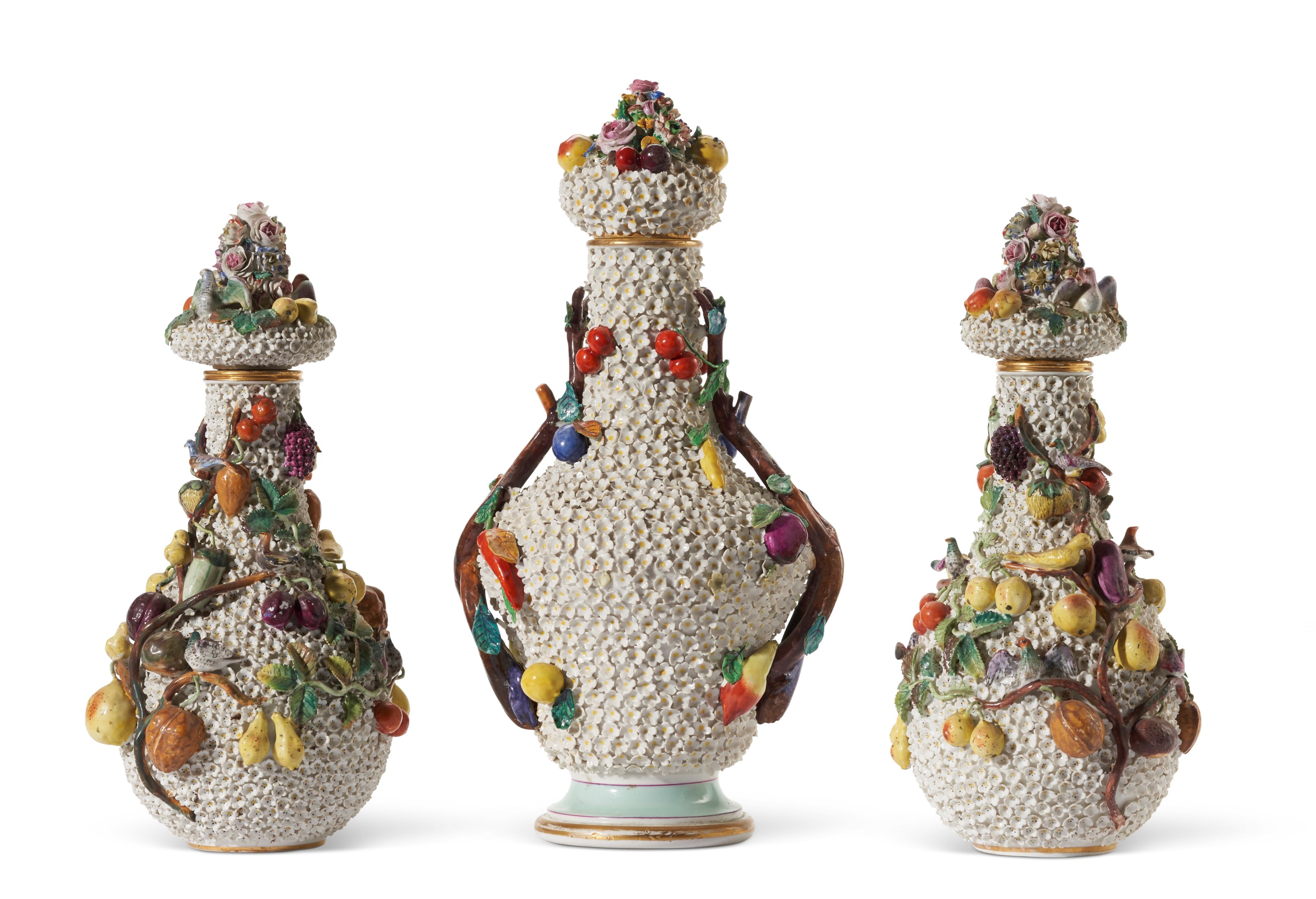
Lot 262PROPERTY FROM THE ESTATE OF FRANK FASULLO
ASSEMBLED FRENCH PORCELAIN SCHNEEBALLEN GARNITURE
MID-19TH CENTURY, THE PAIR JACOB PETIT, ONE WITH BLUE J.P. MARK
Closed20 August 2020
Price Realised
USD 1,375
More Information
Specialist note
Jacob Petit or Mardochée (1796-1868) was a French ceramicist active in the first half of the 19th century. After studying with the neoclassical painter Antoine-Jean Gros, Petit made a tour of Europe and England, where he found he had a great appreciation for decorative design. He published a collection of interior decoration around 1830, and soon after began to feel that porcelain was best suited to express his artistic tastes. Using his wife’s maiden name, Petit, by 1834 Jacob and his brother had established a factory outside of Fontainebleau, and that same year they received an honorable mention at the L’exposition des produits de l’industrie nationale. Specializing in hard-paste porcelain decorated in the flamboyant neo-rococo style, by the 1839, they were a commercial success, and received a bronze medal at the exposition that year. The antithesis of the controlled forms being produced at the national porcelain manufactory at Sèvres, Jacob Petit’s exuberance struck a chord with the buying public, and they soon employed over 150 people, plus another 60 workers for decoration alone.
As is unfortunately often the case, Jacob Petit became a victim of its own success. Poor control inventory control and over expansion proved a problem. With creditors clamoring for payment, Jacob Petit was forced to declare bankruptcy, although production on a reduced scale continued into the next decade. Vases applied with fowers and fgures applied with porcelain lace, a technique developed by Jacob Petit, were exhibited at the Exposition des produits de l’industrie of 1849 and awarded a silver medal. By 1851, the factory at Fontainbleau was reduced in size and relocated to nearby Avon. Despite these reductions, Jacob Petit still displayed works at the 1851 Crystal Palace exhibition in London, and in the Exposition universelle of 1855, including baskets, lithophanes and ormolu-mounted lanterns. In 1862 Mardochée retired, selling his business to his employee Jacquemin.
As is unfortunately often the case, Jacob Petit became a victim of its own success. Poor control inventory control and over expansion proved a problem. With creditors clamoring for payment, Jacob Petit was forced to declare bankruptcy, although production on a reduced scale continued into the next decade. Vases applied with fowers and fgures applied with porcelain lace, a technique developed by Jacob Petit, were exhibited at the Exposition des produits de l’industrie of 1849 and awarded a silver medal. By 1851, the factory at Fontainbleau was reduced in size and relocated to nearby Avon. Despite these reductions, Jacob Petit still displayed works at the 1851 Crystal Palace exhibition in London, and in the Exposition universelle of 1855, including baskets, lithophanes and ormolu-mounted lanterns. In 1862 Mardochée retired, selling his business to his employee Jacquemin.