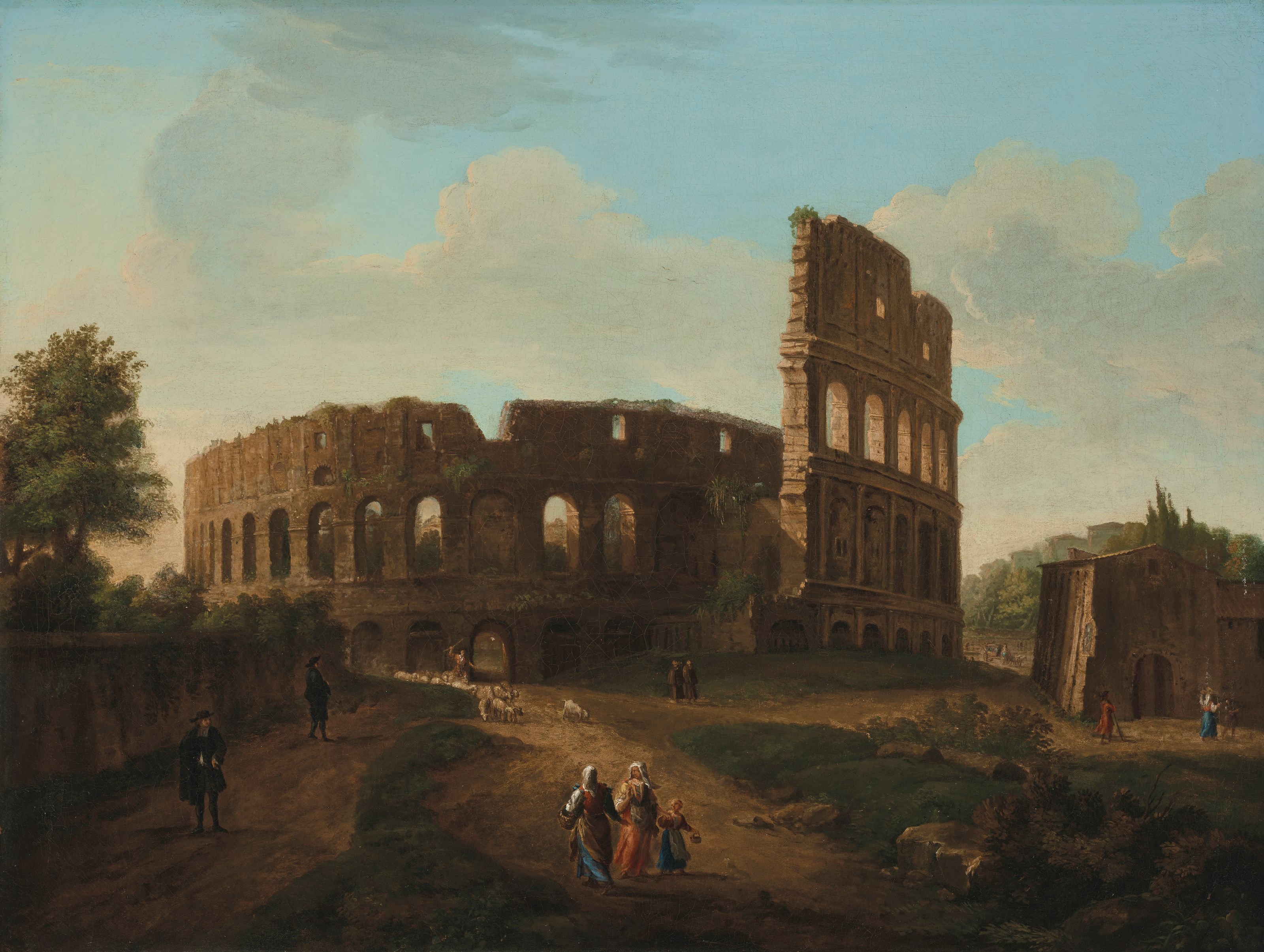
Lot 37PROPERTY FROM THE COLLECTION OF VANNA WHITE
Gaspar van Wittel, called Vanvitelli (Amersfoort 1653-1736 Rome)
A View of the Colosseum, Rome, with the Esquiline Hill beyond
Closed19 June 2020
Price Realised
USD 50,000
More Information
Specialist note
First recorded in Rome in 1675, Vanvitelli remained in the city for the majority of his career, making only brief visits to Venice and northern Italy and a more protracted stay in Naples from 1700-1701. The painter propounded a directness of observation and originality of viewpoints in his oeuvre, an approach without precedent in the history of vedute painting in Italy. The artist’s elegant compositions encompassed panoramic views of the city, combined with careful and meticulous observation of the topography, masterfully enlivened by subtle variations of sunlight and shadow.
Documenting the great Italian cities in this manner, Vanvitelli’s work was in frequent demand, and he often repeated popular views to satisfy patronal demand. The present composition is known in at least two other canvases, both dated to around 1700. The first is a much larger picture now in the Harvard Art Museums, which similarly shows the Colosseum from the south-east, looking toward the Esquiline Hill in the distance at the right. In the Harvard painting, the trees at the left of the composition are reduced, allowing the top of the Arch of Constantine to be shown. The other version, slightly smaller than the present work, is in the collection of Christchurch Art Gallery, New Zealand, and possesses a tonality and treatment of light more closely related to the present work. All three compositions appear to have relied upon a sketch by the artist in ink and watercolour (ruled with pencil), dated 1685 (fig. 1; Rome, Biblioteca Nazionale Centrale).
The painting is first recorded in the collection of James Smith of Jordanhill, a prominent merchant, antiquarian, architect, geologist, and man of letters. In 1818, Smith, accompanied by his wife Mary Wilson and their children, undertook a tour of the Continent, staying in Rome where they were joined by Joan Glassell (c.1775-1828), second wife of John Campbell, 7th Duke of Argyll (1777-1847), and the mother of the 8th Duke (D. McKenzie Robertson, From Roucan to Riches: The Rise of the Glassell Family, Leicester, 2020, pp. 153-4). It is likely that Smith may have purchased the present work during his sojourn in Rome.