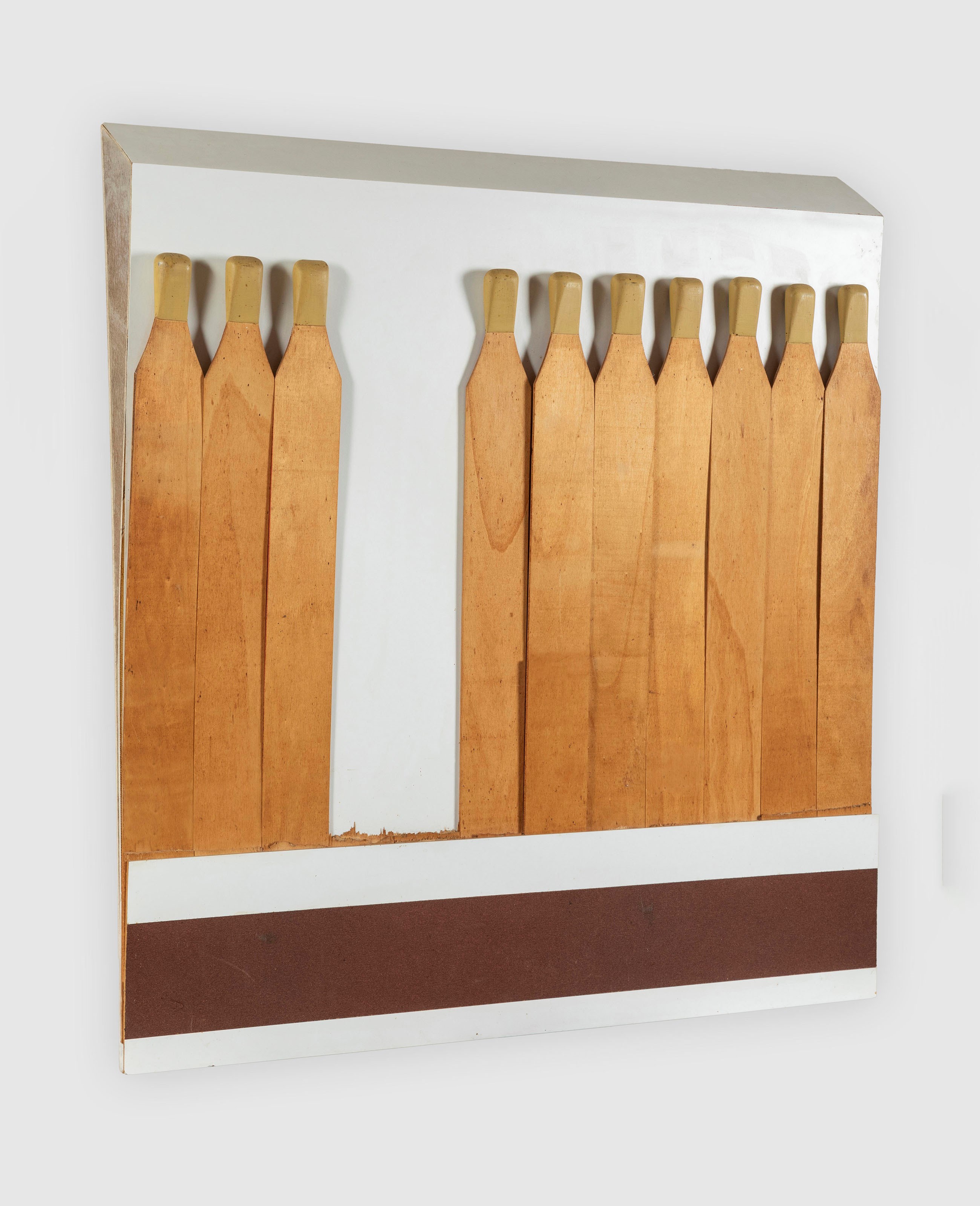
Lot 56
RAYMOND HAINS (1926-2005)
Saffa
Closed11 April 2019
Price Realised
GBP 56,250
More Information
Specialist note
‘My works existed before me, but nobody had seen them, because they were blindingly obvious’
-Raymond Hains
On its surface, Raymond Hains’ Saffa, 1971, appears to be simply an enlarged matchbook, but in fact extends an interrogation into linguistic analogy, double play, and puns that he began in 1964. That year, Hains was in Venice to participate in the 32nd Biennale and while there, he created the fictional personas Saffa and Seita, whose names were derived from Italy’s state-run companies that sold matches and tobacco, respectively. Working as the ‘agent’ for these two ‘artists’, Hains created absurdly oversized versions of the commercial matchbooks these two companies circulated as advertisements. So much of Hains’ practice was rooted in exaggerating the everyday; as the artist himself said, ‘‘I’m not so much the creator, encounters are more my thing’ (R. Hains, interviewed by O. Hahn, Beaux-Arts Magazine, April 1986, n. p.). The amplified proportions of Saffa are reminiscent of works by Claes Oldenburg, whose Pop sculptures drew upon the vernacular world. Certainly Hains’ practice existed at the nexus of Pop and Surrealism, where the possibilities of language could be explored and exploited, where the commonplace could be made monumental.