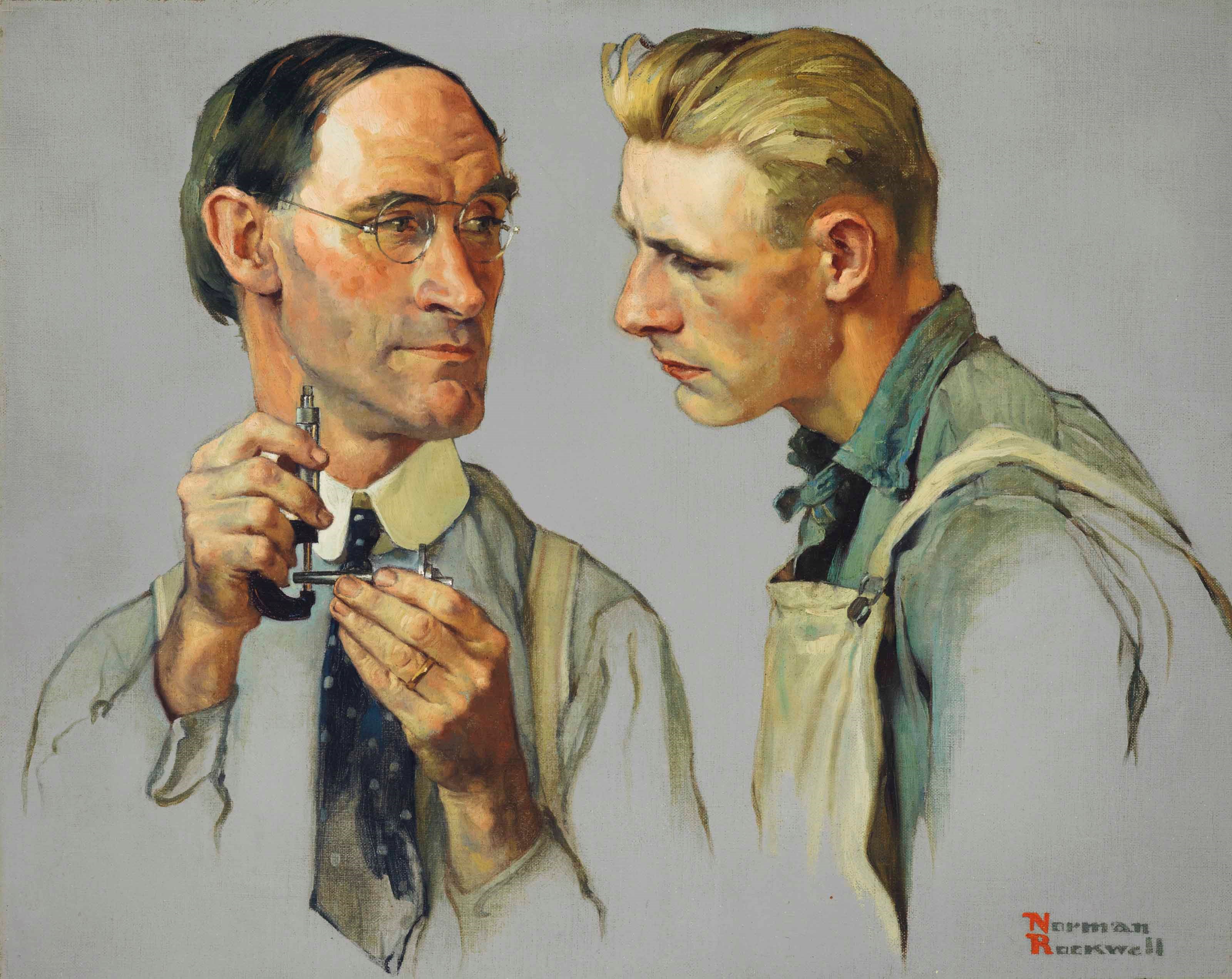
Lot 101
Norman Rockwell (1894-1978)
"Can't You See! It's More Than Three Thousandths Off!" (Machinist and Apprentice Looking at Precision Tool)
Price Realised
USD 68,750
More Information
Specialist note
The present work was published as an advertisement for the American Optical Company's Tillyer Lenses in the October 12th, 1929 issue of The Saturday Evening Post.
The painting depicts two of Rockwell's preferred models, Dave Campion at left and Fred Hildebrandt on the right. Susan Meyer writes, "Dave Campion, who owned a newsstand in New Rochelle, was a favorite model for Rockwell. Although he wasn't a professional, he managed to spend the length of time required for posing. Rockwell was grateful for this because Campion's lean physique was a type he liked to use frequently in his work." Meyer continues, "Lean and lithe, athletic and handsome: that was Fred Hildebrant, a favorite model for several of the New Rochelle illustrators. He could be an ideal Yankee Doodle, an adventurer, or a romantic lover, receiving proposals in marriage from women dazzled by his pictures. Hildebrant was a good friend to Rockwell, helped him with odd jobs when he could, and traveled with him to the west coast." (Norman Rockwell’s People, New York, 1987, pp. 46, 55)
The painting depicts two of Rockwell's preferred models, Dave Campion at left and Fred Hildebrandt on the right. Susan Meyer writes, "Dave Campion, who owned a newsstand in New Rochelle, was a favorite model for Rockwell. Although he wasn't a professional, he managed to spend the length of time required for posing. Rockwell was grateful for this because Campion's lean physique was a type he liked to use frequently in his work." Meyer continues, "Lean and lithe, athletic and handsome: that was Fred Hildebrant, a favorite model for several of the New Rochelle illustrators. He could be an ideal Yankee Doodle, an adventurer, or a romantic lover, receiving proposals in marriage from women dazzled by his pictures. Hildebrant was a good friend to Rockwell, helped him with odd jobs when he could, and traveled with him to the west coast." (Norman Rockwell’s People, New York, 1987, pp. 46, 55)