拍品 39
St Gall neumes (Early German neumes)
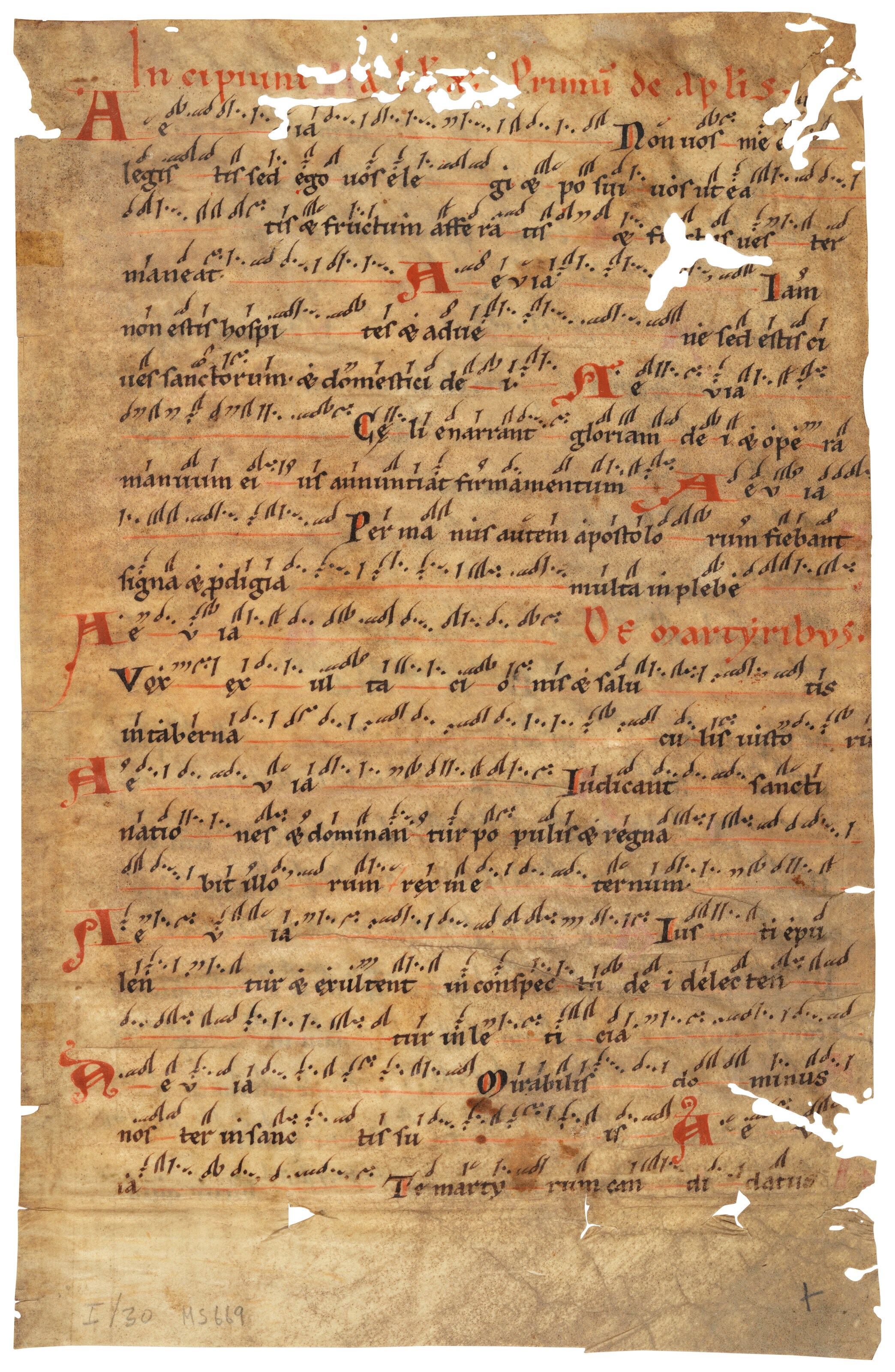
A leaf from a Gradual, in Latin, manuscript on vellum [Southern Germany, first half 12th century]
已結束2023年11月8日
成交價
GBP 1,890
更多資訊
St Gall neumes (Early German neumes)
A leaf from a Gradual, in Latin, manuscript on vellum [Southern Germany, first half 12th century]
A leaf from a Southern German Gradual, with the Alleluias for the Common of Saints.
c.254 x 165mm, 22 lines written in black ink in a late Carolingian minuscule, transitional diastematic (heightened) staffless St Gall neumes (Early German neumes), rubrics and initials in red (edges frayed, a few holes, somewhat cockled and stained). Bound in grey buckram at the Quaritch bindery.
Provenance:
(1) Erwin Rosenthal (1889-1981), bookseller and renowned art historian, his gift in 1956 to:
(2) Bernard Rosenthal, his I/30.
(3) Bernard Quaritch, Bookhands V, cat. 1147 (1991), no 41, acquired in 1990 by:
(4) Schøyen Collection, MS 669.
Text:
The leaf contains the relevant Alleluias for the Common of Saints: here with those for the Common of Apostles, Martyrs, and the Common of a single Martyr, beginning with the rubric 'Incipiunt Alleluia. Primum de Apostolis' and ending 'Alleluia Iustus non conturbabitur quia [dominus firmat manum eius]'. A 1979 note accompanying the lot by John A. Emerson, Professor of Music at the University of California Berkeley, points out that this discreet grouping of Alleluias as a separate unit is 'very typical of Southern German liturgical - musical practice during the 12th-cent.'
Script and music:
The text is written in a right-slanting late Carolingian hand that shows traces of a transition to Gothic. The St Gall neumes, with a single red-line stave, are highly stylised, without significant letters, belonging to the transitional, classical style of the 12th century.