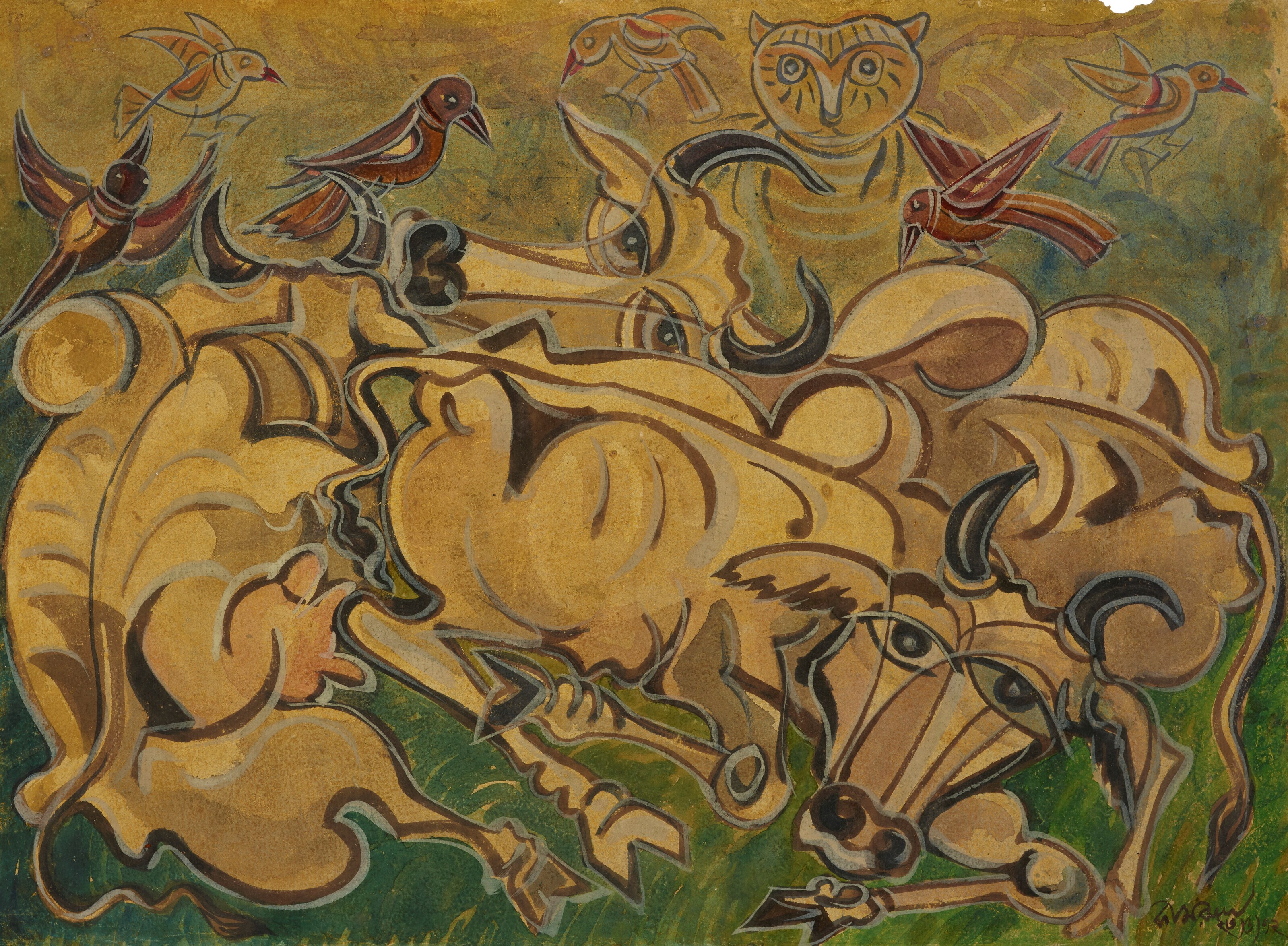
拍品 73PROPERTY FROM A PRIVATE COLLECTION, BANGLADESH
KAMRUL HASAN (1921-1988)
Untitled (Bulls and Birds)
已結束2023年3月28日
成交價
USD 10,080
更多資訊
專家說明
A pioneer of modern art in Bangladesh, Kamrul Hasan is a beloved icon of Bangladeshi culture. Born in Calcutta in 1921 to a fairly conservative family, Hasan’s father opposed his desire to pursue the arts, but agreed to let him attend the Government Institute of the Arts in Calcutta on the condition that he paid for his own education. As a result, Hasan’s pursuit of the arts became his first act of rebellion in a long career of activism.
After graduating in 1948, Hasan and fellow artist and activist Zainul Abedin established the Government Institute of Fine Arts in Dhaka as part of their commitment to increase access to art and education in the region. Nicknamed ‘patua’ for his use of motifs and techniques from traditional pattachitra scroll painting, Hasan was renowned for his ability to unite aspects of traditional and folk art with western techniques like Cubism in his work.
Deeply involved in politics, Hasan painted vignettes from the lives of people in rural Bengal and political caricatures alongside serene landscapes and portraits, juxtaposing works that denounced his country’s bureaucrats and politicians with ones that celebrated its rural beauty and the resilience and sensuality of its people. The artist organized exhibitions supporting the War of Liberation, and was nominated Chairman of the Resistance Committee of Hatirpul. He also designed the first flag of Bangladesh, which was used during the War in 1971 and inspired the design of its national flag following independence.
In the present lot, clearly inspired by pattichitra painting, Hasan uses bold outlines and blocks of color to depict a tranquil scene of animals in nature. He masterfully uses subtle color shifts to suggest three-dimensionality, and diluted pigment to create the illusion of movement and the passing of time. Three bulls lounge in the foreground and stare at the viewer sleepily as if recently awoken from a deep slumber. A few birds flutter behind them, some depicted with bold swaths of color while others are faint, as if in motion or further in the distance. Animals and birds appear often in Hasan’s landscapes, possibly symbolizing nonviolence and the sanctity of nature, untouched by human corruption.