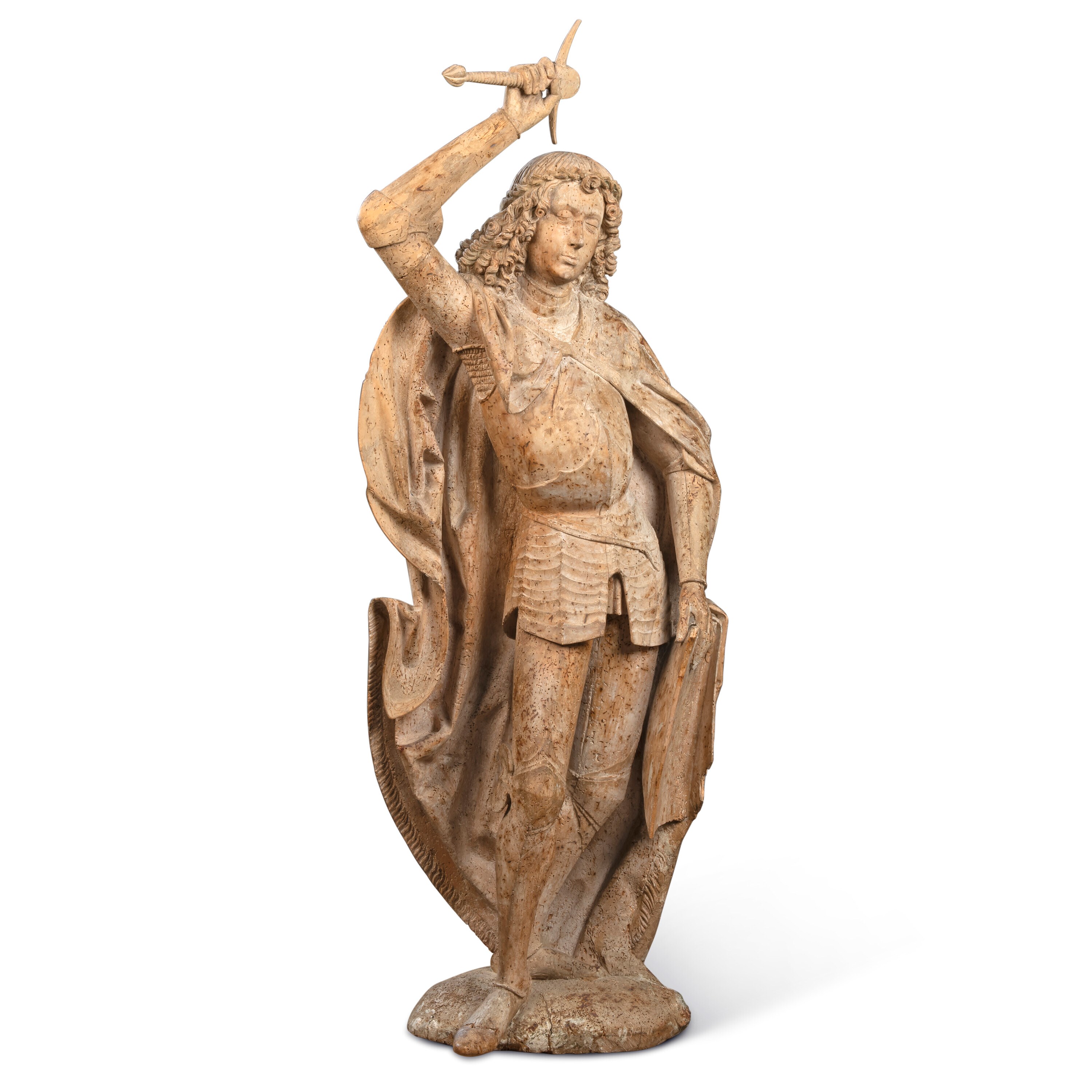
拍品 111PROPERTY FROM THE THYSSEN-BORNEMISZA COLLECTION
UPPER BAVARIA OR SALZBURG, CIRCA 1500-1510
Saint Michael (?)
已結束2022年12月9日
成交價
GBP 44,100
更多資訊
專家說明
Discussions surrounding the identity of the saint represented in the present lot have fluctuated since its earliest known publication in 1929. The iconographic similarities shared by Saint Michael and Saint George, both young men clad in armour shown in the midst of slaying a beast (the Devil or a dragon, respectively) make them at times difficult to distinguish. The fact that the Saint’s foe is not featured in the present lot further complicates attempts at his identification. This figure was not carved with wings, as would be expected for Michael, however, it has been noted that, as with other contemporary examples the wings may have been carved separately and mounted on the wall behind where the work was displayed (Radcliffe et al., op. cit. p. 332). The strongest element pointing to identification in one direction is the distinctive hairstyle, centrally parted underneath a circlet, typically associated with representations of Saint Michael.
The different stylistic influences present in the sculpture point to an artist with close ties to Munich, informed by Erasmus Grasser and the so-called Master of the Blutenburg Apostles, but also looking to the work of contemporaries in Strasbourg, Ulm and Salzburg. These diverse influences make the work hard to place geographically but it remains, ultimately, a highly finished and sophisticated piece. These features, along with the saint’s late Gothic armour, place the work firmly in South Germany at the turn of the 16th century.
The different stylistic influences present in the sculpture point to an artist with close ties to Munich, informed by Erasmus Grasser and the so-called Master of the Blutenburg Apostles, but also looking to the work of contemporaries in Strasbourg, Ulm and Salzburg. These diverse influences make the work hard to place geographically but it remains, ultimately, a highly finished and sophisticated piece. These features, along with the saint’s late Gothic armour, place the work firmly in South Germany at the turn of the 16th century.