拍品 104
CIRCLE OF JOACHIM WTEWAEL (UTRECHT 1566-1638) AND ALEXANDER KEIRINCX (ANTWERP 1600-1652 AMSTERDAM)
Diana and Callisto
已結束2022年12月9日
估價
GBP 25,000–35,000
更多資訊
專家說明
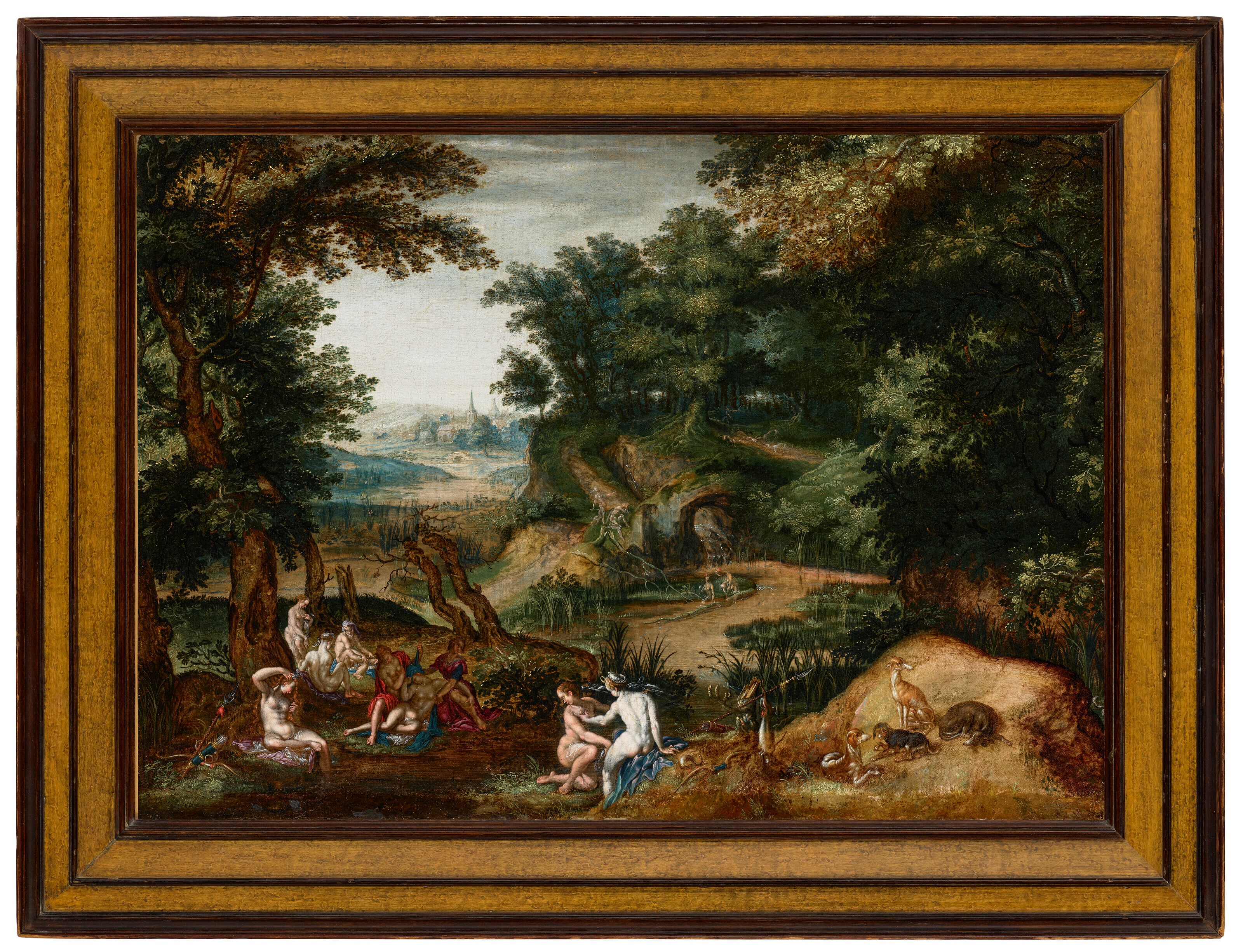
The dramatic focus of this finely executed painting is the moment at which the goddess Diana discovers that one of her attendant nymphs, Callisto, is pregnant. The myth, a hugely popular subject with artists both in Antiquity and then again from the sixteenth century, tells that Zeus took on the form of Diana in order to sleep with Callisto. When the subsequent pregnancy was discovered by the goddess herself, she was furious, as her nymphs had all sworn oaths of chastity to her. In some versions of the tale, Diana then transformed Callisto into a bear, in others it was Zeus’s furious wife Hera who met out this punishment. In her animal form, Callisto then lived in the forest, until one day her son, Arcas, almost killed her whilst hunting and Zeus took pity on the former nymph, setting her in the stars as Ursa Major, the Great Bear.
Here the central, pale figure of Diana gestures angrily across her sacred spring to the swooning nymph, supported by two of her companions. However, it is not only to the figures that the viewer must look for the story in this painting. Keirincx, who executed the landscape, integrated an anamorphous bear into the background, alluding to the nymph’s fate. This can be found at upper right, where the two clearings in the trees act as eyes and the channel through which the spring flows the roaring mouth.
Here the central, pale figure of Diana gestures angrily across her sacred spring to the swooning nymph, supported by two of her companions. However, it is not only to the figures that the viewer must look for the story in this painting. Keirincx, who executed the landscape, integrated an anamorphous bear into the background, alluding to the nymph’s fate. This can be found at upper right, where the two clearings in the trees act as eyes and the channel through which the spring flows the roaring mouth.