拍品 11
Suso's Horologium aeternae sapientiae
Cologne, 1501
已結束2022年4月25日
成交價
USD 3,276
更多資訊
Suso's Horologium aeternae sapientiae
Cologne, 1501
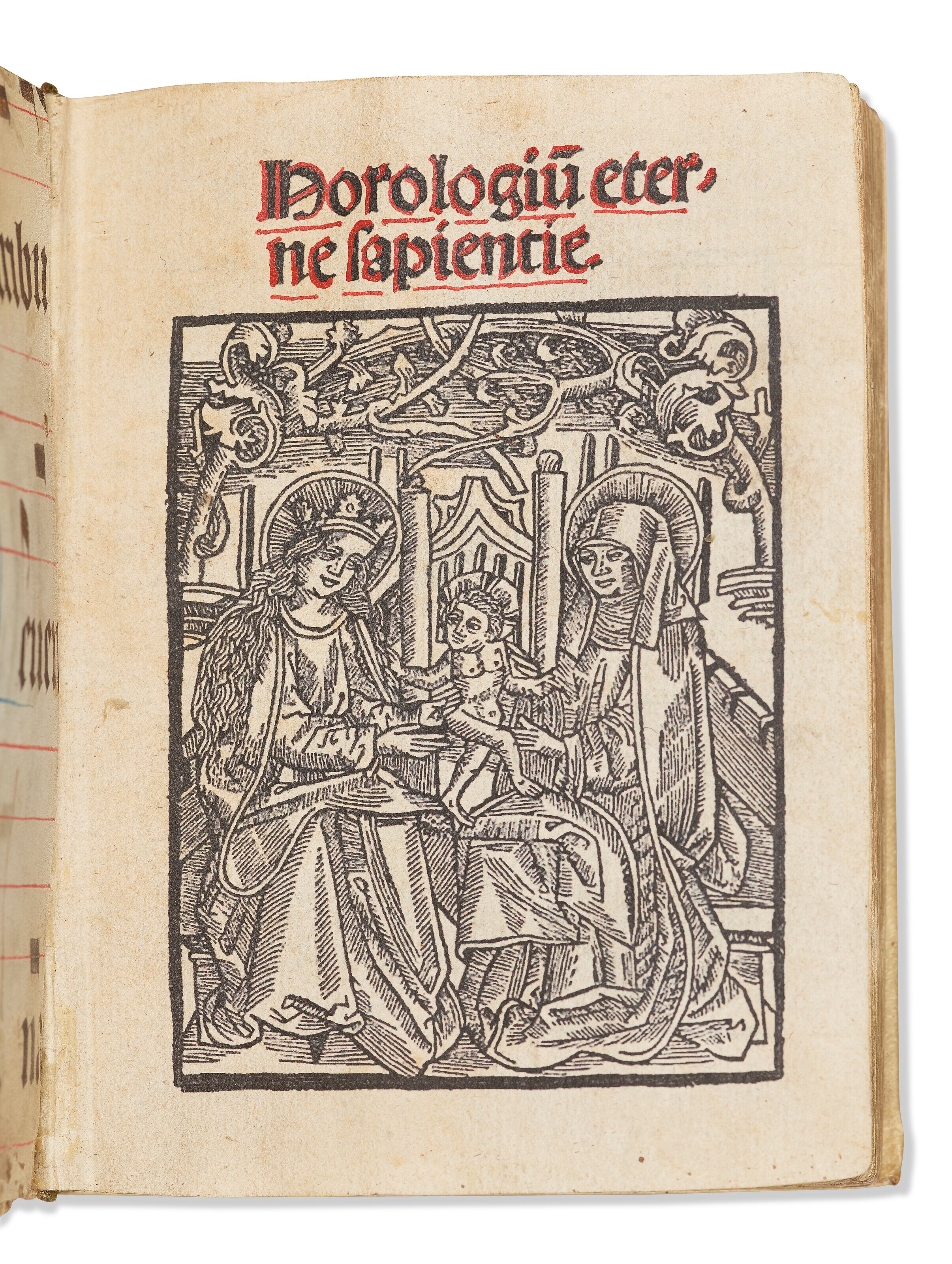
SUSO, Henricus (1295-1366). Horologium aeternae sapientiae. Cologne: Johann Landen, December 1501.
Scarce early edition of one of the most popular German devotional texts of the Middle Ages. Suso was a follower of Meister Eckhart, whose "writing is characterized by a vividness of personal experience and religious fervor" (Ford). One of his most devoted followers was the Dominican nun and mystic Elsbeth Stagel, who saved their letters, which were later published. "In the Horologium aeternae sapientiae Suso casts his mystical experience and theology in the form of a dialogue between Eternal Wisdom and a disciple (himself). He discovered his love for her while reading in the refectory the words of the book of Wisdom… [and] thereafter he devoted himself to her (who appears as Christ, the Bride in Song of Songs, a virgin, Hagia Sophia and Logos Dei) as a knight to his lady with his love guiding every action and thought and their betrothal his single aim" (Ford). The treatise is divided into 24 chapters, a gesture towards the governing model of the clock (horologium), which symbolizes the need for regulation and order under the guidance of Wisdom. No copies of this edition are recorded at auction by ABPC or RBH. C 3171a; VD16 S 6103; ISTC is00876500; Goldschmidt p. 135. See Ford BPH 177 (first edition) and 178 (fourth edition).
Octavo (134 x 100mm). 128 leaves. Lombard initials in red and blue, one with dog-head decoration, red capital strokes, paragraph marks, and underlining. Woodcut appears three times, on title, title verso, and verso of final leaf (margin of f. 2 slightly extended, occasional dampstains at gutter and edges, a few leaves in gathering O stained and one with short closed tear). Modern vellum with manuscript antiphonal leaf reused as pastedowns. Provenance: some marginalia – Randall Scott Uncapher (by descent to current owner).