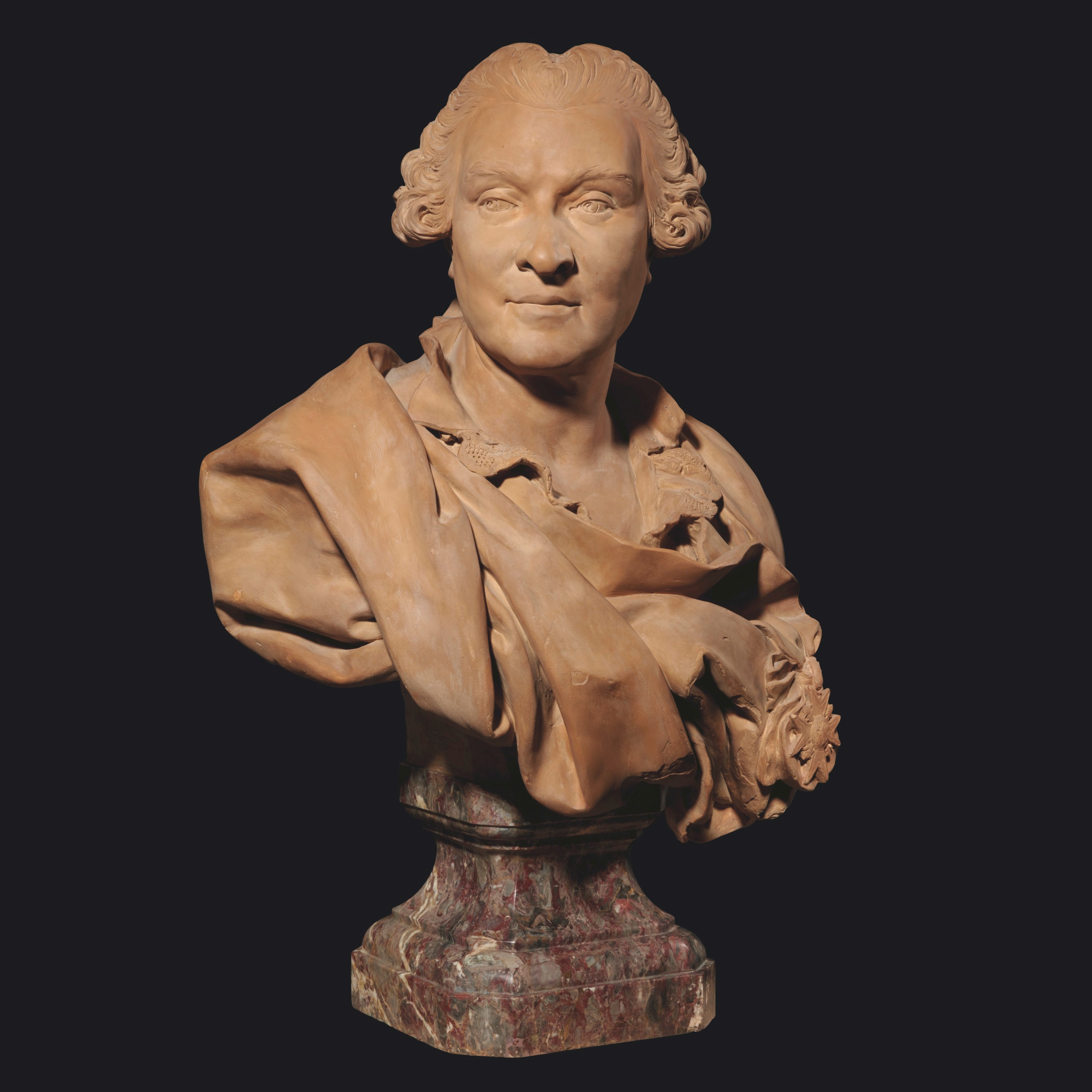
拍品 209
CIRCLE OF AUGUSTIN PAJOU (PARIS 1730-1809 PARIS), 1760
Bust of a gentleman, traditionally identified as Pierre-Joseph Laurent
已結束2021年12月8日
成交價
GBP 8,750
更多資訊
專家說明
The present bust formed part of the collection of the celebrated couturier and connoisseur Jacques Doucet (1853-1929) who also owned Picasso's Les Demoiselles d'Avignon which he purchased directly from the artist. The auction held in 1912 at which Doucet sold part of his collection made the equivalent of over $1,300,000 on the first day alone and was reported by the New York Times to be 'by far the greatest amount ever obtained at a single day's auction'.
Although unsigned, the auction catalogue attributed the work to the French sculptor Augustin Pajou and proposed that the sitter was Pierre-Joseph Laurent (1713-1773). Laurent, who made his name and his fortune as an engineer who specialised in canal building, was ennobled by Louis XV in 1756 and made a knight of the Ordre de Saint Michel, the cross of which the sitter proudly wears on a sash across his chest. Although no painted portraits of Laurent survive, an engraving of him shows the same flared nostrils, short wig and prominent chin (see L. Thbaut, Le Mecanicien anobli, Pierre-Joseph Laurent 1713-1773, 1981, p. vii). It is interesting to note that Laurent designed the water-jets for the fountains of the Château de Brunoy at the top of which Pajou was commissioned to create a colossal figure of a river god, probably in the year 1760. It is therefore highly likely that the two men became acquainted during the course of this project at exactly the time of the creation of the present bust.
A thermoluminescence test performed by Oxford Authentication Ltd (sample number N117b90) states that the bust was last fired between 200 and 350 years ago.