拍品 362
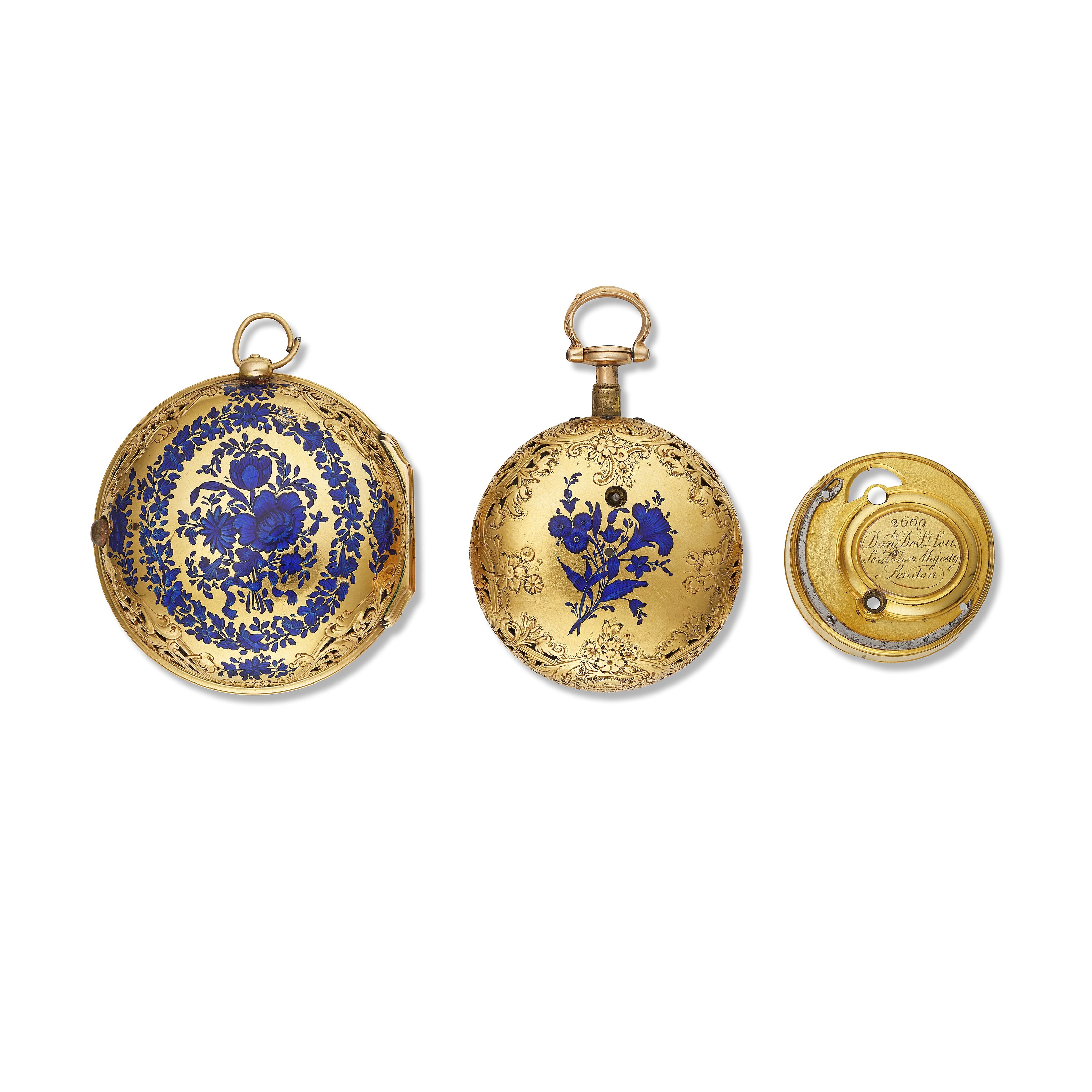
DANIEL DE ST. LEU, YELLOW GOLD AND ENAMEL OPENFACE PAIR CASED QUARTER REPEATING VERGE WATCH
已結束2021年11月16日
成交價
CHF 3,250
更多資訊
專家說明
Of fine quality the present watch epitomizes the work of Daniel de St. Leu. The two cases are distinguished by their beautifully pierced and engraved floral and scroll motifs and the translucent royal blue enamel floral decoration. The movement is set with a diamond endstone, a characteristics of higher grade watches.
Daniel de St Leu (active 1753-1797), of Genevan origin, manufactured some of the most exquisite and elaborate watches of the eighteenth century. Gaining royal favour, he was appointed to Queen Charlotte, wife of King George III in 1765, a title he held for the rest of his life since all his watches after this date are either signed 'Sevt. to her Majesty', or 'Watch Maker to her Majesty'.
He also specialized in the manufacture of watches for wealthy Ottoman customers, requesting their watches to be pieces of jewellery, preferably in richly decorated gold cases, occasionally set with diamonds. During the 18th century, the export of English watches to Turkey operated on a large scale. R. Rolt records in 'A New Dictionary of Trade and Commerce', 1756, "Great quantities of watches are exported to Asia, particularly to Turkey; where they serve more for ornaments like pictures in rooms, than for use in pockets."
Daniel de St. Leu was first recorded working in London in 1753, based at the sign of 'The Golden Head' in Cloak Lane (later known as 17 Cloak Lane). He subsequently moved to 38 Cornhill, where in about 1790 his business was succeeded by the firm of Rivers & Son (who operated from 1782-1815). Daniel de St Leu retired in 1797.