拍品 148
ANTON HEYBOER (1924-2005)
Red Afghan Kazak
已結束2021年9月16日
成交價
USD 1,125
更多資訊
專家說明
A nomadic, abused childhood and time spent in a concentration camp during 1943 both contributed to Heyboer’s rejection of conventional values and lifestyle. Currently choosing to live isolated from society in a dimly lit farm building near Amsterdam, he has evolved a highly personal symbolism. His bold, crudely drawn prints serve as a continuous chronicle of his existence, surrounded by female companions, a few animals, and a miscellaneous accumulation of car wrecks, stones, fossils, and driftwood.
Heyboer has been a prolific etcher since the early 1950s. His printmaking techniques are brutally simple: lines deeply gouged or etched into zinc plates, to which is then applied by hand a brown ink composed of automobile tar. The raw colors — brown, red, orange, blue, and green — often obtained directly from the earth, are either brushed on in monotype fashion before printing or added later. The deceptively spare graphic language of the prints is enriched by the rough application of ink and color.
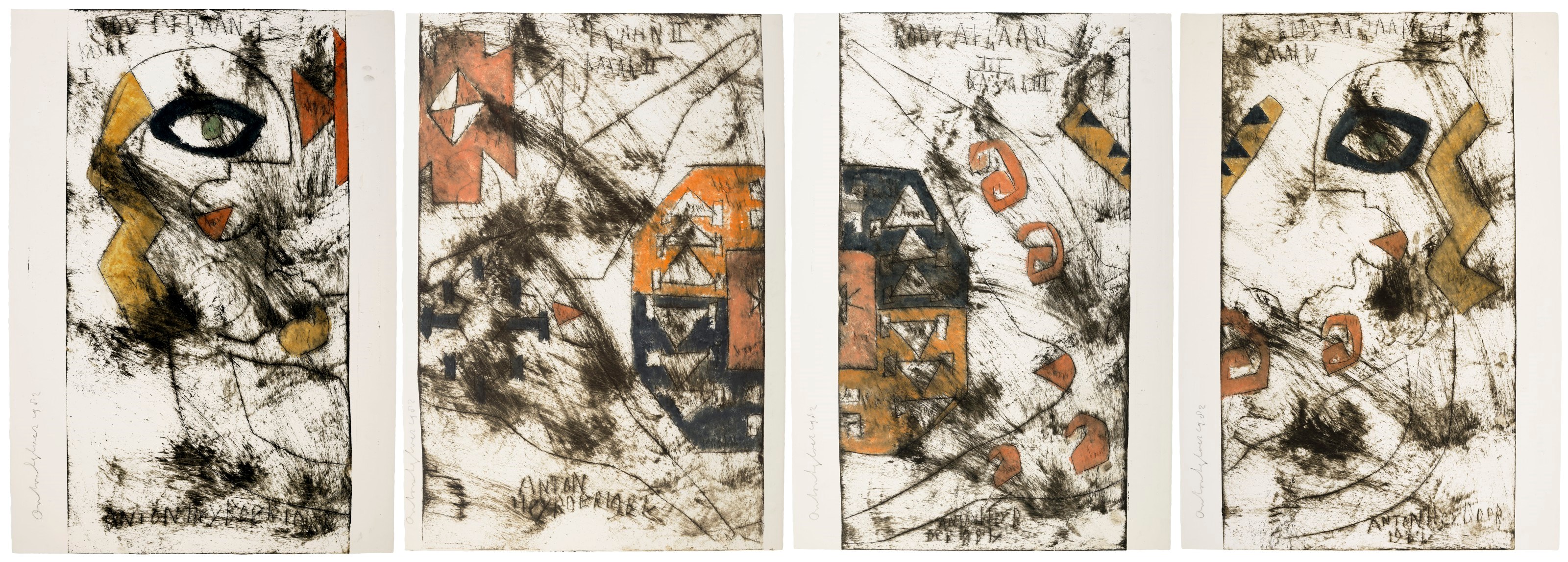
This recent print does not involve Heyboer's customary numbered geometric diagram that charts his emotional state; indeed, it seems unusually representational. Two female figures sit on either side of an octagonal oriental rug; like all of his figures they are two- dimensional, their linear contours resembling those of tribal carvings. The rug adds a mandala-like decorative element at the very center of the image. With a deep feeling for the immediacy of each of his prints, Heyboer frequently goes back and “corrects” the plates, so that rarely does a standard edition result.
David P. Becker, The Modern Art of the Print, p. 126