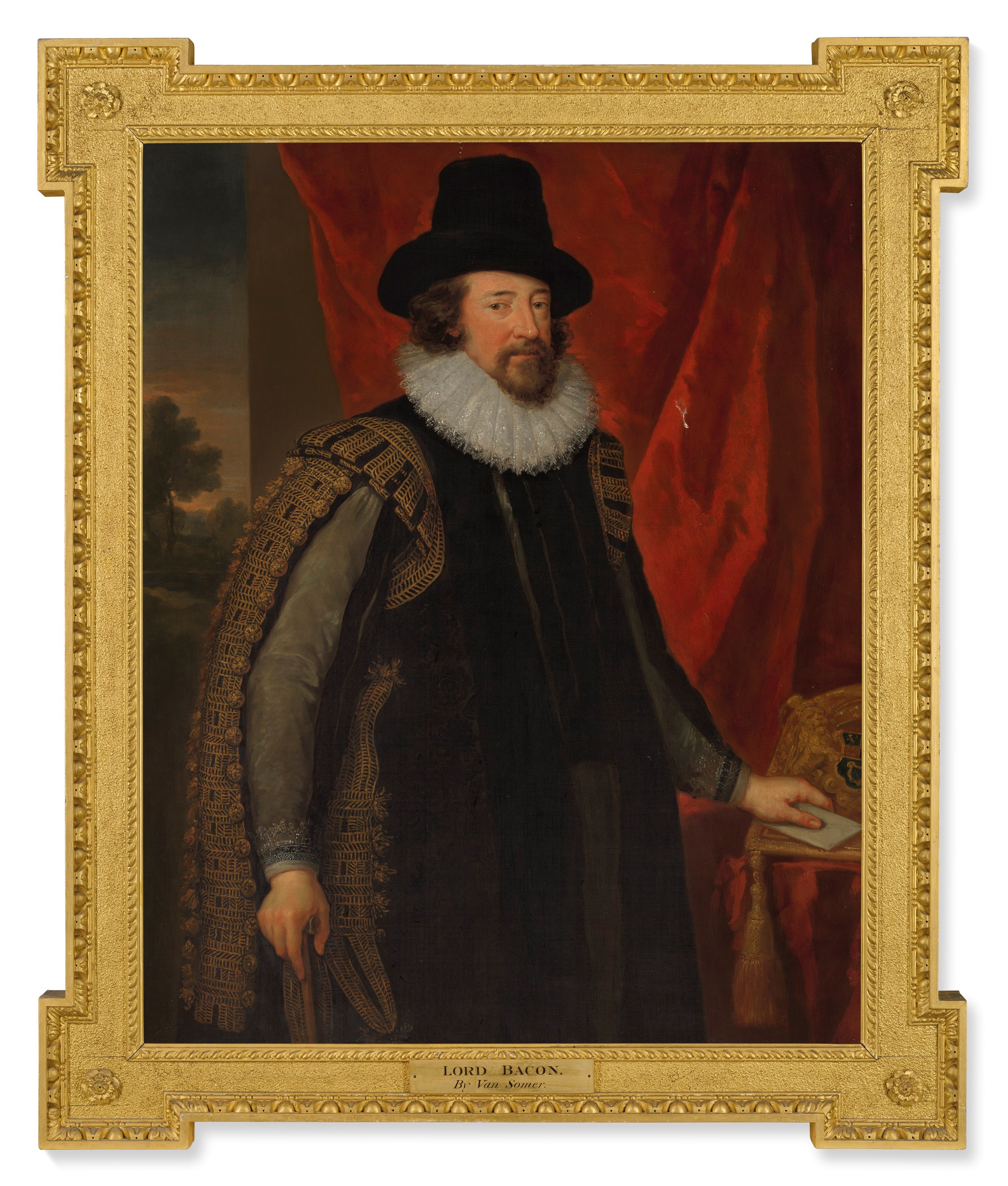
拍品 241PROPERTY OF THE EARL OF MACCLESFIELD (LOTS 173, 241 & 243)
JOHN VANDERBANK (LONDON 1694-1739)
Portrait of Francis Bacon (1561-1626), three-quarter-length, in his Lord Chancellor's robes
已結束2021年7月9日
成交價
GBP 6,000
更多資訊
專家說明
Recognised as a brilliant legal mind, Bacon studied at Gray’s Inn from 1579-1582. Although he played a critical role in the trial and conviction of Robert Devereux, Earl of Essex, following Essex's revolt against Elizabeth I, he only gained royal favour under King James I. He was knighted and nominated King's Counsel in 1603, the year of the King's accession, and was then appointed to a succession of important posts, which culminated in his appointment as Keeper of the Great Seal. He was made Lord Chancellor and raised to the peerage as Baron Verulam in 1618. He was created Viscount St. Albans in 1621 but shortly afterwards fell from grace and retired to his house at Gorhambury to concentrate on his writing. His most important published works - the Essays (1597), De Sapientia Veterum (1609) and Apophthegms New and Old (1624) - developed theories on the search for scientific truth through evidence and controlled experiment.
The diarist George Vertue noted in 1731 that 'At Gorhambury - the Picture of Lord Bacon the whole length original taken down for to be coppyd by Mr. J. Vanderbank who now has made 6 coppys half length' (G. Vertue, Notebooks, Walpole Society, II, 1930-2, pp. 41-42). The original portrait of Bacon at Gorhambury, which Vanderbank copied, is thought to be a posthumous version after the portrait in the Royal Society, which is usually attributed to Abraham van Blyenberch (fl.1617-1622). When Vanderbank made his copies in 1731, the Gorhambury portrait was thought to be the prime. A number of these versions are recorded: at Badminton House (Duke of Beaufort); the National Portrait Gallery (presented to the British Musuem in 1758 by Dr. A. Gifford); and recorded by Vertue in Speaker Onslow's collection.
The diarist George Vertue noted in 1731 that 'At Gorhambury - the Picture of Lord Bacon the whole length original taken down for to be coppyd by Mr. J. Vanderbank who now has made 6 coppys half length' (G. Vertue, Notebooks, Walpole Society, II, 1930-2, pp. 41-42). The original portrait of Bacon at Gorhambury, which Vanderbank copied, is thought to be a posthumous version after the portrait in the Royal Society, which is usually attributed to Abraham van Blyenberch (fl.1617-1622). When Vanderbank made his copies in 1731, the Gorhambury portrait was thought to be the prime. A number of these versions are recorded: at Badminton House (Duke of Beaufort); the National Portrait Gallery (presented to the British Musuem in 1758 by Dr. A. Gifford); and recorded by Vertue in Speaker Onslow's collection.