拍品 152
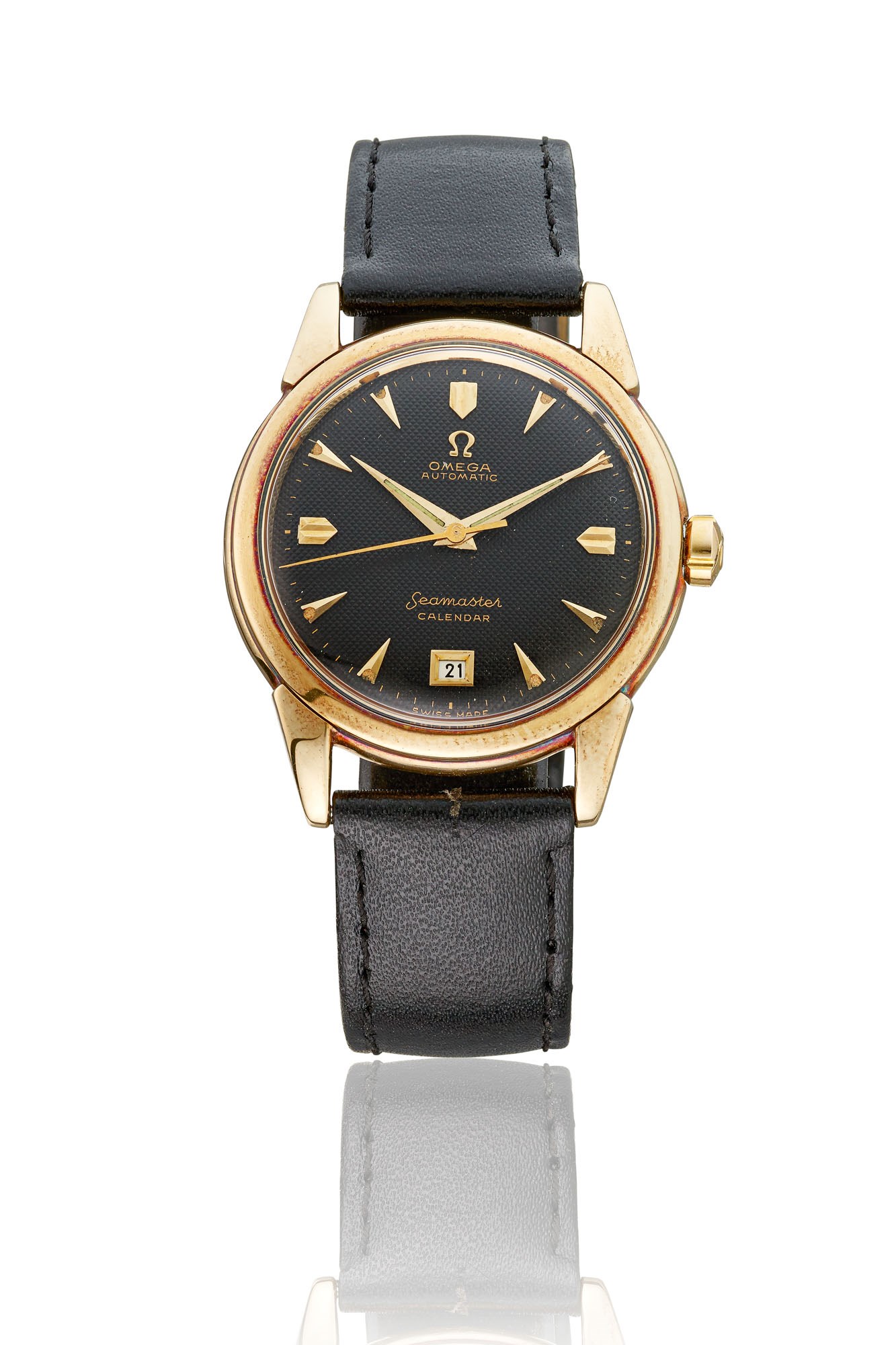
OMEGA, GOLD BLACK HONEYCOMB SEAMASTER CALENDAR WRISTWATCH, REF. 2627 SC
MOVEMENT NO. 12’580’027
已結束2020年11月19日
成交價
CHF 2,750
更多資訊
專家說明
This very well preserved early example of the Automatic Seamaster Calendar immediately attracts due to the fabulous, much sought-after black honeycomb dial in untouched condition, still retaining the original luminous accents to each dart index, and the crisp pink gold case with clear hallmark. The crystal is etched with the Omega micro symbol.
The Omega Seamaster Calendar was introduced in 1952 as reference 2627, the first Omega watch with a date window. The very first examples such as the present, had a rectangular date window. As of 1953 it was redesigned to a trapezoidal shape.
The movement is the automatic cal. 353 with bumper rotors, named after the slight “thud” perceived when the rotor hits a spring and bumps back. Unlike modern rotors that perform a full 360-degree spin, the bumper version moves back and forth at around 120 degrees, ‘bumping off’ a pair of springs on the opposite sides of the bridge. This effective way of accumulating kinetic energy was invented by the English watchmaker John Harwood in 1923.
To celebrate their 100th anniversary in 1948, Omega launched the Seamaster, the brand’s longest running collection still produced today.
The civilian version of the water-resistant wristwatches supplied to the British Airforce during WW II, it was built to resist any sport at any altitude, a robust yet elegant timepiece.
Upon release, the Seamaster was available in two versions, either with centre seconds or with the subsidiary seconds at 6 o’clock, in stainless steel or gold, with or without metal bracelet.
Since these early days the Seamaster has remained a cornerstone of the Omega range, the watches of the series however looking today entirely different to their forbears from the immediate post-war period.
Examples of ref. 2627 are described and illustrated in Omega – A Journey through Time by Marco Richon, p. 277, pl. 2868 & 2758.